30+ Genius Backpack And Homework Organization Ideas To Try!
School mornings in our house used to unravel before we even reached the front door. Backpacks piled up by the entrance, permission slips surfaced at the worst possible moment, and pencils seemed to disappear the second homework began.
After plenty of trial and error, I figured out where things actually fall apart — and it is almost never a lack of effort. It is a lack of a set home for every bag, form, and supply.
That is what this guide is about. These backpack and homework organization ideas cover the whole journey, from the entryway where bags land to the homework systems that keep assignments on track.
Best Backpack Hooks and Entryway Storage Ideas

The front door is where clutter starts, so it is the best place to begin. A few simple entryway ideas can change the whole morning.
1. Wall-Mounted Backpack Hooks for Each Child
Start with one hook per child, mounted low enough for them to reach on their own. It ends the daily hunt for the right bag and gives children a small, manageable job they can actually do themselves. This is the cheapest and quickest fix on the whole list, and it removes a surprising amount of morning friction for almost no effort.
2. Individual Backpack Cubbies With Name Labels
Cubbies add a little more structure than a single hook. Each child gets a defined bay for their bag, plus room for shoes, hats, and other loose bits. Clear name labels help younger children find their own spot instantly, which builds confidence as well as order. It works best in households where several children share one entryway.
3. Entryway Bench With Backpack Storage Below
A bench earns its place twice over: children can sit down to put on their shoes, and their backpacks tuck away underneath, out of the walkway. Add baskets or bins below the seat so things stay contained instead of spilling loose. In a tight entryway, this one piece of furniture can do the work of two or three.
4. Narrow Backpack Station for a Small Hallway
Do not assume a hallway is too narrow for a backpack zone. A slim vertical unit with hooks or narrow shelves can fit into a passage barely a foot wide, and it still gives every bag a proper home. This is the idea I reach for most often in apartments and older homes where the entry space is genuinely tight.
5. Over-the-Door Backpack Organizer for Tight Spaces
For renters, or anyone who cannot drill into walls, an over-the-door organizer is the obvious answer. Pockets or hooks on the back of a door turn dead space into real storage in minutes, with no holes and no commitment. It is portable too, so it moves with you if you relocate.
Flexible Backpack Solutions for Any Layout

Not every home has a proper entryway or mudroom. These ideas work around whatever layout you actually have.
6. Rolling Backpack Cart That Moves Between Rooms
If your family’s routine does not follow one fixed path through the house, a rolling cart follows it instead. Choose one with several tiers so backpacks, shoes, and accessories each get their own level, and wheel it from the entryway to a bedroom or homework spot as needed. It is especially useful in shared or multi-purpose rooms.
7. Pegboard Backpack Wall With Adjustable Hooks
A pegboard is the most adaptable option here because it grows with your children. Hooks can be moved as backpacks get bigger or seasonal gear changes, and the board itself can be painted to match your decor. It is a long-term solution rather than a quick fix, and it looks far better than a row of mismatched hooks.
8. Closet Backpack Zone With a Shelf and Hanging Rail
Repurpose part of an existing closet and the backpacks disappear from view entirely. A shelf above holds extra supplies while a hanging rail below keeps bags off the floor. Entryway or mudroom closets already used for coats are ideal for this, and it costs almost nothing since the space is already there.
9. Staircase Landing Station for School Bags
When the entryway itself has no room, look at the stairs. A few hooks or a small bench at the top or bottom of a staircase creates a natural drop-off point that children pass anyway. It suits split-level and multi-storey homes particularly well, where the front door does not open onto a hallway.
10. Garage Entry Backpack Drop Zone for Busy Families
If your family comes in through the garage, that is where the backpack station belongs. A simple shelf or cubby just inside the garage door catches bags before they ever reach the kitchen counter, which keeps the main living space noticeably tidier. It is a small addition with an outsized effect on kitchen clutter.
Family Calendar and Command Center Basics

Once the bags have a home, the next job is keeping everyone’s schedule visible. A basic command center does that with very little effort.
11. Monthly Family Calendar for School Events
A large monthly calendar is the foundation of every command center. Put it somewhere impossible to miss — the kitchen or the entryway — and it becomes the household’s single shared reference for school events, activities, and deadlines. Without this piece in place, the rest of the system tends to fall apart.
12. Weekly Schedule Board for Classes and Activities
A weekly board adds the detail a monthly calendar cannot hold: daily class times, after-school activities, and pickup arrangements. A dry-erase or magnetic board is easy to update each week, and it keeps everyone aware of what is happening day to day without constant questions.
13. Magnetic Command Center on the Refrigerator
The refrigerator is already the most-visited spot in the house, so it makes a natural command center. A magnetic calendar, notepad, and file pockets together need no wall-mounting or permanent installation, and nothing gets missed when it lives where everyone walks past daily.
14. Wall-Mounted File Pockets for Each Child
Give each child their own file pocket and paperwork stops getting mixed up. Label every pocket clearly and check them together once a week, and forms, notices, and permission slips will each have one obvious place to live. It is a small system that brings real order to the paper pile.
15. Dry-Erase Board for Daily School Reminders
A small dry-erase board near the door catches the details that slip through the cracks — gym clothes, picture day, a library book due. It takes seconds to update each evening, so keep a marker attached to the board itself and the habit will stick. It is the simplest idea on this list to maintain.
Advanced Command Center Systems

For families juggling several children and several schedules, the basic setup needs a few extra layers. These systems add that detail.
16. Color-Coded Calendar System for Multiple Children
Assign each child a colour and use it consistently across every calendar and planner in the house. A glance at the calendar then tells you whose event is whose, without reading every entry. It is the single most effective upgrade for a busy family calendar.
17. Homework and Activity Deadline Tracker
A dedicated deadline tracker stops the blindsided feeling of a project due tomorrow. Review it together during a weekly family check-in rather than trying to hold it all in your head, and it builds real accountability in children as they get older and take on more responsibility.
18. School Meal and Lunch Planning Board
Planning meals and lunches on a simple whiteboard or printed weekly template removes one more decision from the morning. Involve your children in the planning and they are far more likely to eat what was chosen — and your grocery list practically writes itself once the week is mapped out.
19. Permission Slip and Form Submission Station
A designated station for permission slips and forms means nothing gets found crumpled at the bottom of a backpack days after it was due. Check it daily as part of your evening routine and nothing will be missed before an important deadline. Small system, outsized peace of mind.
20. Compact Command Center Inside a Cabinet Door
Short on visible wall space? Tuck the whole command center behind a cabinet door. A calendar, notepad, and small file system all fit inside, fully functional but completely hidden when the door is closed. It suits smaller kitchens and apartments where wall space is precious.
Homework Stations for Focused Study Time

A dedicated homework spot changes how quickly work actually gets started. These ideas create that spot, wherever it fits in your home.
21. Dedicated Homework Desk With Essential Supplies
Start with one consistent desk, stocked with pencils, paper, and the essentials, and reserved for schoolwork only. When children sit down in the same spot every day, it signals that it is time to focus — and the daily search for supplies disappears before work even begins.
22. Portable Homework Caddy for Flexible Study Spaces
When the homework spot changes with the day or the child’s mood, a portable caddy keeps supplies together. Pencils, erasers, and other basics travel in one container to the kitchen table, a bedroom, or wherever work happens. It removes the “I can’t find a pencil” excuse entirely.
23. Subject-Based Homework Bins for Each Class
Older students juggling several classes benefit from sorting materials by subject. Labelled bins keep worksheets and textbooks separated before they become one overwhelming pile, and a quick end-of-week review keeps the system current. Finding a specific assignment becomes fast instead of a dig through a messy folder.
24. Rolling Homework Cart With Multiple Storage Levels
A rolling cart brings the same flexibility to homework that it brings to backpacks. Multiple tiers hold supplies, subject folders, and reference materials in one mobile unit that rolls to wherever study time happens that day. It is ideal when study space is not fixed to one room.
25. Wall-Mounted Homework Organizer Above the Desk
When desk space is limited, go vertical. An organizer mounted above the desk keeps supplies within reach without cluttering the work surface. Clear pockets or bins let children see what is available at a glance, which matters most in smaller bedrooms where every inch of desk counts.
Homework Systems That Track Progress
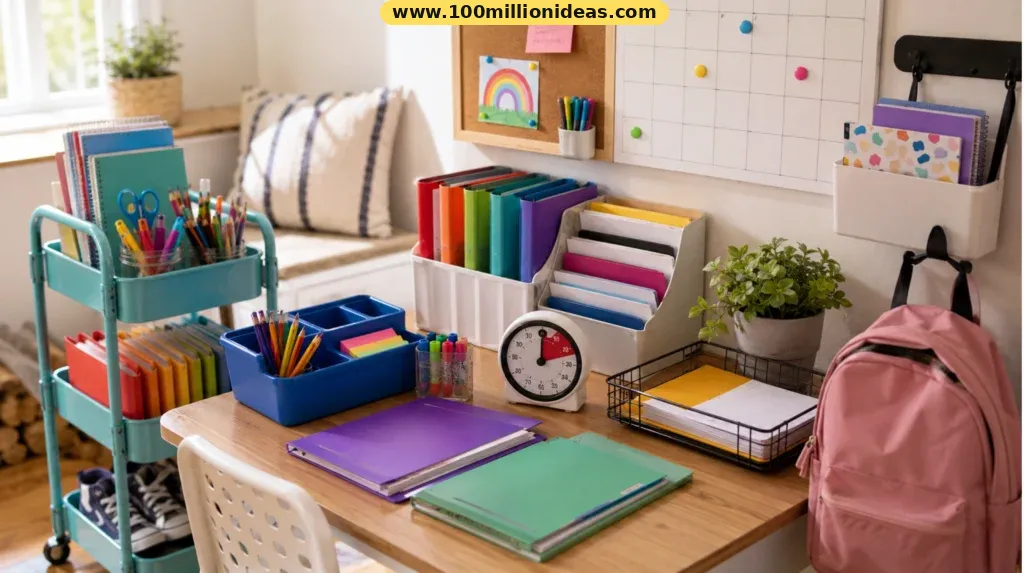
The final group of ideas is about tracking: what is finished, what still needs attention, and how to keep the two from getting mixed up.
26. Timer and Task Card System for Homework Sessions
Break homework into timed segments with task cards and a full assignment list stops feeling overwhelming. Start with short blocks and adjust to your child’s attention span — the structure builds a sense of accomplishment during study time instead of dread. This is a process solution rather than a storage one, and it works.
27. Finished-Work Tray for Assignments Ready to Submit
A dedicated tray for completed homework keeps finished assignments from vanishing into a backpack overnight. Check the tray together each evening before bags are packed for the next day, and the frantic morning search for a completed worksheet disappears. It is a tiny addition that has saved many mornings.
28. Homework Folder System for Incomplete and Completed Work
Two folders — one for in-progress work, one for finished assignments — give children a clear visual cue about what still needs attention. Colour-code them so the distinction is obvious at a glance. It works especially well for children who struggle to track their own progress, and it builds real independence over time.
29. Shared Sibling Study Station With Separate Zones
When siblings share a study space, divide it clearly. Labelled bins or trays for each child keep supplies separate and easy to find, and giving each sibling their own set of supplies ends the daily disputes over borrowed pencils. The shared table still functions as one space, but nobody’s materials get mixed up.
30. Fold-Away Homework Station for Small Homes
Where a permanent desk is not realistic, a fold-away desk or cabinet-style station provides homework space only when it is needed, then disappears completely. Mount it in a hallway or corner that would otherwise go unused. It proves that a lack of a spare room does not mean a lack of a proper homework spot.
Conclusion: Backpack and Homework Organization Ideas
Good backpack and homework organization works best when every bag, form, and supply has one consistent place to live. Start with whichever area causes the most stress each morning — usually the backpack station or the homework routine — rather than trying to overhaul the whole house at once.
Physical storage on its own is only half the answer. Pair it with simple daily habits — a quick evening reset, a check of the trays and file pockets, bags packed the night before — and the system will actually hold up over time. That combination is what turns a tidy entryway into calmer mornings, day after day.