Christmas Candy Trivia Game

This is the game where getting an answer right tastes sweet, quite literally. The Christmas Candy Trivia Game is a set of three hundred trivia questions played with small wrapped chocolates as game pieces: every player starts with a pile of chocolates, and every correct answer earns them the right to eat one. It is the most generous party game you will ever play, because even the losing players end the evening having eaten chocolate, and the winning player ends it having eaten the most chocolate of all.
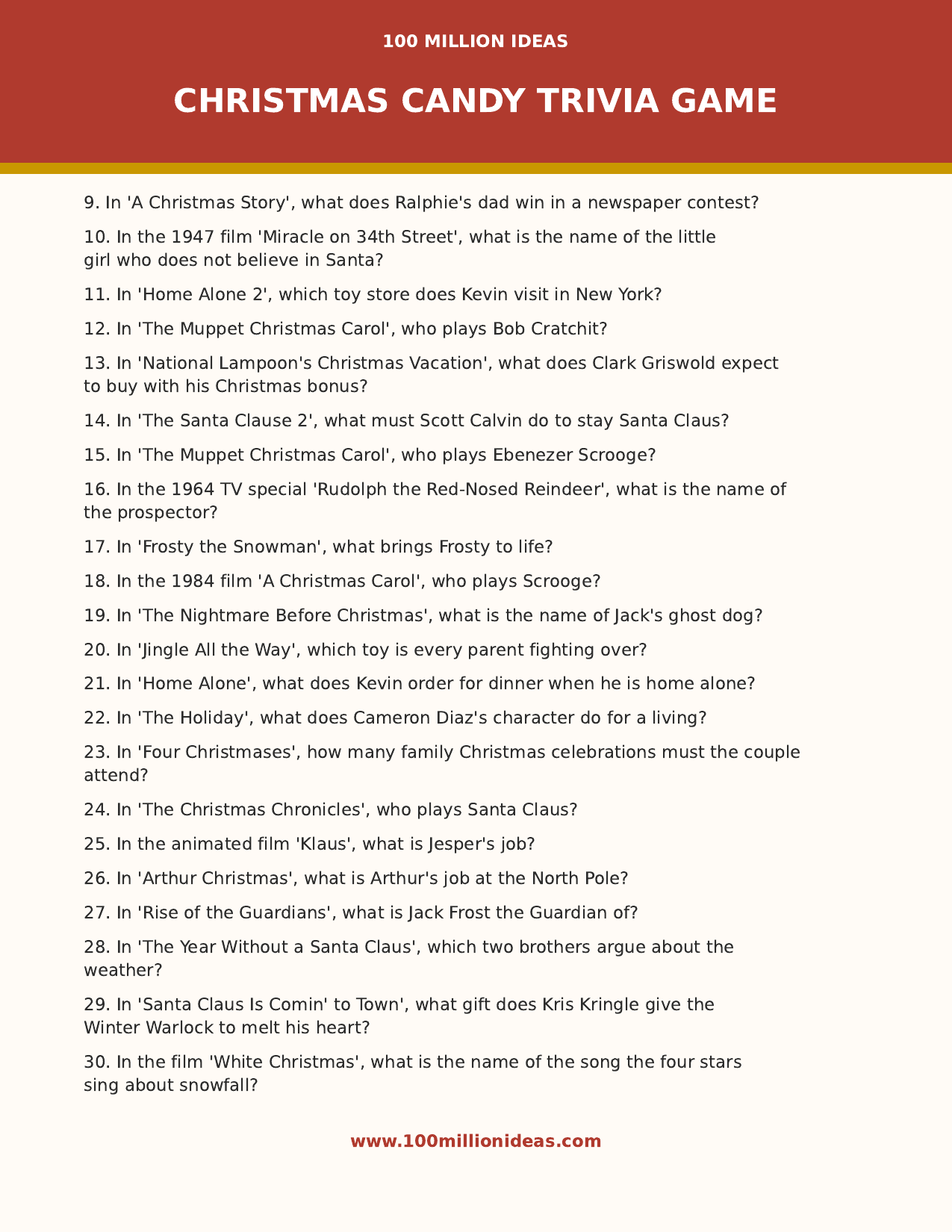
Three hundred questions is a serious number. It means this single printable can carry not just one party but a whole season of game nights, because no group will get through all three hundred in one sitting, and the questions you do not reach this year will still be waiting next year. The questions cover Christmas films, stories, songs, traditions, and food, so the game plays like a full Christmas quiz with a delicious twist: your score is measured in chocolate.

At a Glance
- Players: 2 to 30, solo or in teams
- Ages: 8 and up can play independently; younger children enjoy it most as part of a team with a grown-up
- Time needed: 20 minutes for a short game of 30 questions, 45 to 60 minutes for 100 questions; all 300 questions would take several sessions
- Supplies: one printed game sheet per player, a pen or pencil each, and a bag of small wrapped chocolates, one chocolate per player per question, or one big bowl to share
- Best for: family Christmas parties, friends’ quiz nights, classroom parties, Christmas Eve, and any gathering with a sweet tooth
What You Need to Set Up
Print one question sheet per player, or one per team if you are playing in teams. Hand out pens or pencils. Then sort out the chocolates, because the chocolates are not a garnish here: they are the game pieces, and the setup matters.
Give every player a pile of small wrapped chocolates to use as game pieces, roughly one chocolate per player per question if you plan to play through a set number of questions, or simply give everyone a generous handful and top it up as needed. A bag of small individually wrapped chocolates works best, because each one is a single neat game piece, and the wrappers keep everything hygienic while the chocolates are being handled as pieces. If anyone in your group has a nut allergy or another dietary restriction, choose a chocolate everyone can eat, or offer a wrapped sweet alternative for those players so nobody is left out of the central mechanic of the game.
Choose a quizmaster to read the questions and keep the score. The quizmaster can be the host, or you can rotate the role every twenty questions. Put a bowl in the middle of the table for the shared pile if you are playing the team version described below, and keep a few spare chocolates aside for the winner’s prize.
How to Play
1. Hand out the sheets and the chocolates. Each player gets a printed question sheet, a pen, and a pile of small wrapped chocolates. The chocolates in front of you are both your game pieces and your winnings: they are yours to eat as you earn them.
2. The quizmaster reads each question out loud. Read each question clearly and twice if needed, so nobody misses a detail. Players have 30 seconds to write down their answer.
3. A correct answer earns a chocolate. Every time you answer a question correctly, you get to eat one of your chocolates. If you get it wrong, your chocolate stays in the pile. That is the whole scoring system in its simplest form, and it is wonderfully motivating: players who would normally shrug at a wrong answer will groan out loud when it costs them a chocolate.
4. Keep score as well. One point for each correct answer, marked on the sheet as you go. The player with the most correct answers at the end wins, and the sweetest prize of all is eating your winnings.
5. Check the answers at the end. The printable includes a full answer key at the back. When you have played as many questions as you planned, the quizmaster reads out the answers, players mark their sheets, and the totals decide the winner.
6. Playing with a team. Put a chocolate in the middle for every correct team answer, and share the pile at the end. Team play suits large parties, because it lets the chocolates become a shared celebration rather than an individual prize.
7. The gentler version. For a gentler game, especially with young children, use the chocolates as markers instead: place one chocolate on your answer sheet for each correct answer and count them up at the end, then eat them all afterwards. Nobody loses a chocolate they were looking forward to, and the counting at the end becomes part of the fun.
Why the Chocolate Mechanic Works So Well
Most trivia games reward a correct answer with a point, which is an abstract thing that matters only if you care about winning. This game rewards a correct answer with chocolate, which is a concrete thing that everyone cares about immediately. The effect on a room is noticeable within five questions: players lean forward, they think harder, and they react to a wrong answer with genuine disappointment rather than a shrug. Children in particular play this game with far more focus than they bring to an ordinary quiz, because the reward is sitting right in front of them and they can see it shrinking.
The mechanic also solves the oldest problem in party trivia, which is that the players at the bottom of the leaderboard stop trying halfway through. In this game, a player in last place still has a pile of chocolates and a reason to answer the next question, because every correct answer is a chocolate earned regardless of the overall score. And the winner’s prize is built in: the player with the most correct answers has, by definition, eaten the most chocolate, which is a prize nobody needs to buy or wrap.
A Few Sample Questions to Try
To give you a flavour of the game, here are a few sample questions in the same spirit as the printable. These are not from the game itself, but they show the kind of knowledge it tests:
- What striped sweet is shaped like a walking stick and traditionally hung on the Christmas tree?
- What is the main flavour of a classic red-and-white candy cane?
- Which sweet treat is traditionally built into a house shape and decorated at Christmas?
- What warm drink, topped with whipped cream, is a Christmas favourite in many homes?
- What small chocolate treats are often hidden inside an advent calendar, one behind each door?
If your group answered most of those without hesitating, they are ready for the full game. If they found them tricky, they will enjoy it even more.
Tips for the Quizmaster
Pace the game so the chocolates last. If you are playing fifty questions, make sure the piles are big enough to survive fifty answers, or the game will run out of pieces before it runs out of questions. Read each question at a steady pace and do not rush the first ten: the room needs time to settle into the rhythm. Keep the answer reveal for the end rather than after each question, because revealing answers as you go slows the game down and gives later players an advantage they should not have. And keep a few chocolates in reserve for the winner: even in a game where everyone eats chocolate, a small winner’s prize, such as a chocolate Santa or a small box of chocolates, makes the ending feel complete.
Tips for Players
Write your first instinct. Trivia rewards the answer you knew immediately far more often than the one you reasoned your way to after thirty seconds of doubt. If a question is about a film you have seen, picture the scene rather than trying to recall the fact directly. If you are unsure, guess anyway: a guess can earn a chocolate, and a blank never can. And if you are playing in a team, say your answer out loud even if you are unsure, because the quietest team member often holds the answer nobody else has. Finally, pace yourself with the chocolates. It is tempting to eat everything in the first ten questions, but the game is long, and the players who still have chocolates left at question fifty are the ones having the most fun.
Variations to Try
The full marathon. Set aside an evening and play through one hundred questions with a large bowl of chocolates in the middle. It is a long game, so take a break halfway, and let the leaderboard be announced at the break to build suspense for the second half.
Classroom version. A teacher can run this game with a whole class by playing in teams and using the gentle marker version, where chocolates are placed on the sheet rather than eaten immediately. It keeps the room focused, it gives every team a visible score in chocolate, and the eating happens at the end as a shared treat.
Advent game. Play ten questions a day through December, with each day’s chocolates coming from that day’s pile. By Christmas Eve the group will have played a substantial number of questions, and the daily ritual becomes a tradition in itself.
Non-chocolate version. If your group cannot eat chocolate, the mechanic works with any small wrapped sweet, or with non-food tokens such as small wrapped presents, stickers for children, or coins for a charity jar. The principle is the same: a correct answer earns a tangible reward you can see and hold.
Speed round finish. Play the last ten questions as a speed round with only ten seconds per question. It is a lively way to end, and it often overturns the leaderboard, because speed favours a different kind of player than careful thinking does.
Get the Printable Game in Our Shop
Get the Christmas Candy Trivia Game in our shop — on sale for $5 (regularly $7)
The printable includes all 300 questions with a full answer key at the back, so the quizmaster does not need to know the answers in advance or prepare anything beyond printing and buying the chocolates. It prints cleanly on ordinary home printer paper, in colour or black and white, and you can print as many copies as your party needs.
Given that three hundred questions will last your family more than one Christmas, the Christmas Games Bundle — 24 games for $17 is also worth considering: this game sits alongside twenty-three others in the bundle, so next year’s parties are covered too.
Who It’s For
This game is made for groups that want a quiz with a sense of occasion. It suits family Christmas parties, where the chocolate mechanic keeps children engaged far longer than an ordinary quiz would, and it suits friends’ quiz nights, where the stakes feel higher because every question has a visible reward attached. It suits classroom parties and youth groups, where a teacher needs a game that holds a whole room’s attention, and it suits Christmas Eve, when the group is relaxed, the chocolates are already in the house, and nobody is in a hurry.
It is less suited to a group with many dietary restrictions, unless you choose the sweets carefully, and it needs a table where the chocolates can sit in front of each player, so it is not the right pick for a standing-only party. For a seated gathering with a sweet tooth, it is one of the most memorable games you can bring out, and the one guests are most likely to ask for again next year.

Frequently Asked Questions
How many questions are in the game? Three hundred questions, with a full answer key at the back of the printable.
How many chocolates do we need? Roughly one chocolate per player per question if every correct answer earns a chocolate. For a game of 30 questions with six players, that is about 180 small chocolates, or one large bag. For a shorter game, a smaller bag is plenty.
How long does it take? About 20 minutes for 30 questions and 45 to 60 minutes for 100 questions. All 300 questions would take several sessions, which is why the game lasts a whole season rather than a single evening.
What ages can play? Children around eight and up can usually play solo. Younger children do best on a team with an adult, or with the gentle marker version where chocolates are counted rather than eaten as they are earned.
What if someone cannot eat chocolate? Use any small wrapped sweet they can eat, or use non-food tokens such as stickers or small wrapped presents. The mechanic works with any small tangible reward.
Do we have to play all 300 questions? No. Play as many as you like in a session and save the rest. The unused questions are ready for the next party, which is what makes this game such good value.


