Christmas Floor Inspired Game

This post may contain affiliate links. As an Amazon Associate I earn from qualifying purchases.
Some Christmas games ask your guests to sit still and think. This one asks them to get up, hop across the living room, freeze mid-step, dance on one tile, and possibly steal a tile from their best friend. The Christmas Floor Inspired Game turns your floor into a game board: printed tiles taped down in a winding path, action cards that tell you what to do on each turn, and a race to reach the star at the end. It is loud, physical, and gloriously silly — and it is the game that gets remembered long after the quiz sheets have been recycled.
It is also the game that rescues the part of a Christmas party when the children have too much energy and the adults have had too much food. Ten minutes after you tape the first tile to the floor, the whole room is involved, including people who swore they were just going to watch. If you have a big empty stretch of floor, a group that likes to move, and a party that needs waking up, this is the game to play.
At a Glance
- Players: 2 to 8 (best with 4 to 6)
- Ages: 5 and up; younger children can play with a little help
- Time needed: 15 to 30 minutes per game, plus 10 minutes to set up
- What you need: printed tile sheet and action cards, tape, scissors, and a small token per player
- Space needed: a clear stretch of floor at least 3 metres long — a living room with the coffee table pushed aside is perfect
- Best for: family parties, kids’ Christmas parties, classroom parties, and any gathering where the children need to burn off energy
What You Need
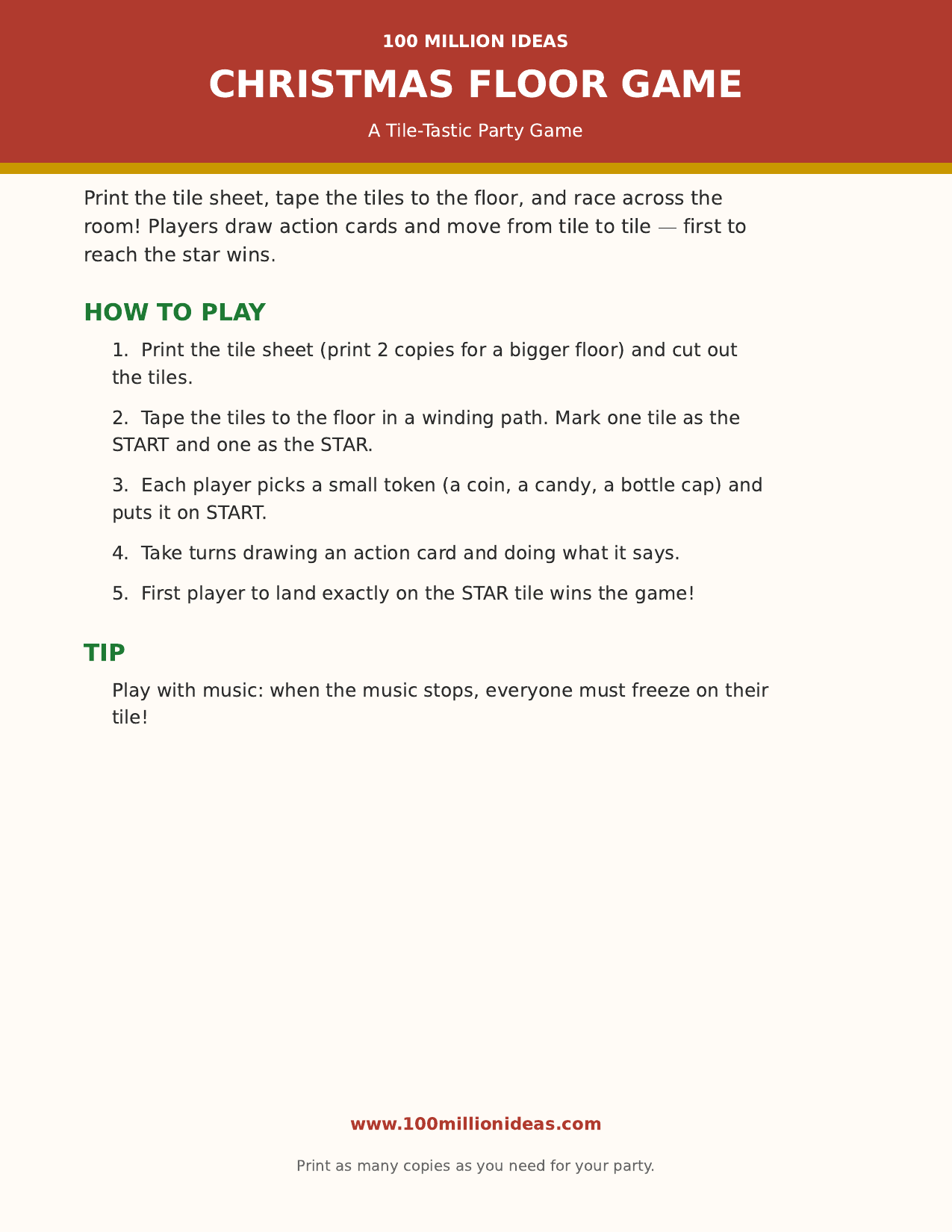
The printed game. The printable has everything: a tile sheet, two pages of action cards, and the how-to-play instructions. Print the tile sheet twice if you want a longer floor — two copies make a properly winding path that fills a living room, and the game is noticeably better on a longer track because the lead changes hands more often. Print the action cards once and cut along the solid lines so you have a deck of individual cards.
Tape. You need tape to fix the tiles to the floor, and this is the one supply worth choosing carefully. Ordinary sticky tape peels up and leaves tiles sliding around underfoot, which is how games end in a heap. Painter’s tape is the right choice: it holds the tiles firmly, peels off cleanly afterwards, and will not damage wooden floors or leave residue on tiles. One roll is plenty for a whole game. ScotchBlue Original Multi-Surface Painter’s Tape is a good option — the wide roll covers the tile corners well and it comes off cleanly when the game is over.
Scissors. For cutting out the tiles and the action cards before the party starts. Do this in advance — cutting cards while guests are waiting is the fastest way to lose a room.
A token per player. Each player needs a small token to move along the tiles: a coin, a wrapped sweet, a bottle cap, a small toy, or a button. Wrapped sweets are the most popular because the winner gets to eat their token, but anything small and flat works. Make sure the tokens are different from each other — different colours, different coins, different sweets — so nobody argues about whose token is whose halfway through.
A clear floor. Push the furniture back and sweep the floor before you start. The tiles need a flat surface, and players will be hopping, spinning, and doing silly walks, so anything they could trip over needs to be out of the way. If you have a rug, either play on top of it with the tiles taped to the rug, or roll it up — tiles taped to a rug edge tend to curl.
How to Play
Setting up
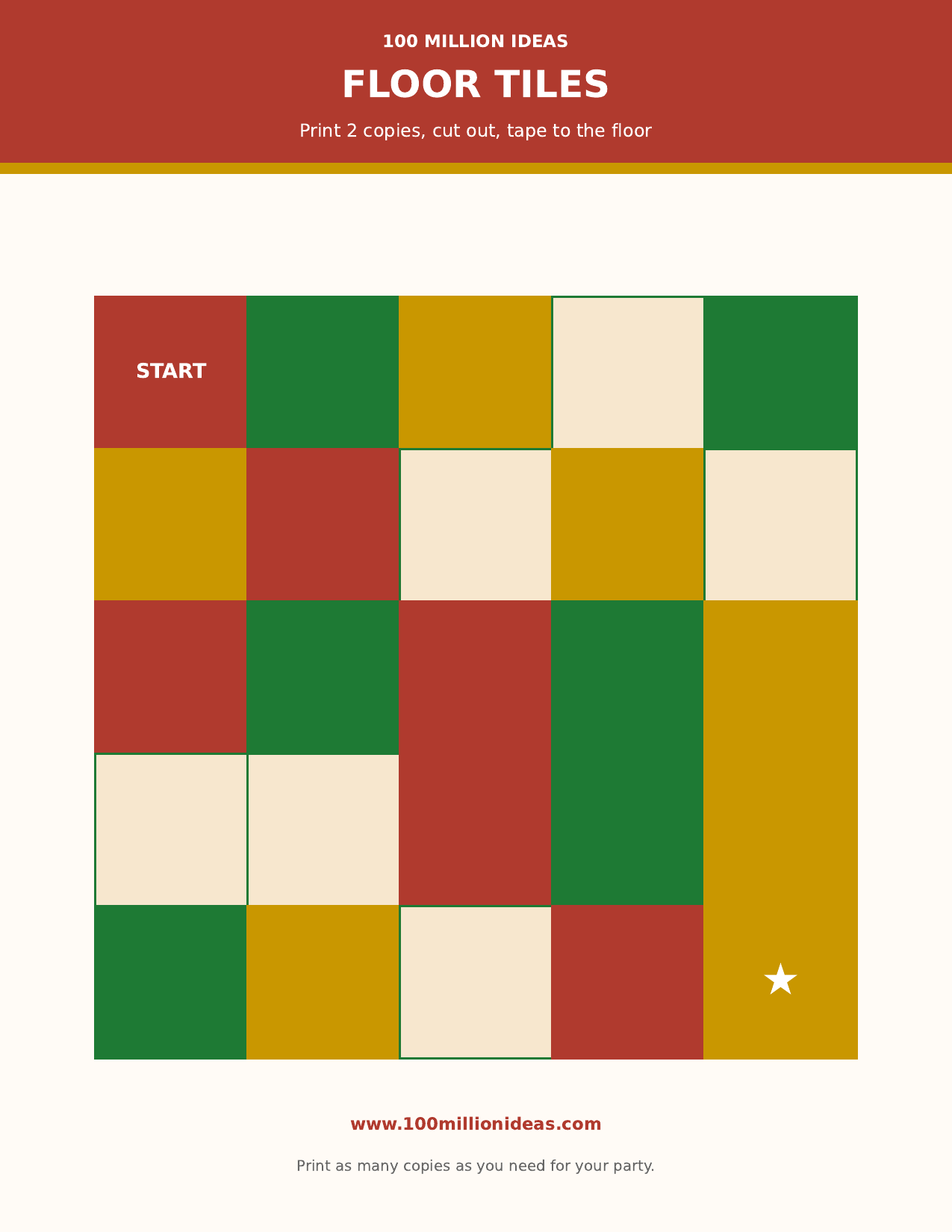
Print the tile sheet and cut out the tiles. Tape them to the floor in a winding path — not a straight line, but a path that curves and doubles back on itself like a snake, so players have to turn and change direction. Mark one tile as the START and one tile as the STAR, at opposite ends of the path. The star tile is the finish line, and it should be clearly marked — a gold star sticker, a drawing, or just the word STAR written in big letters.
Each player picks a token and puts it on the START tile. Shuffle the action cards and place them face down in a pile beside the path. The youngest player goes first, and play moves clockwise from there.
Taking a turn
On your turn, draw the top action card from the pile and do exactly what it says. Then your turn ends and the next player draws. The cards are the heart of the game, and they fall into a few kinds:
Movement cards tell you to move forward one, two, or three tiles, to hop to the next red tile or the next green tile, to move to any gold tile, to jump to the nearest star tile, or to move to the centre or a corner tile. These are the cards that win the game, and drawing a “move three tiles” when you are two tiles from the star is a moment of pure joy.
Setback cards send you back one or two tiles, make you lose a turn, or tell you to stay put. They are annoying in the moment and wonderful for the game, because they keep the leader from running away with it.
Action cards make you do something where you stand: dance on your tile for ten seconds, sing one line of a Christmas song, spin around on your tile, touch your toes and say “ho ho ho”, clap three times then move one tile, or do a silly walk to the next tile. These are the cards that make the audience laugh, and they are the reason this game works at a party rather than just at a table.
Interaction cards involve other players: swap places with any player, steal a tile from a friend, trade tiles with the player on your left, or make everyone move one tile forward. The “steal a tile” card is the most argued-over card in the deck, and it is worth agreeing before you start that a stolen tile means the victim’s token moves back to the tile the thief came from — decide it now, not mid-game.
Winning
The first player to land exactly on the STAR tile wins the game. That word, exactly, matters. If you are two tiles from the star and you draw a “move three tiles” card, you do not win — you bounce back, or you stay put, depending on the house rule you agreed at the start. Most families play that you must land exactly, and if your move would take you past the star, you stay where you are. It makes the ending tense in the best way, because a player can sit one tile from the star for three turns while everyone else catches up.
When the music stops, everyone must freeze on their tile — that is the game’s own bonus rule, printed right on the instructions. Put a Christmas playlist on, and every so often pause it without warning. Anyone who moves after the music stops goes back one tile. It is a small addition, but it turns the whole game into a party.
Tips for Hosting It Well
Build the path before the guests arrive. Taping tiles to the floor takes ten minutes and looks like chaos while it is happening. Do it before anyone arrives so the game is a surprise waiting on the floor, not a chore everyone watches you do.
Make the path interesting. A straight line is a race; a winding path is a game. Add a bend around the sofa, a loop near the tree, and a narrow gap between two chairs that players have to squeeze through. The path itself becomes part of the fun, and it gives the action cards more room to work.
Read the cards out loud. The player draws, but the host — or the player themselves — should read the card out loud so everyone hears it. Half the entertainment is the audience reacting to what the card says, and a silently-read card wastes that.
Keep the deck moving. If a player takes too long deciding who to swap with or which tile to steal, give them a friendly countdown from five. The game should feel fast and breathless, not thoughtful. This is not chess.
Watch the floor. With excited children hopping between tiles, a tile can come loose. Keep the roll of tape nearby and fix it between turns. A loose tile is a tripping hazard, and a quick fix keeps the game safe.
Who This Game Is For
Children from about five up are the natural audience — the game is physical, the cards are simple to understand, and the actions are the kind of thing children love doing in front of an audience. Ages five to seven will need an adult to read the cards for them and help them count their moves, but they can absolutely play and win.
Adults enjoy it more than they expect to, especially when the action cards come out. There is something about a grown adult being told to do a silly walk to the next tile that breaks the ice at any party. It is also a strong game for a mixed group, because the luck of the card draw matters far more than age or skill — a five-year-old can genuinely beat their parents, and the look on their face when they do is worth the price of the tape alone.
It needs space, so it is not the game for a tiny flat or a crowded dining room. And it is not the game for a formal gathering where nobody wants to move. But for a family Christmas with a living room to spare, it is hard to beat.
Variations to Try
Music version. Play with Christmas music running and pause it at random moments. When the music stops, everyone freezes, and anyone who wobbles goes back one tile. It adds a whole second game on top of the first.
Team version. Split into two teams and give each team one token. Team members take turns drawing cards for their shared token, which means the whole team groans together when someone draws a “go back two tiles” card. It works well for a classroom or a large family group.
Obstacle version. Put a soft cushion or a wrapped present on one tile as an obstacle — any player who lands on it has to do an extra dare before their next turn. It is a simple way to make a familiar path feel new on a second play.
Outdoor version. On a dry day, tape the tiles to a patio or a driveway and play outside. The path can be much longer, and the extra space means more players can join. Just make sure the tape will hold on the surface you are using.

Frequently Asked Questions
How much floor space do I need? A living room with the coffee table pushed aside is usually enough. Aim for a path at least three metres long — two copies of the tile sheet will fill that nicely. If your room is smaller, use one copy of the tile sheet and play with fewer players.
Will the tape damage my floor? Painter’s tape is designed to come off cleanly from wood, tile, and laminate, and it is the safest option. Avoid duct tape or packing tape, which can leave residue or pull up finish. Test a small piece in a corner first if your floor is newly finished.
What if I have more than eight players? Play in two heats. Four players race to the star, then the next four play, and the two winners face off in a final. It keeps every game fast and means nobody is waiting too long between turns.
Can younger children play? Yes, from about age five with a little help. Pair a younger child with an adult or an older sibling who reads the cards and counts the moves with them. The action cards — dancing, spinning, silly walks — are the parts young children love most.
How long does a game last? Fifteen to thirty minutes depending on the path length and the number of players. A longer path and more players means a longer game, so use one copy of the tile sheet for a quick game and two copies when you have the time and space.
What happens if the action cards run out? Shuffle the discard pile and start again. The deck is designed to be reused mid-game, and reshuffling is part of the game.
Get the printable game in our shop: Christmas Floor Inspired Game — $3 (regular $7)
It includes the tile sheet, both pages of action cards, and the how-to-play instructions — print as many copies as you need for your party. It is also included in the Gift Exchange Games Bundle — $9 (regular $15), which has 11 printable gift exchange games in one download, including dice games, left-right stories, and card games.