18 Pan Storage Ideas for 2026
Almost every kitchen has that one cupboard. You reach in for a single pan and suddenly three more slide forward, lids crash together, and you’re left digging through a noisy, tangled pile just to find the one you actually need.
Most people assume the problem is not having enough cabinets. Usually, though, the number of cabinets isn’t the issue at all — it’s the way the pans are stored inside them.
When pans are stacked the wrong way, they swallow up space and turn a simple cooking task into more work than it should be.
If your kitchen could use more breathing room, this guide is for you. Here are 18 smart pan storage ideas you can put to work in 2026.
How Do You Store Pans Without Wasting Cabinet Space?
Most cabinets feel full because the pans inside them are arranged badly. Stacking them wastes space and makes it hard to pull out the one you want.
The better approach is to store pans upright instead of flat. Slide a simple divider or rack into the cabinet and stand each pan on its side.
That way you can grab one pan without shifting all the rest, and the non-stick surfaces stay free of scratches.
If your cabinet is deep, add a pull-out organizer so nothing ends up forgotten at the back.
The principle is simple: keep every pan visible and within reach, and leave enough breathing room between pieces so they don’t crowd each other.
Pan Slots
When every pan has its own slot, opening the cabinet stops feeling like a chore. Upright dividers like these are a great fit for lower cabinets.
You can lift out a frying pan without hauling three others out first, which is a big win in a smaller kitchen.
Flat stacking wastes more space than most people realize. Wooden dividers also keep non-stick pans from touching, which helps prevent scratches building up over time.
Sizing the slots to match your pans makes a real difference — wider gaps for deep skillets, narrower sections for the pans you reach for every day.
You can put this look together quite easily with cabinet dividers, plywood separators, or adjustable organizers that slot into existing cabinets without a full kitchen remodel.

Photo credit: @thesteadyhand
Drawer Space
Deep drawers quietly solve one of the kitchen’s biggest headaches: heavy pans crammed into awkward cabinets.
With deep pull-out drawers like these, everyday cookware is much easier to reach because everything stays in view.
Nothing ends up buried at the back. Sorting by size works particularly well for small saucepans, frying pans, and Dutch ovens.
Low cabinets near the stove are the best place to copy this setup — cooking feels easier when the pans you use most are close at hand.
Drawer liners stop things sliding around, and simple pan protectors prevent scratches when cookware touches.

Photo credit: @lauraashleyfittedfurniture
Hook Hanger
A busy kitchen feels far more under control when pans aren’t piled on top of each other.
Sliding hooks turn an ordinary cabinet into a grab-and-go spot where every frying pan hangs on its own.
Pulling one out no longer causes a noisy avalanche. Lids tucked into holders on the cabinet door save a surprising amount of space too.
The easiest way to copy this setup is to use a narrow lower cabinet, ideally near the stove, where your everyday cookware stays within reach.
Solid pull-out rails and heavy-duty metal hooks matter here, since heavier skillets add weight fast.

Photo credit: @designerappliances
Bin Storage
Cabinets instantly look bigger once nothing is sliding around in a jumble. Storage bins like these work well for pans, lids, and cooking tools.
Every category gets its own section instead of one messy pile. A single bin of smaller lids alone frees up shelf space and makes cookware easier to find.
This setup usually suits wider base cabinets, especially where deep drawers tend to swallow things at the back.
Pull-out bins make life simpler — you can lift out the whole container instead of digging around inside it. Grouping cookware together also saves time.
Keeping everyday pans, lids, and utensils close together in one easy-to-reach zone means nothing is scattered across separate cabinets.

Photo credit: @omochazakka
Rack Pullout
Crowded corner cabinets stop being a struggle when the cookware slides out to you instead of hiding at the back.
Pull-out racks like these are a game-changer for larger pan collections — each frying pan, pot, and lid gets its own spot instead of being stacked into a tangled heap.
The top rack holds matching lids as well, so you don’t waste time hunting for one when dinner is already on.
Base corner cabinets are the best place to copy this layout, particularly where deep shelves are going to waste.
Strong, sturdy sliding hardware matters here because cookware gets heavy quickly, and cheap rails can start sticking over time.

Photo credit: @home.orga
Slide Hooks
The empty space at the top of small cabinets can be put to work. Sliding hook bars like these make cookware feel far more manageable.
Pans hang separately instead of stacking into one heavy mass, and pulling the rack out saves you from reaching into dark drawers for a single skillet.
This idea works well in narrow base cabinets, especially if you feel your cabinet shelves are wasted or hard to use.
Heavy cookware needs strong pull-out hardware, and tough metal hooks keep everything in place.
To keep the set balanced, mix saucepans and skillets of different sizes and leave enough space between pieces to protect non-stick surfaces from scratches.

Photo credit: @rebodehome
Shelf Tower
Counter corners often sit empty, but a stacked shelf rack like this turns unused space into a handy cookware station.
Larger pots go on top and everyday frying pans underneath, so nothing gets lost behind heavy stacks and cooking gets easier.
If your cabinets already feel full, open storage is a good alternative. It works well in apartment kitchens and small cooking spaces.
Vertical shelving uses height instead of more cabinets. Adjustable metal racks suit pots and pans of different sizes.
Felt pads under heavier cookware protect the shelves and stop things shifting around.

Photo credit: @plenty_to_shopke
Panel Rack
The slim gaps between cabinets can be some of the best storage spots in the kitchen. Pull-out panel racks like these keep frying pans, lids, and smaller cookware standing upright, so you can see everything and nothing disappears onto deep shelves.
Suddenly your favorite skillet is easy to reach, with every piece out in plain view.
This setup suits tall, narrow spaces beside appliances or kitchen units — ideal if standard cabinets feel too cramped.
A pegboard back and movable hooks add flexibility, since cookware sizes always change over time.

Photo credit: @aluminium_glass_design
Corner Shelves
Most people don’t realize how much cookware can fit into unused cabinet corners. Shelves like these, with several levels, stop heavy pots ending up in one frustrating pile, because each piece sits on its own level and is easy to reach.
There’s no more lifting three heavy pots to find the one hiding underneath when you need a frying pan.
This works especially well in deeper under-sink or lower cabinets, as long as the plumbing leaves enough room above.
Adjustable shelf organizers help when your cookware comes in different heights. Keep heavier stock pots on the lower shelves to stay balanced.

Photo credit: @adunnistoreng
Rack Divider
Morning cooking feels less stressful when every pan has its own lane instead of one big pile.
Divider racks like these keep frying pans, pots, and lids upright, so you never have to upset the whole cabinet to get one out.
Matching lids kept at the front save time too — no more searching elsewhere, since everything stays together.
Lower cabinets or pantry shelves suit this layout best, especially if stacking keeps scratching your cookware.
Adjustable dividers make life easier, since bulky stock pots need wider gaps while slimmer frying pans fit closer together.
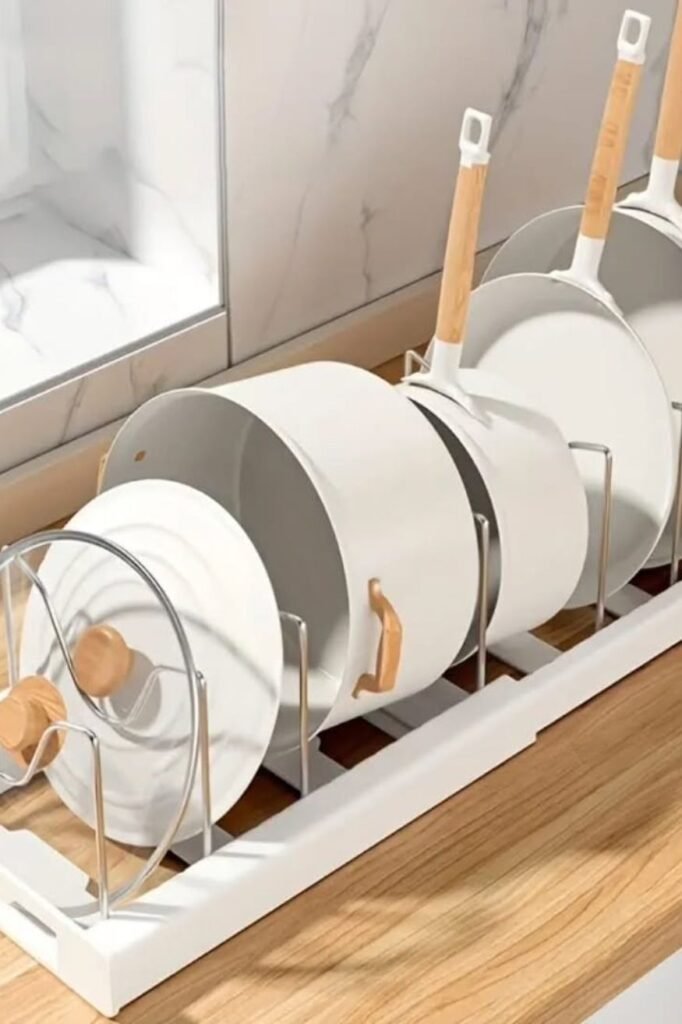
Photo credit: @adollar.pk
Hidden Wall
Blank cabinet sides can quietly turn into extra storage without taking up more kitchen space.
Sliding pegboard panels like these are a great answer for frying pans, spatulas, lids, and everyday utensils.
Everything hangs vertically and is easy to grab. With your favorite pan right by the stove instead of buried in a packed cupboard, cooking feels faster.
One of the best ways to copy this is with a tall, thin pull-out space — it works particularly well beside refrigerators or pantry cabinets, where awkward gaps usually go unused.
Adjustable hooks help a lot, since cookware sizes change over time.

Photo credit: @tiffany_design_studio
Door Lids
No more lids sliding into odd corners — opening a cabinet feels much calmer. These door-mounted holders quietly free up shelf space.
They keep matching lids right where you need them, next to the cookware you actually use. Vertical dividers at the bottom make heavy pots easier to grab, since each piece stands upright instead of sitting in one big stack.
This setup is easiest to copy with wide lower cabinets, especially near the stove where cookware gets used every day.
Adjustable lid racks on cabinet doors fit different sizes without taking up extra room.

Photo credit: @2borganizeddenver
Shelf Zones
Tall pantry cabinets hold far more cookware when every shelf has a set purpose.
Frying pans on one shelf, deeper pots on another, and lids in their own divider make cooking feel less frustrating right away.
Nothing ends up buried under something heavier. Getting a pan out becomes easy instead of turning into a noisy cabinet shuffle.
Narrow pantry-style cabinets suit this best, since the vertical height is used far better than with wide stacking.
Simple wire lid organizers at the bottom hold covers upright, while soft pan protectors between stacked skillets prevent scratches.

Photo credit: @inlineorganizing
Drawer Lines
Deep drawers don’t feel cluttered when each pot and lid has its own compartment. Dividers like these make kitchenware easy to reach.
Nothing stacks too high or slides around when the drawer opens. Glass lids at the front stay protected too, instead of being buried under heavy pans.
Wide lower drawers next to the stove are the best way to get this layout, especially if deep cabinets tend to turn into junk drawers.
Adjustable wire dividers let you fit different pot sizes without wasting space, and you can keep frying pans together near the back so the handles don’t get tangled.
Non-slip liners underneath also help heavier cookware stay put instead of shifting every time the drawer moves.

Photo credit: @yamazakihome
Corner Spin
No more wasted space in hard-to-reach corner cabinets, with shelves that come out to you instead of you having to crawl halfway inside.
Heavy cookware is much easier to handle with pull-out corner trays like these, keeping frying pans, stock pots, and Dutch ovens separated and visible. Suddenly grabbing a pan feels straightforward instead of a balancing act.
Blind corner cabinets are the best place to copy this setup, especially if kitchenware keeps disappearing into deep, awkward spots.
Smooth rotating pull-out hardware matters here, because it keeps heavier pots from tipping or sliding around.

Photo credit: @bestdeal_luxurious_kitchen
Cabinet Rows
When frying pans stop leaning on each other like falling dominoes, lower cabinets feel noticeably quieter.
Vertical organizers like these give each pan its own space, so you no longer have to move half the collection to reach your favorite skillet.
Stacking pots on the upper shelf also frees up extra space without crowding the cabinet.
Long shelves in wide base cabinets suit this look especially well, giving pan handles plenty of room to lie neatly in one direction.
Adjustable dividers make organizing easier when your cookware comes in different sizes. Keep everyday frying pans toward the front to save time when you’re busy cooking.

Photo credit: @cindyology
Hanging Rails
Heavy cookware is much easier to handle when the cabinets aren’t stacked towers of pans.
Pull-out hanging rails like these make room for every pot, frying pan, and lid, so nothing gets scratched or stuck under heavier pieces.
Matching lids hung beside the cookware save time too, since everything stays together instead of spread across random cabinets.
Deep bottom cabinets are the way to go to copy this design, especially if you’re always knocking over towers of cookware when you reach inside.
Big pans add weight fast, so strong sliding rails matter here, along with sturdy hooks to keep everything balanced.

Photo credit: @spruce_spaces
Counter Rack
When pots and lids stop fighting for cabinet space, busy kitchens feel less cluttered. This slim divider rack holds cookware upright.
You can pull out a single pan in seconds instead of moving a heavy stack first. Matching lids beside the pots make cooking smoother, since everything is easy to see.
If your cabinets already feel full, counter corners or pantry shelves are great spots to copy this setup.
Adjustable wire dividers let you fit different pan sizes without wasting space, and placing larger lids near the ends keeps them from wobbling.
This idea helps a lot in a smaller kitchen, since vertical storage takes up less room and helps your cookware dry.
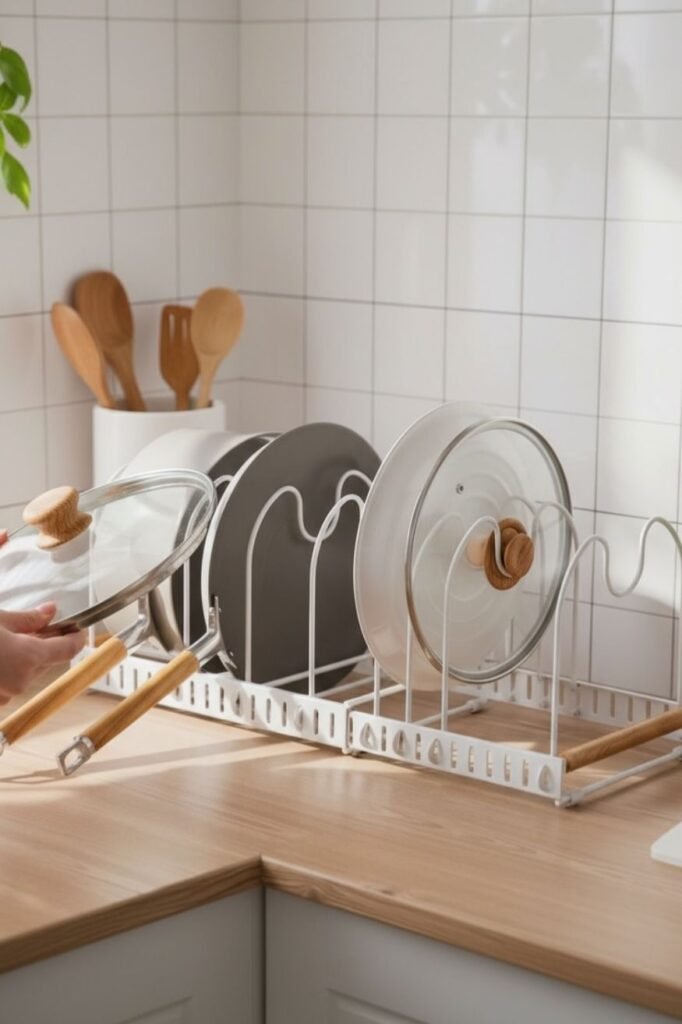
Photo credit: @essentialhomedecor_
FAQs
What is the most space-efficient way to store pans in a kitchen cabinet?
Storing pans vertically is usually the most space-efficient option. Rather than stacking pans on top of each other, vertical dividers or pan racks let each pan stand upright.
That uses the cabinet height better and makes it easy to grab any pan without lifting the rest.
Where should pans be stored for the easiest access while cooking?
Keep your pans in a cupboard or drawer near the stove or cooktop. Having pots and pans close to where you cook cuts down on unnecessary trips across the kitchen.
Deep drawers, pull-out racks, or vertical dividers in the cabinet beside the stove work best, since they make the pans you use most often easy to see and reach.
