18 Water Bottle Organization Ideas for 2026
Water bottles are one of those things that seem easy to store until you open a cabinet and find it packed full of them.
Tall tumblers fall over. Little bottles vanish behind the bigger ones. Lids end up in a different drawer altogether. Then you pull one bottle out and three more tumble forward.
Before you buy another organizer, empty everything out and take a proper look at what your household really uses. Keep the favourites, the school bottles, the gym bottles, and anything that genuinely gets used during the week.
Once you know what actually needs a home, these 18 water bottle organization ideas can make the whole space far easier to manage.
Save this article for later! 👇👇

Water Bottle Organization Ideas
1. Vertical Drawer Dividers
If you have a deep kitchen drawer, try keeping bottles upright in it instead of cramming them onto a shelf.
Adjustable dividers can make small sections for different bottle sizes and stop everything sliding about when the drawer opens.
Measure your tallest tumbler before you set it up. It is all too easy to arrange the whole drawer and then discover your biggest bottle stops it from closing.

Photo credit: @therevivedhome
2. Magazine Holder Storage
A sturdy magazine holder can work surprisingly well for bottles kept on their sides.
Slide a few bottles into each holder and they stay contained instead of rolling around the cabinet.
This is especially handy on shelves that are wide and deep but not tall enough for your larger bottles.
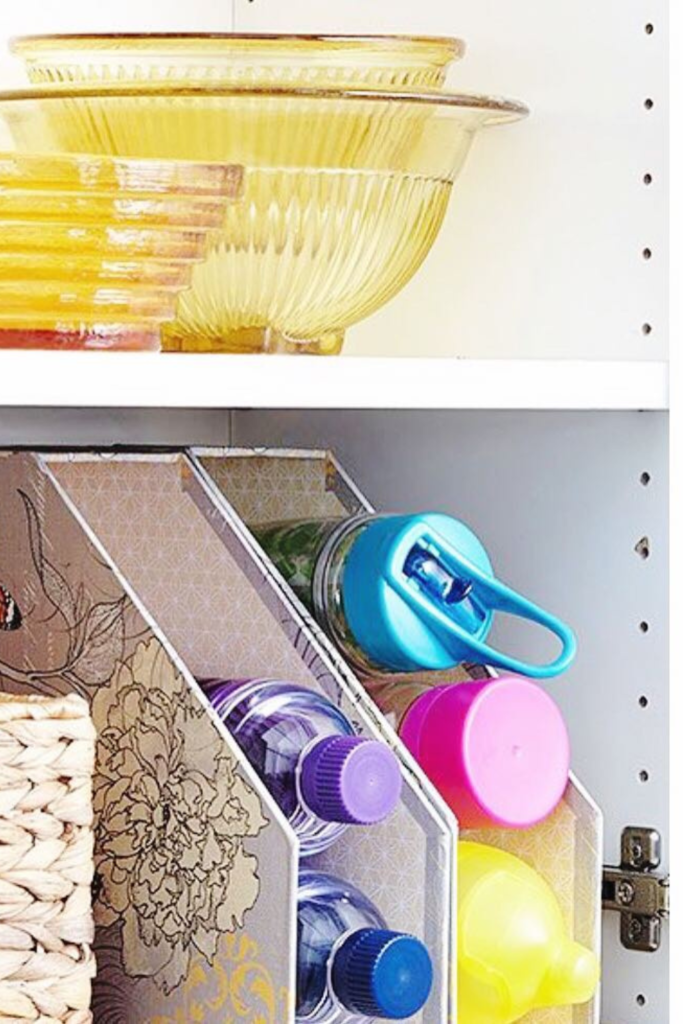
Photo credit: @ocdaz
3. Over-the-Door Bottle Storage
When the cabinets are already full, the back of a pantry or utility door can give you a little extra room.
A pocket organizer works best for lighter bottles, especially kids’ bottles and plastic drink bottles.
Keep the heavier ones lower down so the organizer does not pull awkwardly on the door.

Photo credit: @taylorflanery
4. Sports Bottle Station
Sports and school bottles tend to be bigger than everything else, so sometimes they are easier to manage when they have their own spot.
A basket, shelf, or door organizer near the pantry or mudroom can become the grab-and-go area.
If several people in the house use similar bottles, separate them by person rather than trying to remember which one belongs to who.
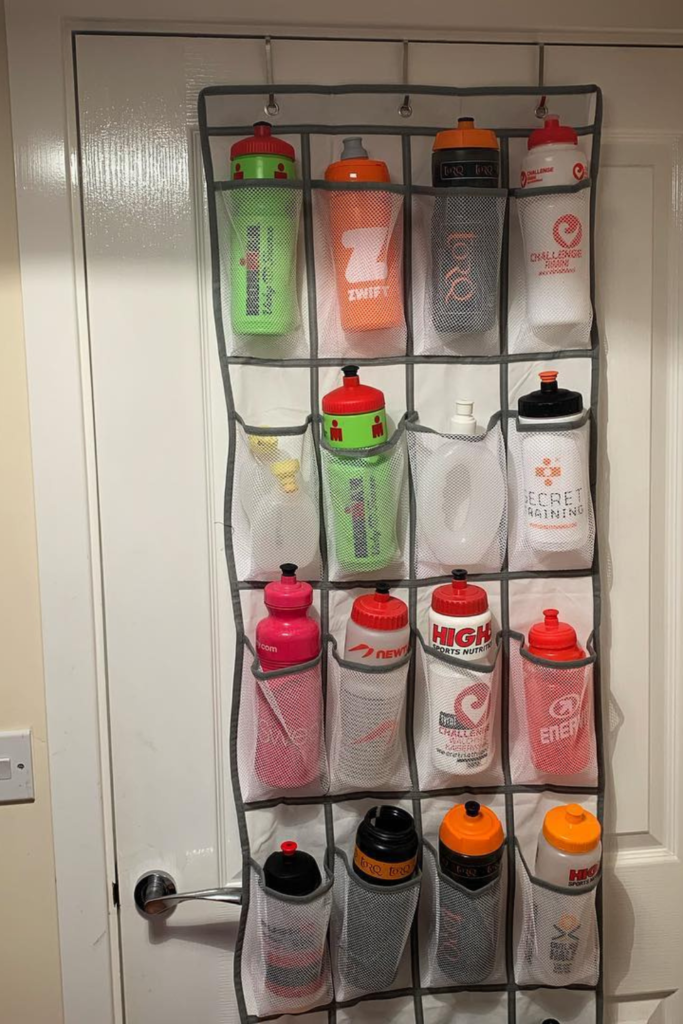
Photo credit: @tomridesandruns
5. Custom Door Rack
If you have a narrow pantry door with unused space, a shallow wooden rack can hold a surprising number of bottles.
The important part is measuring carefully.
You need enough depth to hold the bottles without stopping the door from closing, plus a small front rail to keep them from falling out.

Photo credit: @danmadehome
6. Stackable Horizontal Rack
This is one of the easiest fixes for the classic bottle avalanche.
Each bottle gets its own horizontal slot, so removing one does not disturb everything around it.
Stackable racks are especially useful inside cabinets where you have plenty of width but awkward shelf height.
Want to try this idea? A stackable bottle organizer gives each bottle its own horizontal slot so they do not roll around the cabinet. See water bottle organizers on Amazon →
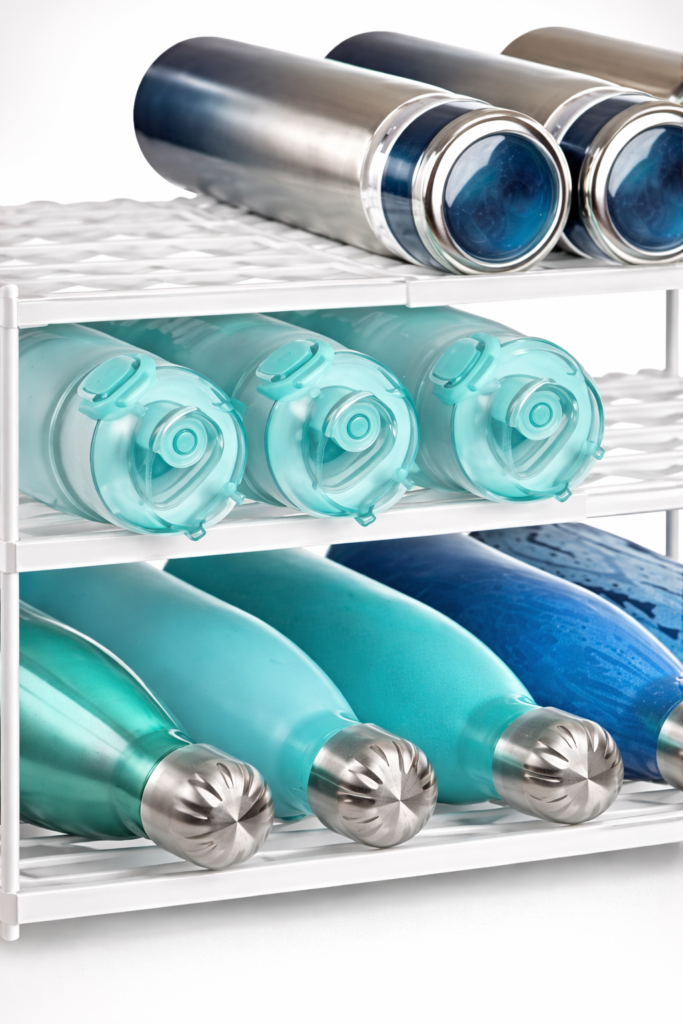
Photo credit: @neatnestfindsins
7. Large Water Jug Rack
Large refill jugs need their own system.
Instead of leaving them standing on the floor or piled in a corner, use a sturdy rack designed to hold the weight horizontally.
Check the rack’s weight capacity before loading it.

Photo credit: @arvani_home_essentials
8. Clear Bin Rows
Clear bins are a good option if you do not want to install anything.
Lay bottles on their sides with the lids facing forward, then slide the entire bin out when you need something from the back.
They work particularly well in deep upper cabinets where loose bottles tend to disappear.
Want to try this idea? Clear storage bins make deep shelves easier to use because you can pull the whole group forward at once. See clear storage bins on Amazon →

Photo credit: @organizewithtracy
9. Wall-Mounted Holders
An empty pantry or utility wall can become useful bottle storage with individual holders.
This works best for a smaller collection of bottles you use regularly.
Space them far enough apart that handles and wide lids do not bump into each other, and make sure the mounting hardware is strong enough for heavier stainless steel bottles.

Photo credit: @simplybetterhome
10. Give Each Shelf a Job
Sometimes the easiest answer is simply to stop mixing everything together.
One section can be for tall tumblers, another for kids’ bottles, another for shaker cups.
Lids and straws can have their own small container nearby.
It does not need to look perfect. It just needs to be obvious where things go when someone puts a clean bottle away.

Photo credit: @orderlysc
11. Countertop Turntable
A rotating turntable, often called a Lazy Susan, can work well for large handled tumblers that are awkward to fit anywhere else.
Place them around the tray and rotate it to reach the one you want instead of moving the front row every morning.
This can work on a counter, pantry shelf, or in a deep corner cabinet.
Want to try this idea? A large non-slip turntable can make oversized tumblers much easier to reach in a deep cabinet or pantry. See large lazy Susans on Amazon →

Photo credit: @lamuhome
12. Cubby-Style Bottle Slots
Individual cubbies are useful if everyone in the house has a favorite bottle.
Each bottle gets its own slot, stays visible, and cannot roll into the next one.
Clear stackable organizers are an easy way to create this setup without changing the cabinet itself.

Photo credit: @organizedbyellis
13. Drawer Compartment Grid
A wide drawer becomes much more useful once you divide it into smaller sections.
You might keep kids’ bottles in one area, travel mugs in another, and shaker cups at the back.
Adjustable dividers are worth using here because bottle collections have a habit of changing.

Photo credit: @neatwithknight
14. Give the Lids Their Own Home
Sometimes trying to keep every lid attached actually makes storage harder.
If that is happening, put all the clean, dry lids into a small container beside the bottles.
You can separate straw lids, flip tops, and shaker lids if you have enough of them to make that useful.
The important part is keeping the lids close enough that nobody has to search through three different drawers.
Want to try this idea? A small divided organizer can keep bottle lids and straws together without taking over the whole cabinet. See lid organizers on Amazon →

Photo credit: @getorganizedpei
15. Labeled Bottle Bins
Labels can help when different types of bottles keep getting mixed together.
You could have one bin for everyday bottles, one for kids, and one for gym or shaker bottles.
Keep the categories broad. Too many tiny labels just create another system nobody wants to maintain.

Photo credit: @rose_home_organizing
16. Mix Different Storage Types
You do not have to make every bottle fit the same organizer.
A horizontal rack might be perfect for regular bottles, while oversized tumblers stand upright beside it.
Then a small bin can hold the lids and straws.
A mixed setup often works better than forcing every bottle into the same kind of organizer.

Photo credit: @thespringersisters901
17. Split the Cabinet by Use
If you have a lot of bottles, organize them around your routines.
School bottles together. Gym bottles together. Everyday tumblers together.
Keep the things you use most often at the easiest height and move backups higher or farther back.
That small change can make the cabinet feel much less crowded without actually removing anything.

Photo credit: @beeorganized.co
18. Use a Turntable in a Deep Cabinet
Deep lower cabinets are where bottles tend to disappear.
A large turntable lets you rotate the back row forward rather than reaching around everything.
Keep the bottles on the tray and put lids or straws in a small container beside it.
This setup is especially useful if bending down and digging through a cabinet is already annoying.

Photo credit: @mdesign
Before You Buy an Organizer
Do a quick count first.
It is easy to buy a rack for 12 bottles and then discover that half your collection is too wide to fit.
Check the width of your biggest tumbler, the height of your cabinet shelves, and the depth of the drawer or cupboard you want to use.
Also think about how you naturally grab a bottle.
If you are always rushing out the door, a beautiful organizer hidden in the back of a cabinet may be less useful than a simple basket near the kitchen exit.
And if your kids are putting their own bottles away, make sure the storage is somewhere they can actually reach.
What About All the Lids?
This is usually the part that causes the mess.
If your bottles are completely dry and fit comfortably with the lids attached, keeping each set together is easy.
But if the lids make everything too tall or awkward, separate them.
Use one small bin and keep it right beside the bottles.
I would rather have a slightly less “perfect” cabinet where everyone can find the right lid than a pretty setup that gets destroyed every morning.
If Your Cabinet Is Still Too Full
You probably do not need a more complicated organizer.
Take another look at the bottles.
There are usually a few promotional bottles, old kids’ bottles, duplicates, or cups nobody really likes using.
Keep the ones your household reaches for.
Put rarely used bottles somewhere else.
And let the everyday ones have enough room that you can grab one without causing an avalanche.
That is really the whole goal.
