Christmas Building Block Challenge

This post may contain affiliate links. As an Amazon Associate I earn from qualifying purchases.
If your house has a box of building bricks, you already own the best Christmas game there is — you just need the ideas. That is what this challenge set does. It gives you twenty Christmas building challenges on printable cards, from a simple snowman to a full Santa’s workshop, each one with a difficulty rating so you can pick the right challenge for the right builder. Cut the cards apart, pick one, grab your bricks, and build.
The game is gloriously simple, and that is why it works. There are no rules to explain, no pieces to lose, and no setup beyond tipping the brick box onto the floor. A child who has been bouncing off the walls all afternoon sits down, picks a card, and is suddenly quiet, focused, and building a reindeer. An adult who “isn’t playing” will be found twenty minutes later adding a chimney to a gingerbread house. Building is one of those activities that ignores age completely.

What’s Inside the Printable
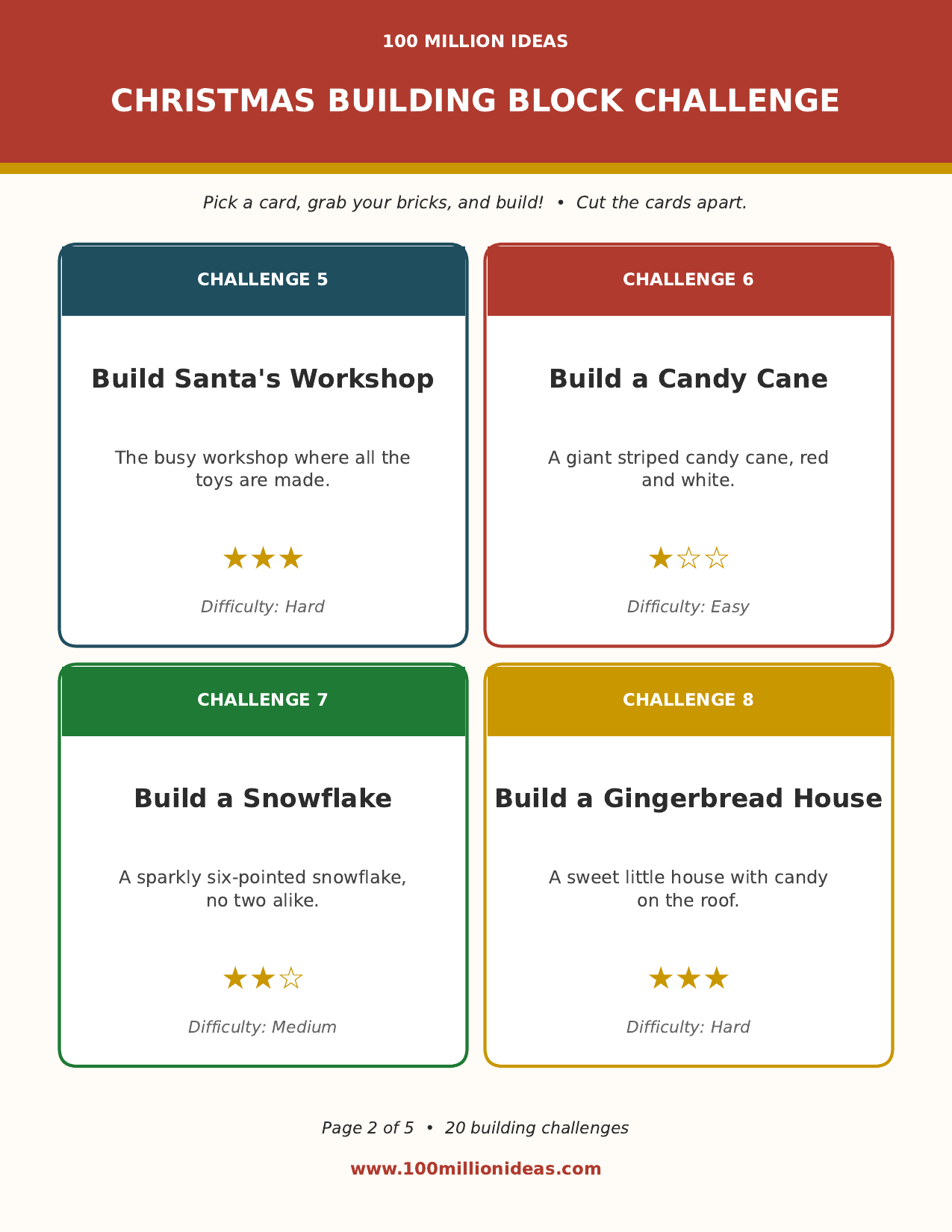
The download is five pages, and each page holds four challenge cards, making twenty challenges in total. Each card names something to build, gives a short description to spark ideas, and shows a difficulty rating of Easy, Medium, or Hard.
The easy challenges are Challenge 1, Build a Snowman — a jolly snowman with a carrot nose and a cosy scarf; Challenge 2, Build a Christmas Tree — a tall tree with colourful ornaments and a star on top; Challenge 6, Build a Candy Cane — a giant striped candy cane, red and white; Challenge 9, Build an Elf; Challenge 11, Build a Star; Challenge 12, Build a Present; Challenge 13, Build a Wreath; and Challenge 15, Build a Stocking.
The medium challenges are Challenge 3, Build a Sleigh — Santa’s sleigh, ready to fly through the night sky; Challenge 4, Build a Reindeer — a friendly reindeer with big antlers and a red nose; Challenge 7, Build a Snowflake — a sparkly six-pointed snowflake, no two alike; Challenge 10, Build a Fireplace; Challenge 14, Build a Chimney; Challenge 16, Build a North Pole Sign; and Challenge 18, Build an Igloo.
The hard challenges are Challenge 5, Build Santa’s Workshop — the busy workshop where all the toys are made; Challenge 8, Build a Gingerbread House — a sweet little house with candy on the roof; Challenge 17, Build a Christmas Train; Challenge 19, Build a Snow Globe; and Challenge 20, Build a Toy Shop.
That spread of difficulties is what makes the set work for a whole family. A four-year-old can build the star. An eight-year-old can tackle the sleigh. A determined ten-year-old — or a competitive parent — can spend a happy hour on Santa’s workshop. And because there are twenty cards, the game does not run out after one evening.
How to Play
Print the five pages and cut the cards apart along the edges. That is the only preparation. You will need a set of generic interlocking building bricks — the kind most families already have in a box somewhere. If you do not have a set, or your set is too small for the bigger builds, a 1,000-piece set of classic building bricks in ten colours gives you plenty of bricks for every challenge in the pack, including the hard ones.
Then play in whichever way suits your group. The simplest way is to pick a card, build it, and admire it. That is enough — the building is the game. But if you want more structure, here are the ways that work best.
Pick a Card, Any Card
Shuffle the cards face down and let each player draw one. Everyone builds their challenge at the same time, and when the building is done, everyone shows their model. There is no winner and no loser; the fun is in seeing how differently people build the same thing. Five people building a snowman will make five completely different snowmen, and that is the point.
Race the Clock
Set a timer for ten minutes for an easy card, fifteen for a medium card, and twenty for a hard card. Everyone builds the same challenge, and when the timer goes off, building stops. Then vote on the best model — funniest, tallest, most detailed, or most creative. The time limit is what makes this exciting: it forces quick decisions, and the results are gloriously wonky in the best way.
The Advent Build
Use the set across December as a daily challenge. Draw one card each day from the 1st of December, build it, and display it on a shelf or a windowsill. By Christmas Eve you have a whole village of builds — a tree, a sleigh, a workshop, a train — and the shelf looks wonderful. This is my favourite way to use the set, because it stretches the fun across the whole month and gives children something to look forward to each day.
Team Build
For the hard challenges, build in teams. Two or three people working on Santa’s workshop together can split the job — one person builds the walls, one builds the roof, one builds the toys inside. Team building teaches negotiation, planning, and the art of not knocking over somebody else’s work, all without anyone noticing they are learning anything.
Who This Is For
This game is aimed at children aged about four to twelve, and it genuinely covers that range because the difficulty ratings do the work. A four- or five-year-old can build the easy cards with a little help — the star, the present, and the candy cane are all simple shapes with few pieces. A six- to eight-year-old can manage the easy and medium cards independently, and will love the sleigh and the reindeer. A nine- to twelve-year-old can take on the hard cards, and will enjoy the challenge of the workshop, the train, and the toy shop.
It is also one of the best games for mixed-age groups. At a family Christmas, a four-year-old, an eight-year-old, and a grandparent can all play at the same table, each with a card that suits them, and nobody is bored or out of their depth. In a classroom, it works as a station activity: set out the cards and the bricks, and let children choose their own difficulty.
And it is not just for children. Building with bricks is relaxing for adults too, and a parent who sits down to “help” will often end up building their own model. That is not a flaw in the game — it is the game working as intended.
What You Need
You need the printed challenge cards and a set of building bricks. Any standard interlocking bricks will do — the kind that come in mixed tubs and boxes. A small tub of a few hundred bricks is enough for the easy and medium challenges, but the hard challenges — the workshop, the train, the toy shop — need a bigger collection, so a 1,000-piece set is worth having if you plan to tackle those.
A flat surface helps. A table is ideal, but the floor works just as well, and children often prefer it. A baseplate is useful for the bigger builds, because it stops the model from sliding around, but it is not essential. If you have one, use it for the hard challenges.
Scissors are needed to cut the cards apart. If you want the cards to last, print them on card rather than paper, or laminate them. A set of laminated cards in a small box is a Christmas game you can bring out year after year, and the cards will survive being handled by excited children.
Tips for Better Building
Sort the bricks before you start a hard challenge. It takes two minutes, and it saves ten minutes of hunting for a red brick in a pile of mixed colours. Sort by colour for the candy cane and the stocking, and by size for the workshop and the train.
For the snowflake, remember that it needs six points, not four or eight. Count the points as you build, and the snowflake will look right. For the Christmas tree, build it wider at the bottom and narrower at the top, in layers — it looks more like a tree and is much more stable. For the sleigh, build the runners first and the body on top; a sleigh built the other way round falls apart.
If a build keeps falling over, the problem is almost always the base. Make the bottom layer wider than the top, and the model will stand. Children often build tall and narrow because it looks impressive, but wide and stable beats tall and wobbly every time.
When a build is finished, take a photo before it gets knocked over. A row of photos of the twenty builds, printed out or kept on a phone, is a lovely record of a December of building — and it means the bricks can go back in the box without anyone feeling sad about dismantling their workshop.
Variations to Try
Once the twenty cards have been played through, they can be played again in new ways. Try a blind draw where you must build whatever you pick, even if it is hard. Try a swap round where you build someone else’s card for them. Try a speed round where everyone builds the same easy card in five minutes and the results are judged on creativity, not accuracy.
A good variation for a party is the mystery build. One player builds a model in secret, and the others have to guess which challenge card it is. A reindeer with a red nose is easy to guess; a snow globe is much harder, and the guessing is half the fun.
Another variation is the free build. Put the cards away, tip out the bricks, and build whatever you like — but it has to be Christmas. A Christmas rocket, a Christmas castle, a Christmas robot: the only rule is that it must be festive. Free building after a structured game is a wonderful release, and children often make their best models when the cards are put away.
For a classroom or a youth group, turn the set into a display. Each child builds one card, and all twenty models go on a shelf together to make a Christmas village. Label each model with the builder’s name and the challenge number, and you have a display that parents will photograph.

Frequently Asked Questions
How long does one challenge take? An easy card takes about five to ten minutes. A medium card takes ten to twenty minutes. A hard card can take twenty to forty minutes, especially if the builder is being careful. A full set of twenty cards, built over several days, fills many happy hours.
What ages is the building block challenge suitable for? About four to twelve. Four- and five-year-olds manage the easy cards with help. Six- to eight-year-olds handle easy and medium cards on their own. Nine- to twelve-year-olds enjoy the hard cards. Adults enjoy all of them.
Do I need a specific brand of bricks? No. Any standard interlocking building bricks work — the cards describe what to build, not which bricks to use. Use whatever set you already have at home.
How many bricks do I need? A few hundred bricks are enough for the easy and medium challenges. For the hard challenges, a larger set of around a thousand pieces gives you enough bricks to build big without running out halfway.
Can the cards be reused? Yes. Print them on card or laminate them, and they will last for years. The set is designed to be played again every December, and children will build the same challenges differently each year as they grow.
Get the Printable in Our Shop
Get the printable cards in our shop: Christmas Building Block Challenge — $3
All twenty challenge cards are available as an instant download in our shop for $3. Print them, cut them apart, and start building. If you are collecting quiet Christmas activities for the kids, the Kid Activities Bundle — $11 includes these challenge cards along with our other printable activity sets — one download, and the festive fun is covered for the whole of December.
You may like to read!
- Ultimate Christmas Kids Bucket List
- Christmas Family Bucket List Ideas
- DIY Christmas Decoration Ideas at Home
- Best Paper Christmas Decorations
- Fun Healthy Holiday Snacks
Images:
- Cover: ~/workspace/100millionideas-shop/covers/christmas-building-block-challenge.png
- Body images: rendered pages of ~/workspace/100millionideas-shop/files/christmas-building-block-challenge.pdf — page 1 (challenges 1–4: snowman, tree, sleigh, reindeer), page 3 (challenges 9–12: elf, fireplace, star, present), page 5 (challenges 17–20: train, igloo, snow globe, toy shop).