Christmas Categories Game

There is a moment at every Christmas party when the food has been eaten, the presents are open, and everyone drifts toward their phones. The Christmas Categories Game is built for exactly that moment. It is a fast word game where each round hands you a letter and ten Christmas categories, and you have two minutes to think of an answer for every category that starts with that letter. It takes about sixty seconds to explain, needs nothing but printed sheets and pens, and it has a way of pulling even the quietest guest into the middle of the fun, because the best answers are usually the strangest ones.
What makes it work so well is the scoring. A shared answer earns one point, but an answer nobody else thought of earns two. That single rule changes everything. The first answer that pops into your head is almost always the answer everyone else thought of too, so the real game is deciding whether to write down the safe answer quickly or gamble a few seconds hunting for something cleverer. I have watched confident players freeze on a category as simple as a Christmas food because every idea they had started with the wrong letter, and I have watched a shy ten-year-old win a round outright with an answer no adult in the room had considered. That is the whole charm of it.

At a Glance
- Players: 2 to 20, or more in teams
- Ages: 8 and up can play on their own; children younger than that do best paired with a grown-up on the same team
- Time needed: 15 minutes for 3 rounds, 30 to 45 minutes for all 12 rounds
- Supplies: one printed round sheet per player per round, a pen or pencil for each player, and a phone or kitchen timer
- Best for: family parties, friends’ Christmas nights, classroom parties, office holiday parties, and Christmas Eve
What You Need to Set Up
Setup takes about five minutes, and most of that is printing. Print one copy of the round sheet for every player, for as many rounds as you plan to play. If eight people are playing four rounds, that is 32 sheets. The printable game includes 12 rounds, one per letter, so you can play a short game of three or four rounds and save the rest for another night, or play the full set in one long session.
Give every player a pen or pencil. Pens are better than pencils here, because nobody can quietly rub out an answer and change it after the timer ends, and that small detail prevents most arguments. Put one timer where everyone can hear it: a phone timer on the table works, and a kitchen timer with a loud ring works even better in a noisy room. Clear a flat writing surface for each player, a table is ideal, but laps and clipboards work if your party is spread around a living room.
Before the first round, agree on two house rules and say them out loud. First, decide who judges disputed answers. The host is the simplest choice, or let the group vote on anything unclear. Second, decide whether funny answers count. My advice is yes, as long as the answer genuinely fits the category and starts with the correct letter. A joke answer that fits the rules is exactly the kind of thing people remember and talk about afterwards.
How to Play
Here is the full round, step by step, so you can run it without ever having played before.
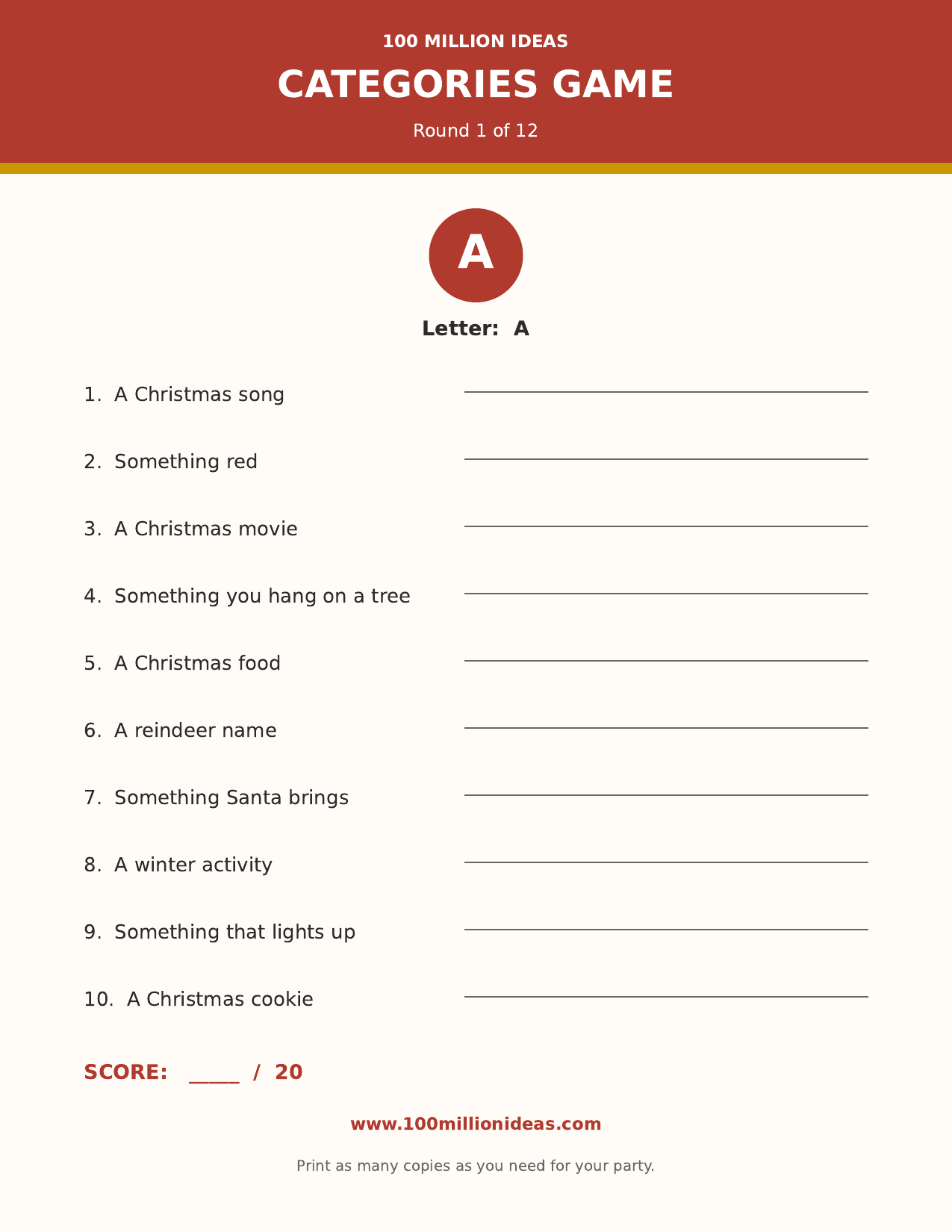
1. Hand out the round sheet. Each round sheet has a letter printed at the top and ten Christmas categories below it. The categories cover things like a Christmas song, something red, a Christmas movie, something you hang on a tree, a Christmas food, and a reindeer name, with different categories across the twelve rounds.
2. Start the timer: two minutes. Everyone writes one answer per category. Every answer must start with the round’s letter. Spelling does not have to be perfect, but the first letter has to be right, and the answer has to fit the category. No peeking at other players’ sheets, and no copying answers.
3. Call time and read the answers out loud. Go through the categories one by one. For each category, have every player read out what they wrote. Reading aloud is half the entertainment, because this is when the unexpected answers come out and the whole room reacts.
4. Score the round. A unique answer that nobody else wrote earns 2 points. An answer shared with one or more other players earns 1 point. A blank category earns 0 points. Add each player’s points for the round.
5. Repeat for as many rounds as you like, then add up the totals. The player with the most points after the final round wins.
A worked example makes the scoring obvious. Say the letter is C and the category is a Christmas food. Four players wrote candy cane, candy cane, Christmas cake, and cranberry sauce. The two candy cane players each score 1 point, because their answer was shared. The Christmas cake player scores 2 points, and the cranberry sauce player scores 2 points, because nobody else wrote those. Over twelve rounds, those two-point answers add up fast, and the winner is usually the player who found the most unusual answers, not the fastest writer.
Scoring Disputes and How to Settle Them
Every group hits a disputed answer sooner or later, so it helps to know how to handle one before it happens. If an answer clearly fits the category and starts with the right letter, it counts, even if it is unusual. If an answer is a stretch, let the judge decide, or put it to a quick group vote and move on. The one rule worth enforcing firmly is that an answer must start with the round’s letter: an answer that starts with a different letter scores nothing, no matter how good it is. Keep disputes short. The game is at its best when rounds move quickly, and a two-minute argument over one answer costs more fun than the point is worth.
Tips That Actually Help You Win
After a few rounds, players start to develop habits that genuinely improve their scores, and these are the ones worth passing on before you begin.
Write the obvious answer first, then improve it. If you have an answer for a category, write it down immediately so the space is not blank, then come back to it if you have time. A shared answer worth one point beats a blank worth nothing, every single time.
Think in unusual directions. For a category like something red, most people think of the first red thing they can picture. The two-point answers come from thinking about the edges of the category instead: red things in the kitchen, red things outside, red things in a Christmas story.
Skip and come back. If a category stumps you, leave it blank and move on. Two minutes disappears quickly, and a stuck player can lose three easy points while staring at one hard category. Circle back at the end if time remains.
Watch the clock, not the other players. You cannot see what anyone else wrote, so there is no advantage in rushing to match them. Spend your time thinking, not worrying about how fast the person next to you is writing.
Variations to Try
The basic game is strong on its own, but these variations keep it fresh when you play it more than once.
Team play. Split a large group into teams of two or three and let each team fill in one shared sheet. Team play suits office parties and big family gatherings, because shy players get to contribute without the pressure of playing alone, and the discussion inside each team is often funnier than the answers themselves.
Speed rounds. Once everyone knows the rules, cut the timer to 90 seconds, or even 60. Shorter rounds reward quick thinking and produce far more blanks, which makes the scoring swings bigger and the results less predictable.
Kids’ version. For younger children, allow answers that start with the letter anywhere in the word rather than at the beginning, or pair each child with an adult and let them decide answers together. Either change keeps the game playable without making the children feel left behind.
Funniest answer bonus. Let the group vote on the silliest answer of each round and award one extra point to its writer. It costs nothing, takes ten seconds, and it encourages exactly the kind of creative thinking the game rewards.
Winner picks the next letter. If you finish the printed rounds and want to keep playing, let the winner of the last round choose a new letter and reuse the same ten categories. The answers are almost always completely different the second time around.
Get the Printable Game in Our Shop
Get the Christmas Categories Game in our shop — on sale for $3 (regularly $5)
The printable includes all 12 rounds with full instructions on the first page, so the host never has to memorise the rules. It prints cleanly on ordinary home printer paper, in colour or black and white, and you can print as many copies as your party needs.
The Christmas Categories Game also appears in the Christmas Games Bundle — 24 games for $17, a single purchase that stocks your game shelf for every party from now through New Year’s Day at well under the cost of buying each game separately.
Who It’s For
This game fits almost any Christmas gathering, but it is especially good in three situations. First, mixed-age family parties, where grandparents, parents, and children all want to play the same game and most games are either too babyish for the adults or too hard for the children. Second, parties where guests do not all know each other well, because the game gives everyone something to talk about within minutes and nobody is put on the spot alone. Third, classroom and youth group parties, where a teacher needs a game that runs quietly indoors, keeps older children interested, and needs no expensive supplies.
It is less suited to a very formal dinner where nobody wants to write at the table, and it needs a flat surface, so it is not the right pick for a standing-only drinks party. For everything else, it is one of the most reliable games you can bring out.

Frequently Asked Questions
How many people can play? Two players works, but the game is best with four or more, because shared answers only happen when several people are thinking at once. With more than twelve or fifteen players, split into teams so the read-aloud stage does not drag on.
How long does a full game take? Each round is two minutes of writing plus two to three minutes of reading and scoring, so twelve rounds take roughly 45 to 60 minutes. For a shorter game, play three or four rounds, which takes about 15 to 20 minutes.
What ages can play? Children around eight and up can usually play solo, since the categories are all familiar Christmas ideas. Younger children do best on a team with an adult, or with the relaxed kids’ version described above.
Do we have to play all 12 rounds? No. Play as many rounds as you like. Three or four rounds make a complete game for an evening, and the unused rounds are ready for the next party.
What if two players write the same unusual answer? They each score one point, because the answer was shared. That is the risk of a clever answer: if someone else was equally clever, you both drop from two points to one.


