Christmas Charades

This post may contain affiliate links. As an Amazon Associate I earn from qualifying purchases.
There is a moment in every game of Christmas charades when the actor, who was so confident a second ago, freezes completely. Their team is shouting guesses, the timer is ticking, and the actor is flapping their arms in a way that could mean a snowman, a Christmas tree, or a person drowning. The room is laughing too hard to guess properly, and the actor is laughing too hard to act properly, and somehow that is the best part of the evening. Charades has been a Christmas party staple for generations for exactly this reason: it needs almost nothing, it works for every age, and it reliably produces the kind of undignified hilarity that people remember long after the party is over.
The Christmas version is even better than the ordinary one, because the words are all things everyone knows — a snowman, a candy cane, a gingerbread house, a stocking, a wreath, mistletoe, a sleigh, a reindeer, a snowflake, a snow globe — and because the actions are all things people can actually attempt, from shovelling snow to a snowball fight to making a snowman. Nobody needs to know anything obscure. The challenge is not knowledge, it is communication without words, and that is a challenge that a seven-year-old and a seventy-year-old can meet on equal terms.

How Christmas Charades Works
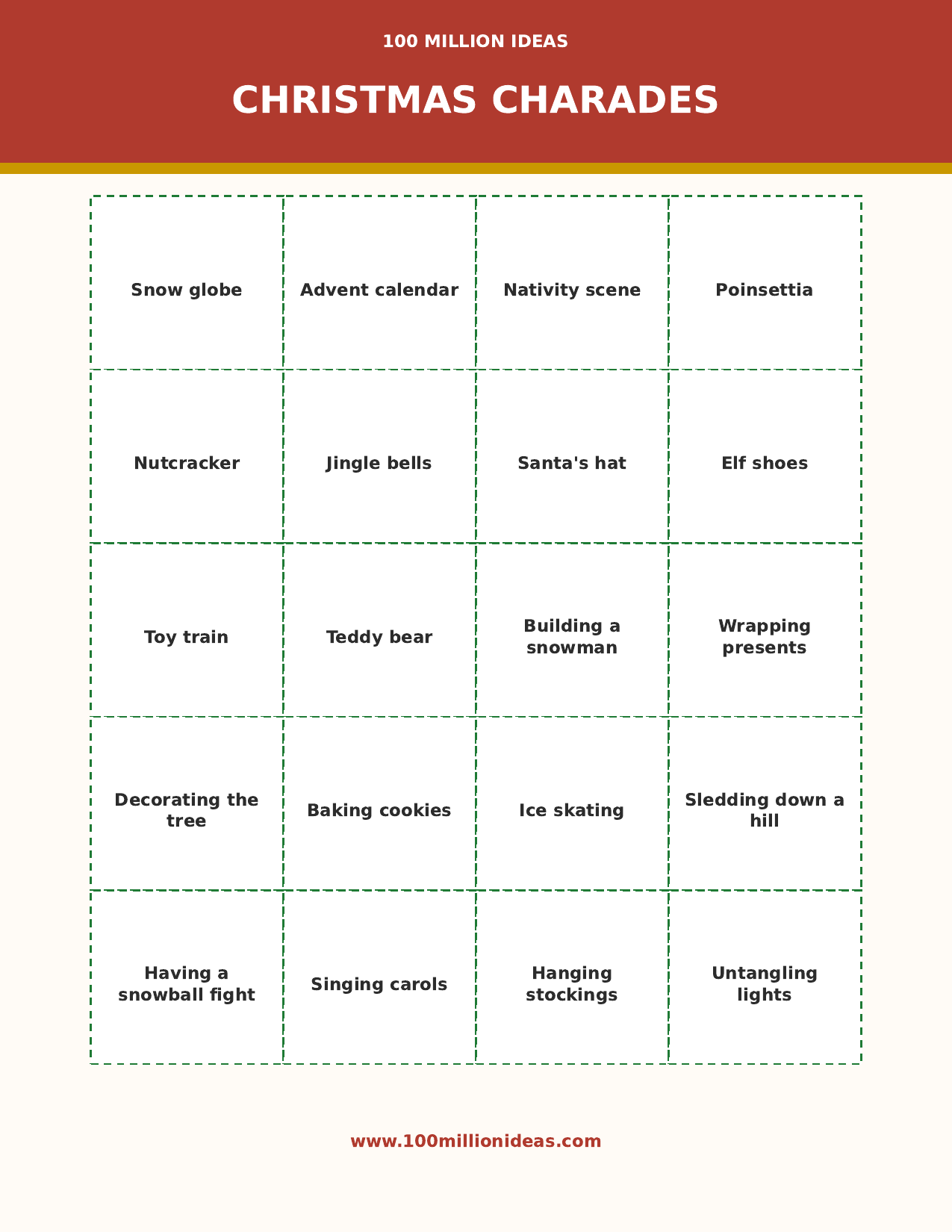
The game is played with a set of one hundred word cards. The cards are printed, cut out, folded, and dropped into a bowl. Players split into two teams. One player draws a card and acts out the word or phrase without speaking — no sounds, no pointing at objects, and no spelling words in the air. Their team has sixty seconds to guess. One point is given for each correct guess. Then it is the other team’s turn. Play continues until the bowl is empty, and the team with the most points wins.
The sixty-second limit is important, and it is worth enforcing with a visible timer. Without a timer, a difficult word can eat up five minutes while the actor grows more desperate and the team grows more frustrated. With a timer, a difficult word costs at most one minute, and the game keeps moving. Use a phone timer, a kitchen timer, or an hourglass — anything the whole room can see. When the timer ends, the card is set aside, the next player steps up, and the game moves on. Nobody remembers the word that was not guessed; everyone remembers the game that kept moving.
The one hundred words cover the full range of Christmas: objects like a Christmas tree, a stocking, a wreath, a sleigh, and Christmas lights; winter activities like a snowball fight, shovelling snow, and making a snowman; festive figures like a snowman and a reindeer; and carol titles, including Let It Snow and familiar favourites about Rudolph and the Christmas season, which are among the hardest cards because acting out a song title without singing is a genuine challenge. That mix is what keeps the game interesting across a whole evening — the easy words build confidence, and the hard ones create the moments people talk about afterwards.
What You Need and How to Set Up
You need the printed cards, a bowl or a hat to draw them from, a timer, and a way to keep score — a piece of paper on the wall works, and so does a whiteboard. Print the cards and cut them out along the dashed lines, then fold each one and drop it into the bowl. The printable’s own advice is worth following here: print on thick paper or card stock so the words do not show through. A folded card printed on thin paper is readable from the outside, and a player who can read the next card through the paper has an unfair advantage. This Neenah Bright White Cardstock, 8.5 x 11 inches, 65 lb, 75 sheets is a good weight for game cards: thick enough that nothing shows through, sturdy enough to survive being folded and handled all evening, and it prints cleanly on most home printers.
Set aside thirty to forty-five minutes for a full game with all one hundred cards, or twenty minutes if you plan to use only half the bowl. For a party with other games planned, use about fifty cards and save the rest for another night — the game still feels complete, and the unused cards stay fresh. Split the room into two teams before you start, and try to balance them: mix ages, mix the confident performers with the quieter ones, and avoid putting all the children on one team. If you have an odd number of players, the extra player can be the timekeeper and scorekeeper, which is a real job and not a consolation prize — the timekeeper controls the pace of the whole game.
Choose a performance area — a clear space at one end of the room, with the team seated facing the actor — and make sure everyone can see. Move any fragile decorations out of the way before you start, because an enthusiastic actor miming a snowball fight will knock over a vase. Put the bowl on a table beside the performance area, and put the timer where both teams can see it.

How to Play, Step by Step
Start with a demonstration round. Ask a confident volunteer to act out the first card while everyone watches, and let the room see how it works before the scoring starts. The demonstration takes one minute and it matters, because it shows the shy players that acting badly is not only allowed, it is the point. Pick an easy card for the demonstration — a snowman is ideal, because everyone knows how to mime a snowman, and the room will guess it in seconds.
Then begin properly. The first actor draws a card from the bowl, shows it to nobody, and steps into the performance area. The timekeeper starts the sixty-second timer. The actor mimes the word, and their team shouts guesses. The actor may nod or shake their head, may point to parts of their own body, and may use as many gestures as they like — but they may not speak, make sounds, point at objects in the room, or spell words in the air. If the team guesses correctly, the actor draws another card and keeps going until the time runs out; each correct guess is one point. If the team cannot guess a card, the actor may pass and draw a new one, but the passed card goes back into the bowl for later, so nobody can dodge the hard words forever.
When the timer ends, the actor sits down, the scorekeeper records the points, and it is the other team’s turn. Play alternates until the bowl is empty, and the team with the most points wins. Keep the score visible throughout — write it on a piece of paper on the wall, or on a whiteboard — because a visible score changes how people play. A team that is two points behind in the final round plays very differently from a team that thinks the score is close.
The Rules, Spelled Out
The rules of charades are simple, but they are worth stating clearly before you start, because most arguments at a party come from rules that were never agreed. The actor may not speak, and that includes mouthing words, whispering, or making sound effects — a “ho ho ho” is speaking, even if it is festive. The actor may not point at objects in the room, because pointing at the Christmas tree to indicate “Christmas tree” is not acting, it is pointing. The actor may not spell words in the air or write letters with a finger, because that turns the game into a spelling test.
What the actor may do is use gestures, mime, facial expressions, and body language. They may act out the number of words by holding up fingers — one finger for a one-word answer, two for a two-word phrase — and they may indicate a small word by pinching thumb and finger together, which is a traditional charades signal worth teaching the room before you start. They may break a phrase into parts and act out each part separately, which is the key skill for the carol titles. And they may nod, shake their head, and wave their team on when a guess is close.
If a team guesses the wrong word but the actor accidentally nods, the point does not count — the actor’s job is to stay neutral until the exact word is said. If a player from the other team shouts out the answer, it does not count for anyone, and the card goes back into the bowl. These are small rules, but agreeing them in advance prevents the one argument that can sour an otherwise lovely game.
Who Can Play
Charades works from about age six upward, and it is one of the few games that genuinely suits a mixed-age room. Young children can play on a team with an adult, and they should be given the easier cards — objects like a snowman or a candy cane — rather than the carol titles. Let a child act alongside an adult for their first turn, so they learn the rhythm of the game without the pressure of performing alone. Children who are shy about acting can be the team’s best guessers instead, which is just as valuable.
Teenagers enjoy charades more than they expect to, especially in teams, because it rewards quick thinking and dramatic flair. Adults enjoy it because the Christmas words are familiar and the sixty-second timer creates real urgency. And because the game needs no knowledge beyond everyday Christmas things, nobody is ever stuck with a word they have never heard of, which is the problem with most other party games.
It works with as few as four players — two per team — and as many as you can fit in a room. With a very large group, split into three or four teams and rotate, so no team waits too long between turns. For a classroom or youth group, teams of six to eight work well, with the actor rotating so everyone gets a turn in the spotlight.
Variations to Keep It Fresh
The kids-only version is the simplest variation: set aside the harder cards — the carol titles and the longer phrases — and play with the easy objects and actions only. Children aged six to nine will have a wonderful time with just the simple words, and the game moves faster, which suits shorter attention spans. You can tell which cards are the easy ones by looking at them; the objects and actions are obvious, and the song titles are the ones that need a second thought.
The tournament version works for a competitive group: play in rounds, with the losing team from each round dropping out, until two teams remain for a final. This suits a party with several families, or a work party where teams have formed naturally. Keep the rounds short — ten cards per round — so the tournament does not drag on.
Reverse charades is a lovely twist for a second game: the whole team acts out the word together while one player guesses. It is chaotic, it is hilarious, and it is much harder than it sounds, because five people miming a snowman at the same time is a sight to behold. Try it after the normal game has warmed everyone up, and keep it to ten cards so it stays a treat rather than a marathon.
For a quieter group, try the silent-points version: the actor may not use the traditional signals like holding up fingers for word counts, and must convey everything through pure mime. It is harder, slower, and more thoughtful, and it suits a smaller group of adults who enjoy a challenge. Do not try it with children — they will find it frustrating rather than fun.
Hosting Tips That Actually Help
Do the demonstration round, even if everyone says they know how to play. It sets the tone, it shows the shy players that bad acting is welcome, and it gives you a chance to explain the signals — holding up fingers for word counts, pinching fingers for a small word — before the scoring starts. A one-minute demonstration saves you from five minutes of explaining later.
Keep the pace brisk. Sixty seconds per turn, no exceptions, and move straight to the next actor when the timer ends. If a team is struggling with a card, let them pass and move on — the passed card goes back into the bowl, and the game continues. A game that moves quickly is a game people enjoy; a game that stalls on one difficult word is a game people stop watching.
Rotate the actors so everyone gets a turn, and do not let the confident performers take every turn. If someone is reluctant, let them act with a partner for their first turn, or let them be the timekeeper for a round and then step in when they are ready. The best charades evenings are the ones where the quietest person in the room ends up giving the funniest performance, and that only happens if the host makes space for them.
Finally, keep the cards after the game. If you printed on card stock, they will last for years, and you can reuse them next Christmas with a different group. Put them in an envelope with the date on it, and store them with your other Christmas games — future you will be glad you did.
Frequently Asked Questions
How long does a game of Christmas charades take? Thirty to forty-five minutes for all one hundred cards, or about twenty minutes if you use half the bowl. Each turn lasts sixty seconds, and with two teams alternating, a full game moves at a good pace.
What ages can play? From about age six upward. Younger children can play on a team with an adult, and they should get the easier cards — objects and actions rather than carol titles. There is no upper age limit.
What are the rules for the actor? No speaking, no sounds, no pointing at objects in the room, and no spelling words in the air. Gestures, mime, and facial expressions are all allowed, and the actor may hold up fingers to show how many words are in the answer.
Can we play with more than two teams? Yes. With a large group, split into three or four teams and rotate turns. Keep the rounds short so no team waits too long between turns.
What happens if a team cannot guess a card? The actor may pass and draw a new card. The passed card goes back into the bowl, so it will come up again later for the other team.
Can we reuse the cards next year? Yes, especially if you print on card stock. Store them in an envelope with your other Christmas games, and they will be ready to play again next year — or with a different group, where the words will feel completely fresh.
Get the Printable Game
Get the printable game in our shop: Christmas Charades — $3 (regular $5) — a 6-page printable with 100 Christmas charades words on cards to cut out and fold, plus how-to-play instructions. Print on card stock, cut, fold, drop them in a bowl, and you are ready to play.
Want a whole evening of games? The Christmas Games Bundle — $17 (regular $21) includes this charades game along with more than twenty other printable Christmas games, from bingo and trivia to scavenger hunts and the carol unscramble, so you can run a full party games night from a single download.


