Christmas Color by Number

This post may contain affiliate links. As an Amazon Associate I earn from qualifying purchases.
Color by number is the activity that turns a child who says “I can’t draw” into a child who has just made a beautiful Christmas tree. It works because it removes the hardest part of colouring — deciding what colour goes where — and replaces it with a simple, satisfying rule: find the number, match it to the colour key, and fill in that section. The picture appears piece by piece, and the moment a child realises what they have made is genuinely delightful.
This set gives you six Christmas pictures to colour by number: a tree, a snowman, a star, a stocking, a wreath, and a gift box. Each one has its own colour key at the bottom of the page, with four or five colours at most, so the game stays simple enough for a young child and satisfying enough for an older one. It is colouring with a puzzle built in, and children who would not sit still for a plain colouring page will happily work through all six.

What’s Inside the Printable
The download is six pages, one picture per page, and each page carries its own colour key.
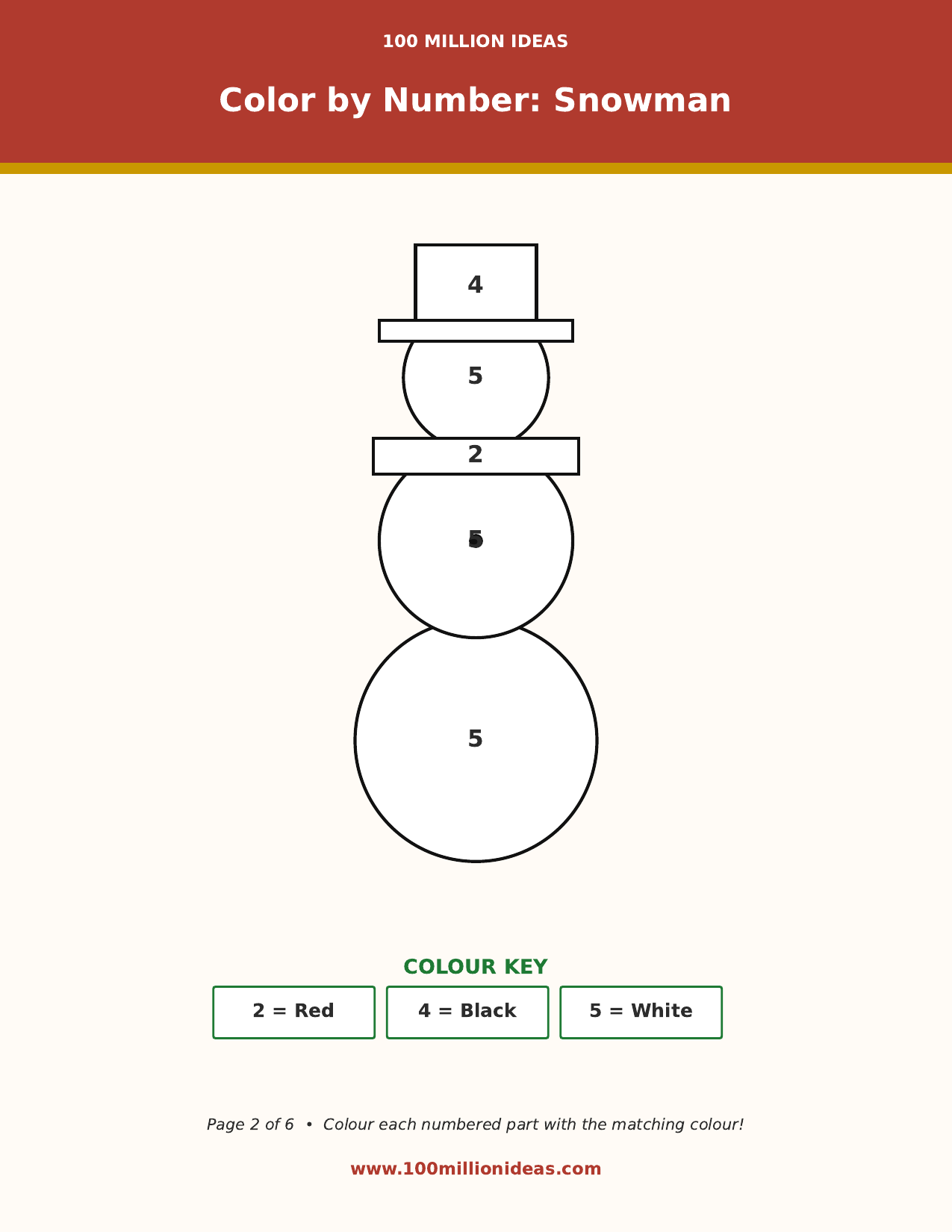
Page 1 is the Christmas tree, with a key of 1 = Green, 2 = Red, 3 = Gold, and 4 = Brown — the tree itself in green, ornaments in red and gold, and the trunk in brown. Page 2 is the snowman, with 2 = Red, 4 = Black, and 5 = White: a red scarf, a black hat, and a white body. Page 3 is the star, with 1 = Gold, 2 = Red, and 3 = Yellow. Page 4 is the stocking, with 1 = Red, 2 = Green, and 5 = White. Page 5 is the wreath, with 1 = Green and 2 = Red. Page 6 is the gift box, with 1 = Gold, 2 = Red, and 3 = Green.
Notice how small the colour keys are — two to four colours per picture. That is the point. A colour-by-number page with twelve colours is a chore; a page with three or four colours is a game. A child can hold the whole key in their head after the first minute, and the challenge becomes finding the numbers, not remembering the colours.
How to Play
Give each child a printed page and a set of crayons, coloured pencils, or markers that includes the colours in the key. Before they start, read the colour key together and lay out the matching colours in a row. It takes thirty seconds, and it prevents the most common frustration: a child halfway through the tree who realises they have been using the wrong green.
Then the rule is simple. Find a numbered section, check the key to see which colour that number means, and colour that section in that colour. Work through the numbers one at a time — all the 1s first, then all the 2s, then the 3s — or work across the picture section by section. Either method works, and children quickly develop a preference. Finishing all of one number before moving on is usually faster and more satisfying, because the picture changes dramatically with each colour completed.
For younger children, point at the key and say the colour out loud for the first few sections: “Number 1 means green. Where is a number 1?” After three or four sections, they will be doing it on their own. For older children, the challenge is accuracy — finding every tiny numbered section and making sure none is missed. A finished picture with one white section left uncoloured is a good lesson in checking your work.
What You Need
You need a printer, plain white paper, and colouring tools in the right colours. The keys use a small palette — green, red, gold, brown, black, white, and yellow — so almost any basic set will cover it. The one colour worth checking for is gold: not every crayon box has a gold crayon, and the star and the gift box both use it. If your set has no gold, yellow is a perfectly good substitute, and it is worth telling the child that before they start, so they do not get stuck hunting for a crayon that is not there.
For tools, crayons are the friendliest choice for younger children — a 24-count box of Crayola crayons includes gold, brown, and every other colour in the keys. Coloured pencils give older children finer control for the small numbered sections, and a 12-count set of pre-sharpened Crayola coloured pencils covers the palette nicely. Washable markers give the brightest finish and make the star and the gift box shine — a 10-count pack of Crayola Ultra-Clean washable markers is a good choice, especially if the colouring happens on a table you care about. Whichever you choose, print on slightly heavier paper if you are using markers, so the ink does not bleed through to the next page.
Who This Is For
Color by number is aimed at children aged about four to nine, and it fills a gap that plain colouring pages sometimes leave. A four-year-old who is still learning numbers gets to practise recognising 1, 2, 3, 4, and 5 in a way that feels like play. A six-year-old who is confident with numbers gets the satisfaction of following instructions and watching a picture appear. An eight- or nine-year-old who thinks colouring is “for little kids” will still enjoy color by number, because it feels like a puzzle rather than a colouring page.
It is especially good for children who are less confident with art. A blank page can be intimidating — where do you start, what colours do you choose, what if it looks wrong? A color-by-number page removes all of that. The decisions are made, the picture is guaranteed to look good, and the child gets to take the credit. For a child who has ever said “I can’t draw”, that is a meaningful experience.
It also works well for children who need to practise focus. Following a colour key for ten minutes is a genuine concentration exercise, and it is one that children will do willingly because the reward — a finished, recognisable picture — is visible the whole time.
When to Use It
Color by number is a wonderful calm activity for the busy days of December. Use it on a rainy afternoon, in the car on a long journey, in the kitchen while the Christmas baking is in the oven, or on Christmas Eve when children are too excited to sit still but need something to hold their attention. A single page takes about ten to fifteen minutes, so the whole set fills an hour — a very useful hour, in the week before Christmas.
It is also a natural classroom activity. A teacher can print a class set, hand out the pages, and have a quiet, focused twenty minutes with no preparation and no marking. Because each page has its own key, there is nothing to explain beyond “match the number to the colour”. And because every child is making the same picture, the finished pages make a beautiful classroom display — six different pictures, thirty different colourings, all recognisably Christmas.
For a party, color by number works as a calm station. Set up a table with the printed pages and the crayons, and let children drift over between the louder games. It is the activity that gives overexcited children a way to slow down without being told to slow down.
Tips for a Better Result
Print the pages at full size, one picture per page. The numbered sections are small, and shrinking the page makes them hard to read and hard to colour neatly. If a child is struggling to read the numbers, it is not the child — it is the print size.
Before starting, lay out the colours from the key in a row on the table. It sounds trivial, but hunting through a box of twenty-four crayons for the one gold crayon, six times per picture, is what turns a relaxing activity into a frustrating one. With the colours laid out, the child can focus on finding numbers instead of finding crayons.
Encourage children to colour lightly at first. A light layer can be darkened; a heavy layer cannot be lightened. This matters most on the tree, where the green sections are large and a child who presses hard from the start can end up with a tree that looks muddy. Light, even strokes give the prettiest result.
For the small sections, coloured pencils beat crayons. The tip of a pencil can reach into a tiny numbered space that a crayon cannot, and older children will notice the difference. If you have both, offer the child a choice and let them decide which tool suits which picture.
When the picture is finished, hold it up and look at it from arm’s length. That is the moment the picture really appears — the separate coloured sections join up into a tree, a snowman, a star. Let the child have that moment. It is the whole point of the activity.
Variations to Try
Once the six pages have been coloured by the key, they can be played with again. Try a free-colour round: print the same picture a second time and let the child colour it any way they like, ignoring the numbers entirely. The comparison between the two versions — the “correct” one and the creative one — is a lovely conversation starter, and the creative one is often the prettier of the two.
Try a speed round with older children: two players, the same picture, and the first to finish correctly wins. Accuracy still matters — a missed section means going back — so the race rewards care as well as speed.
Try a memory round: cover the colour key with a strip of paper after the first minute, and see if the child can remember which number means which colour. It is harder than it sounds, and it turns a simple activity into a genuine memory game.
For a group, try a relay. One child colours all the 1s, passes the page on, the next child colours all the 2s, and so on. The finished picture belongs to the whole group, and it is a surprisingly good team activity.

Frequently Asked Questions
How long does one page take? About ten to fifteen minutes for a child working carefully. Younger children finish faster, usually in under ten minutes, and older children who take their time can spend twenty minutes on the tree. The full set of six pages fills a comfortable hour.
What ages is color by number suitable for? About four to nine. Four- and five-year-olds need the key read to them and may need help finding the numbers. Six- to nine-year-olds can play independently and will enjoy the puzzle element.
What if we do not have a gold crayon? Use yellow. It looks just as good on the star and the gift box, and the child will not know the difference. The same applies to any missing colour — a close substitute is always fine.
Can I print the pages more than once? Yes — reprint as often as you like for your own family, classroom, or party. A fresh copy each time means every child starts with a clean picture and a clean key.
Is color by number good for learning? Yes, in a quiet, practical way. It practises number recognition, matching, following instructions, and fine motor control — and it does all of that inside an activity children choose to do, which is the best kind of learning there is.
Get the Printable in Our Shop
Get the printable pages in our shop: Christmas Color by Number — $3 (regular $5)
All six pictures are available as an instant download in our shop for $3 (regular $5). Print as many copies as you need for your family, classroom, or party. And if you are gathering quiet Christmas activities for the kids, the Kid Activities Bundle — $11 includes this color-by-number set along with our other printable activity packs — one download, and the calm activities are covered for the whole festive season.
You may like to read!
- DIY Christmas Decoration Ideas at Home
- Ultimate Christmas Kids Bucket List
- Best Paper Christmas Decorations
- Fun Healthy Holiday Snacks
- Christmas Family Bucket List Ideas
Images:
- Cover: ~/workspace/100millionideas-shop/covers/christmas-color-by-number-pages.png
- Body images: rendered pages of ~/workspace/100millionideas-shop/files/christmas-color-by-number-pages.pdf — page 1 (Christmas tree), page 2 (snowman), page 4 (stocking), page 6 (gift box); other pages as needed.