Reindeer Games

This post may contain affiliate links. As an Amazon Associate I earn from qualifying purchases.
Every December, the same thing happens in our house: the children are bouncing off the walls by mid-afternoon on Christmas Eve, the adults are trying to finish cooking, and somebody says, “Can we do something fun?” That is exactly the moment reindeer games were made for. A reindeer hunt turns an ordinary house into a treasure map. Twenty reindeer cards hide in twenty ordinary places — behind the curtains, inside the cookie jar, under the couch cushions — and suddenly the hallway your kids walk down every day becomes the most exciting place in the world.
The version we love best is a proper scavenger hunt with rhyming clue cards, one for each reindeer. It works because it is built for real houses and real children. The clues point to places every home has, the hunt takes about twenty minutes from start to finish, and the setup takes less time than wrapping a single present. You can run it for two children on a quiet afternoon or for a whole classroom of sugar-fuelled seven-year-olds, and the only thing that changes is how loudly everyone shouts when they find Rudolph.

Reindeer Games at a Glance
- Players: 2 to 20 hunters (best with 4 to 12)
- Ages: 4 and up — pre-readers can hunt with a partner who reads the clues
- Time needed: 15 minutes to hide the cards, 20 to 30 minutes to hunt
- What you need: the printed reindeer cards, scissors, a small prize for the winner, and optionally a candy cane for each hiding spot
What You Need and How to Set Up
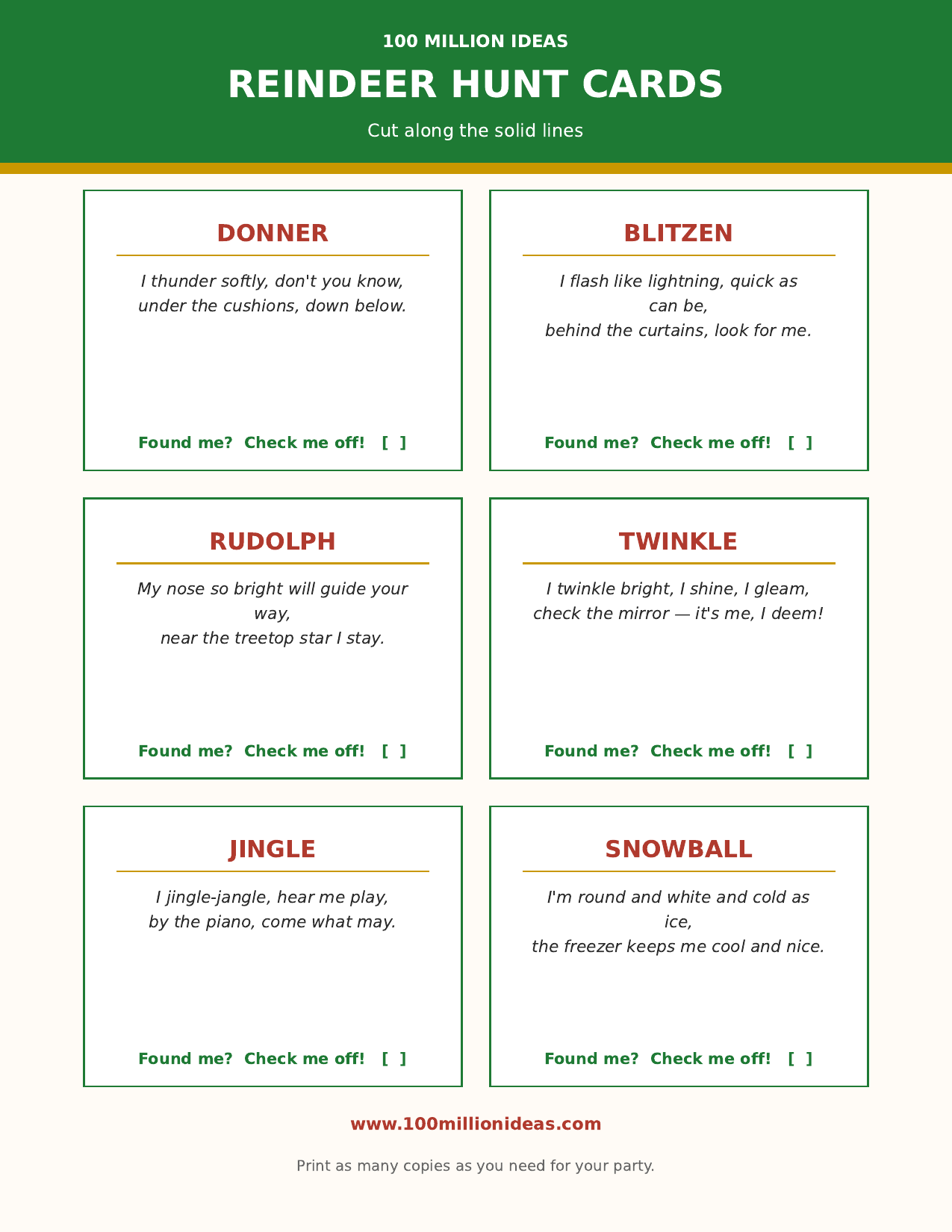
The heart of the game is a set of twenty reindeer cards. Each card names one reindeer and gives a rhyming clue about where it is hiding. Dasher loves the smell of cookies cooling, so he hides where the cookies cool. Dancer twirls beneath the tree. Prancer waits by the front door wreath. Vixen curls up inside a stocking, Comet zooms up onto the bookshelf, and Cupid hides where the sweet things live — inside the cookie jar. The full set covers the whole house: Donner under the couch cushions, Blitzen behind the curtains, Rudolph on the tree near the star, Twinkle in the bathroom mirror, Jingle by the piano keys, Snowball in the freezer, Cocoa beside the kettle, Frosty in the bathtub, Holly on the dining table, Mistletoe above a doorway, Sugarplum in the pantry, Tinsel around the stair rail, Glider on the windowsill, and Starlight by the nightstand lamp.
Print the cards and cut them out along the solid lines. Each card has a little checkbox — “Found me? Check me off!” — so hunters can tick off each reindeer as they find it. Give every hunter a checklist, or give one checklist per team if you are playing in pairs. Then, and this part matters, hide the cards yourself while the hunters wait in another room. The answer key that comes with the game tells you exactly where each reindeer belongs, so you do not have to memorize anything or improvise hiding spots on the fly. Hide each card at its spot, making sure a corner of the card peeks out just enough to be findable. A card buried completely inside a closed drawer is not a hiding spot, it is a lost card.
One tip from the printable itself is worth following: hide a candy cane with each reindeer card, so hunters keep the candy they find. A bulk bag of individually wrapped mini candy canes is the easiest way to do this — mini candy canes, 100-pack gives you enough for all twenty spots with plenty left over for the cocoa afterwards. Check for allergies before you hide food around the house, and skip the candy entirely for very young children or for hunts in classrooms with food rules.

How to Play the Reindeer Hunt
Step 1: Gather the hunters and explain the rules. Everyone gets a checklist. Explain that the reindeer are hidden all over the house, each card has a clue, and the first hunter to find all twenty wins. Set two ground rules before anyone moves: no running indoors, and no opening closed cupboards or drawers that are not part of the game. The answer key spots are all in open, ordinary places, so there is no need for anyone to go digging through your bedroom drawers.
Step 2: Send them off. Say “go” and step back. The first minute is always chaos — children scattering in every direction, shouting reindeer names — and then something lovely happens. They slow down, they start reading the clues on the cards they have already found, and they start thinking. A child who finds Comet on the bookshelf will read the next card, think about where sweet things live, and head for the kitchen. The rhymes are doing quiet teaching work while everyone thinks they are just playing.
Step 3: Check off each find. When a hunter finds a reindeer, they tick it off their checklist and carry the card with them, or leave it in place and just tick the box — decide this before you start, because nothing causes an argument faster than two children both claiming they found the same reindeer first. Our rule is simple: the card stays where it is, you tick your list, and you move on. That way every child can find every reindeer, and the race is about speed, not about grabbing.
Step 4: Declare a winner and celebrate everyone. The first hunter to tick off all twenty reindeer wins a prize. Keep the prize small and sweet — a chocolate reindeer, a small toy, or the honor of handing out the candy canes. Then let everyone else finish their hunt at their own pace, because the child who found nineteen reindeer deserves to find the twentieth. When the hunt is over, gather everyone and read through the full list together. Children love hearing where the ones they missed were hiding, and the groans when someone realizes Frosty was in the bathtub all along are half the fun.
Step 5: Pack up in two minutes. Because each card is ticked off on a checklist, you will know immediately if a card is missing. Walk the answer key backwards — tree, curtains, freezer, pantry — and collect them all. The cards are sturdy enough to reuse next year if you print them on card stock, which is worth doing if this becomes a tradition.
Tips That Make the Hunt Better
Hide for the age of your hunters. For children under six, hide every card in an easy, open spot — on top of the table, not behind it — and hunt together as a group rather than racing. Point at the room and let them search together. For children over eight, tuck the cards a little deeper: behind the curtain fold rather than in front of it, inside the stocking rather than hanging on it. The same twenty cards can serve both ages; only the hiding depth changes.
Use the answer key as your hiding map. Do not try to be clever and invent your own hiding spots. The clues on the cards match the answer key exactly, and if you hide Dasher somewhere other than where the cookies cool, the child reading the clue will search the wrong place and feel cheated. Trust the key. It was designed so that every clue is solvable by a child who reads it carefully.
Play in teams for mixed ages. Pair a younger child with an older one, or a child with a grandparent. Teams solve the age problem completely: the older partner reads the clues, the younger partner does the spotting, and both feel like they contributed. Give each team one shared checklist and one shared prize.
Keep the noise in check. Twenty excited children in a small house gets loud fast. If you are playing at school or in an apartment, make the hunt a quiet one: whispering only, and anyone caught shouting has to freeze for ten seconds. Children treat it as part of the game rather than a rule, and your neighbors will thank you.
Do not hide cards near anything breakable. Skip the shelf with the good vases, skip the top of the piano if your piano has ornaments on it, and keep Snowball out of the freezer if your freezer is a precarious tower of frozen food. A quick walk through the house before hiding takes two minutes and saves a broken ornament.
Variations to Try
Timed team hunt. Split into two teams, give each team the same checklist, and set a fifteen-minute timer. The team with the most reindeer found when the timer rings wins. This is the best version for a classroom or a youth group, because it keeps the energy high and the finish line clear.
Photo hunt. For older children and teenagers, who might find a simple hunt too easy, add a twist: each time you find a reindeer, you must take a photo of it in its hiding spot before ticking it off. The photos make a wonderful slideshow afterwards, and teenagers who would never admit to enjoying a scavenger hunt will absolutely compete over who took the funniest photo.
Outdoor reindeer games. If you have a garden and the weather is kind, hide the cards outside instead — under a flowerpot, behind the fence, in the branches of a bush. Just remember to bring them in before the rain does, and do not hide any card somewhere a child could climb dangerously to reach it.
Reindeer relay. For a party with lots of children, turn the hunt into a relay: one hunter from each team runs to find one reindeer, tags the next teammate, and so on until all twenty are found. The relay version keeps everyone involved even in a big group, because nobody sits on the sidelines waiting.
Christmas Eve tradition. Hide the reindeer on Christmas Eve afternoon, when the waiting for Santa feels endless. The hunt burns off the afternoon excitement, and by the time the last reindeer is found, it is time for cocoa and an early night. If you do it every year, children will start asking about it in November.
Get the Printable Reindeer Hunt Game
The full game — all twenty rhyming reindeer cards, the hunter checklists, and the parents-only answer key — is ready to print in our shop. The Reindeer Hunt Game is $3 on sale (regular $5), a six-page printable you can print as many times as you need for your party. Page one explains the game, pages two through five hold the twenty reindeer cards, and page six is the answer key with every hiding spot listed.
If you want a whole shelf of Christmas games for the price of a few, the Christmas Games Bundle is $17 (regular $21) and includes twenty-four games in one download. Buy it once, print games all season, and you will never be the host who runs out of things to do before dessert.
Frequently Asked Questions
What ages is the reindeer hunt best for? Ages four to ten are the sweet spot. Four- and five-year-olds hunt happily with an adult partner; seven- to ten-year-olds can race independently and solve the rhyming clues on their own. Older children enjoy the timed and photo variations.
How long does it take to set up? About fifteen minutes: print, cut out the twenty cards, and hide them using the answer key. The first year takes a little longer because you are learning the spots; the second year takes ten minutes.
Can I play the reindeer hunt at school or church? Yes, and it works very well there. Hide the cards around one classroom or hall rather than a whole building, keep the no-running rule, and play in teams so that every child participates. The candy cane version should be checked against school food policies first.
What if a card goes missing? Check the answer key and walk the hiding spots in order. Nine times out of ten the card has slipped behind something — behind the curtain, under the cushion — rather than actually disappearing. Print a spare set if you are playing with a large group, just in case.
Can I reuse the cards next year? Yes. Print them on card stock or laminate them, and store them in an envelope with the answer key. The cards do not have a year printed on them, so they work every December.