Reindeer Hunt

This post may contain affiliate links. As an Amazon Associate I earn from qualifying purchases.
Somewhere in the house, twenty reindeer are hiding. One is on top of the bookshelf, one is in the freezer, one is above a doorway, and one — the most important one — is on the Christmas tree, near the star. The children do not know any of that yet. All they know is that Santa’s reindeer have escaped, they each have a checklist, and the first hunter to find all twenty wins a prize. That is the whole premise of the Reindeer Hunt, and it is enough to keep a house full of children happily searching for a solid half hour on Christmas Eve, which is exactly when you need them happily searching.
It is a simple game, and its simplicity is the point. There is nothing to explain beyond “find the reindeer”, nothing to read, and no score to keep beyond checking boxes off a list. A four-year-old can play it. A ten-year-old can play it competitively. And because the hiding spots are spread all over the house, the game turns an ordinary home into a small adventure — children look behind curtains, under cushions, and inside stockings, and every find feels like a small victory.

How the Reindeer Hunt Works
The game comes with twenty reindeer cards to cut out and hide, plus a checklist for each hunter. The host hides the cards around the house according to the answer key, then hands each hunter a checklist. When a hunter finds a reindeer, they check it off their list. The first hunter to find all twenty wins a prize. For little kids, the cards are hidden in easy, open spots and the hunt is done together as a group; for older children, the hiding spots can be trickier and the race is real.
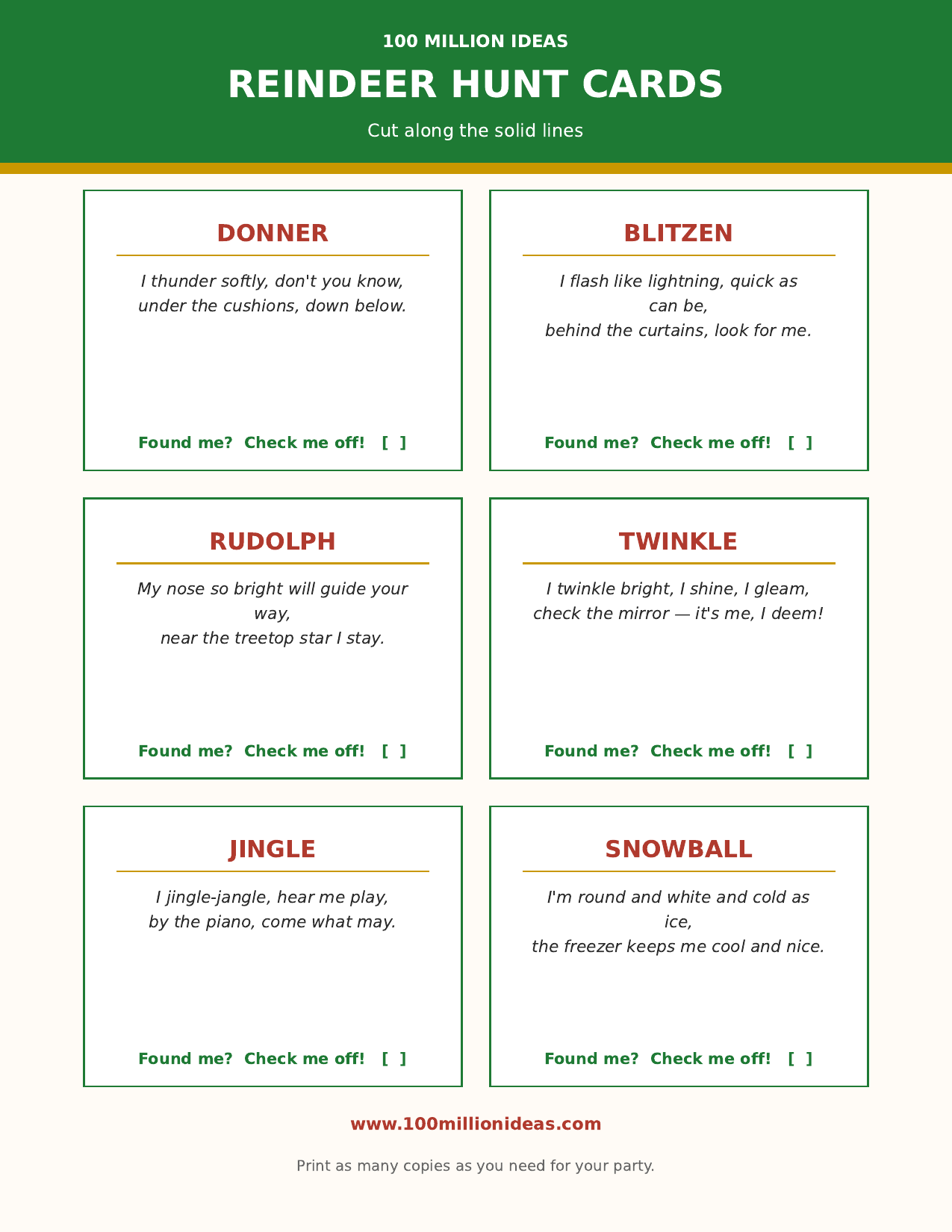
The twenty reindeer are the nine classic reindeer — Dasher, Dancer, Prancer, Vixen, Comet, Cupid, Donner, Blitzen, and Rudolph — plus eleven new friends with festive names: Twinkle, Jingle, Snowball, Cocoa, Frosty, Holly, Mistletoe, Sugarplum, Tinsel, Glider, and Starlight. Each card shows the reindeer’s name and a short rhyming clue about where it likes to hide, so the cards themselves are charming enough that children want to collect them all, not just check them off. Dasher’s card, for example, mentions the smell of cookies cooling, and the answer key places Dasher where the cookies cool. Dancer hides under the Christmas tree, Prancer by the front door wreath, Vixen inside a stocking, Comet on top of the bookshelf, Cupid inside the cookie jar, Donner under the couch cushions, Blitzen behind the curtains, and Rudolph on the tree, near the star — the spot every child checks first and somehow still misses.
The other eleven are hidden just as thoughtfully: Twinkle in the bathroom mirror, Jingle by the piano keys, Snowball in the freezer, Cocoa next to the kettle, Frosty in the bathtub, Holly on the dining table, Mistletoe above a doorway, Sugarplum in the pantry, Tinsel around the stair rail, Glider on the windowsill, and Starlight by the nightstand lamp. The spots are spread across the whole house, so hunters have to search everywhere, and each find teaches them a little about where the next one might be.
What You Need
You need the printed game, a pair of scissors, and a small prize for the winner. Print the reindeer cards and the checklists — one checklist per hunter, plus a few spares. Cut the twenty reindeer cards out along the solid lines. Printing on card stock makes the cards sturdier, which matters when they are being hidden behind curtains and under cushions and handled by excited small hands — this Neenah Bright White Cardstock, 8.5 x 11 inches, 65 lb, 75 sheets is a good weight for game cards and prints cleanly on most home printers. Regular paper works too, but card stock cards survive the hunt and can be used again next year.
The printable’s own tip is worth following: hide a candy cane with each reindeer card, so hunters keep the candy they find. Buy twenty small candy canes before the day, and place one beside each hidden card. It gives every find an immediate reward, it keeps younger children motivated through all twenty finds, and it means every hunter goes home with something even if they do not win the grand prize. If you would rather not use sweets, small stickers work the same way.
You also need a pen or pencil per hunter for the checklist. Pencils are better for younger children, since they will want to change a check mark at least once. Set aside twenty to thirty minutes for the hunt itself, plus about fifteen minutes beforehand for hiding the cards.
Setting Up: Hiding the Reindeer
Hiding the reindeer takes about fifteen minutes, and it should be done while the hunters are out of the room — children have a sixth sense for a parent hiding things. Work through the answer key in order, from Dasher to Starlight, and place each card at its spot. Tuck the card in so that part of it is visible — a corner peeking out from behind the curtain, an edge showing under the cushion — because a card that is completely hidden is not a game, it is a lost card. The rule of thumb is that a hunter standing in the middle of the room and looking carefully should be able to spot each card within a minute or two. For older children, tuck the cards in a little deeper; for little ones, leave them half out in the open.
Place a candy cane beside each card as you go, and tick each reindeer off on the answer key as you hide it, so you know you have hidden all twenty. Then do a quick walk-through of the house, room by room, checking that every card is where it should be and that nothing has fallen behind a piece of furniture. Keep the answer key on your person during the game, not on a table — a hunter who finds the answer key will finish in three minutes, and the game will be over before it began.
Choose a starting point, usually the living room, and gather the hunters there. Explain the rules, hand out the checklists and pencils, and remind everyone of the two rules that matter: do not move furniture, and do not open cupboards or drawers that are not part of the game. Then say go, and step back.

How to Play, Step by Step
Each hunter gets a checklist with all twenty reindeer names on it. When they find a reindeer card, they check that reindeer’s name off their list and, if there is a candy cane beside it, they keep it. They do not need to bring the card back to the host — the card stays where it is, so other hunters can find it too. That is an important detail: every hunter is looking for the same twenty cards, and finding one does not take it away from anyone else. The race is about who checks off all twenty first, not about who collects the most cards.
For little kids, hide the cards in easy, open spots and hunt together as a team, with an adult walking along and pointing them in the right direction. The printable suggests exactly this, and it works: a four-year-old who finds Rudolph on the tree by themselves will remember it all day, and an adult walking alongside can make sure they do not miss the ones tucked behind the curtains. For older children, run it as a race, with each hunter on their own and the first to complete the checklist winning the prize.
When a hunter thinks they have found all twenty, they bring their checklist to the host, who checks it against the answer key. If they have missed one, the host tells them which reindeer is missing — not where it is, just the name — and sends them back out to find it. That last missing reindeer is usually the one hidden in the most obvious place, which is why it was missed, and the groan when they realise where it was is one of the best moments of the game.
Playing With Different Ages
With children under five, hunt as a group and keep the cards in easy, visible spots. An adult should walk with them, read the reindeer names aloud as they are found, and help with the checklist. At this age, the game is about the joy of finding, not the competition, so let every child find a reindeer and celebrate each one. Give every child a small prize at the end, not just the winner.
With children aged five to nine, individual play works well, and the race feels real. This age group is fast, thorough, and deeply competitive about checklists, and they will search a room properly rather than glancing at it. Keep the hiding spots at the standard difficulty, and expect the hunt to take twenty to thirty minutes. A small prize for the first finisher and a small prize for the last finisher — for persistence — keeps the slower hunters happy.
With children aged ten and up, make it harder. Tuck the cards in deeper, add a time limit of fifteen minutes, and let the competitive ones race properly. Teenagers will enjoy it more than they expect, especially if there is a decent prize, and the game works well as a warm-up before a bigger party game, since it gets everyone moving and talking.
Variations to Try
The timed race is the simplest variation: fifteen minutes on the clock, and the hunter with the most reindeer checked off when the timer ends wins. This suits older children and larger groups, and it stops the game from dragging on while one hunter searches for the last reindeer. If two hunters tie on the number found, the one who finished first wins.
The team version works well for a big family gathering: split into two teams, give each team one checklist, and let the team search together. Teams are louder, faster, and funnier than solo hunters, because teammates argue about which room to search next and celebrate each find together. It also means younger children can be on a team with older siblings, so nobody is left searching alone.
For a second round, try the photo hunt: hunters must take a photo of each reindeer they find, rather than just checking it off. This works for older children with phones, and it gives you a set of photos of the house that are fun to look back on. Or try the outdoor version on a mild day, hiding the cards around the garden instead of the house — just make sure the cards are in a sheltered spot and the candy canes are not left out for long.
Tips for a Smooth Hunt
Count the cards before and after the game. Twenty cards go out, twenty cards come back — check the answer key at the end and collect any cards that were missed, because a reindeer left behind the curtains will be found in March, and it will be a surprise for everyone. Keep the cards after the game if you printed on card stock; they are reusable next year, and the hiding spots will feel fresh again after twelve months.
Match the hiding difficulty to the youngest hunter, not the oldest. A game that is too hard for the little ones ends with tears, while a game that is too easy for the older ones still ends with laughter, because the older ones will finish fast and then help the younger ones find the rest. If you have a wide age range, hide the cards at standard difficulty and let the older children help the younger ones after they finish — they usually enjoy being the expert.
Finally, have the prize ready and visible before the game starts. A prize sitting on the table where everyone can see it makes the last five minutes of the hunt genuinely exciting, and it gives the winner a moment to enjoy. A small wrapped gift, a Christmas book, or a treat bag all work. And if the hunt ends in a tie, split the prize or have a second small prize ready — a tie is a good ending, not a problem to solve.
Frequently Asked Questions
How long does the Reindeer Hunt take? About twenty to thirty minutes of play, plus fifteen minutes of setup for hiding the cards. Younger children hunting as a group may take a little longer; older children racing may finish in fifteen minutes.
What ages is it suitable for? It works from about age three or four upward when played as a group with an adult, and from about age six upward as an individual race. There is no upper age limit — teenagers and adults enjoy it as a warm-up game.
Do the hunters keep the reindeer cards? No — the cards stay where they are hidden, so every hunter can find the same twenty reindeer. Hunters keep the candy cane hidden beside each card, and they check the reindeer’s name off their checklist. Collect the cards at the end so you can reuse them.
What if a hunter cannot find the last reindeer? Tell them which reindeer is missing, by name, and send them back out. Do not tell them where it is. If they are still stuck after a few minutes, give them the room it is in. The last reindeer is almost always hiding in the most obvious place.
Can we play it outside? Yes, on a mild, dry day, by hiding the cards around the garden instead of the house. Keep the cards sheltered from wind and rain, and do not leave candy canes outside for long. The indoor version is the classic, though, and it works in any weather.
Can we reuse the game next year? Yes. If you print the cards on card stock and collect them all at the end, they will last for years. Change the hiding spots next year, and the game will feel new even for children who played it before.
Get the Printable Game
Get the printable game in our shop: Reindeer Hunt Game — $3 (regular $5) — a 6-page printable with 20 reindeer cards to cut out and hide, a hunter’s checklist, and a parents-only answer key. Print it, hide the reindeer, and hand out the checklists.
Playing a full season of games? The Christmas Games Bundle — $17 (regular $21) includes this reindeer hunt along with more than twenty other printable Christmas games, from bingo and trivia to scavenger hunts and charades, so you always have a game ready.


