Roll a Christmas Tree Dice Game

This post may contain affiliate links. As an Amazon Associate I earn from qualifying purchases.
Give a child a blank piece of paper, a pencil, and a die, and you have a game. Roll a Christmas Tree is a dice drawing game: each player draws a Christmas tree, and every roll of the die adds a new part to it. Roll a one and you draw the star. Roll a two and you add an ornament. Roll a three and you string the lights. The first player to finish their tree wins — and because the die decides what you draw next, the game is different every time you play it.
It takes about ten minutes, needs nothing you do not already have in the house, and works for children as young as four. It is the game to reach for on a rainy December afternoon, in the half hour before dinner when the children are restless, or at a party where you need something that keeps small hands busy and does not make a mess. There is no reading, no writing, and no losing in the way that matters — every player ends the game with a drawing of a Christmas tree, and every drawing looks different.

What You Need
One die per player is ideal, but one die shared between the players works just as well — it only makes the game a little slower, and it gives everyone a reason to watch each other’s rolls. If you do not have a die in the house, borrow one from a board game, or pick up an inexpensive set. A set of standard six-sided dice like this 10-pack of Koplow six-sided dice with multi-colour pips costs very little, gives every player their own die, and will be useful for board games and other dice games all year round.
Each player needs a sheet of paper and something to draw with. Pencils are the simplest, because a mistake can be rubbed out. Crayons are better for younger children, because they are easier to hold and the colours make the finished tree look festive. Coloured pencils are the best of both — precise enough for the details, colourful enough for the decorations. Give each player a few colours at least: green for the tree, yellow for the star, red for the ornaments, and whatever else they want for the lights and presents.
You also need a flat surface to play on — a table, a tray on the floor, or a clipboard on a lap. And that is everything. No printing, no cutting, no preparation. It is a game you can start two minutes after someone suggests it, which is exactly what you want when the suggestion comes from a bored six-year-old.
How to Play
Start by giving every player a sheet of paper and asking them to draw the outline of a Christmas tree. A simple triangle shape with a small rectangle for the trunk is all it needs to be. Younger children can draw a big triangle and be done with it. Older children might draw a tree with three layers, or a tree with branches. It does not matter what the outline looks like, as long as everyone starts with a tree shape and a trunk. The outline does not count as a part of the game — it is the canvas.
Then explain the rolls. Each number on the die adds one thing to the tree:
- Roll a 1 — the star. Draw a star at the top of your tree. Just one star, right at the very top, where the star goes.
- Roll a 2 — an ornament. Draw one ornament on your tree. A bauble, a circle, a shape — whatever you like, as long as it is one ornament.
- Roll a 3 — the lights. Draw a string of lights. A wavy line across the tree with little dots along it, or a row of small circles — however you like to draw lights.
- Roll a 4 — the garland. Draw a garland draped across your tree. A curved line with a few loops, or a line of little beads.
- Roll a 5 — a present. Draw one present under your tree. A square with a ribbon, or a rectangle with a bow. It goes under the tree, not on it.
- Roll a 6 — a candy cane. Draw a candy cane hanging on your tree, or leaning against the trunk. A curved stick with stripes, if you are feeling detailed, or a simple hook shape if you are not.
Each player needs to roll each number a certain number of times to finish their tree. The simplest version, and the one to start with, is: one star, three ornaments, two strings of lights, one garland, two presents, and one candy cane. That is ten rolls in total if every roll gives you something you still need — but of course it does not work like that, because the die does not know what you need. You will roll three ornaments in a row when you have already drawn all three, and you will wait five turns for the star. That is the game. The first player to complete all ten parts wins.
Play it as a race. Everyone rolls in turn, draws the part they rolled if they still need it, and if they roll something they have already finished, they draw nothing and pass the die on. It is that simple, and the simplicity is the point. A four-year-old can play it. A forty-year-old will still enjoy it, because the die is unfair in a way that makes everyone laugh.
Scoring and Winning
There is no score to keep. The first player to finish their tree wins, and the game ends there — or, if you want everyone to finish, let the other players keep rolling until their trees are done too, and celebrate each finished tree as it happens. With young children, letting everyone finish is usually better than stopping at the first winner, because a half-finished tree is a disappointment and a finished tree is a picture they can take home.
If you want to make it competitive for older players, add a rule: a player who rolls a number they no longer need loses their next turn. It is a small penalty, but it makes the end of the game tense, because the player who is one star away from winning can be stuck waiting for a one while everyone else catches up. Or play it as a timed game: ten minutes on the clock, and the player with the most parts drawn when the time runs out wins. That version works well when you have a large group and not everyone can finish in the time available.
The prize, if you want one, should be something small: the winner gets to put the star on the real tree, or picks the Christmas film for the evening, or gets the first candy cane from the tree. Or no prize at all — the finished drawing is the prize, and most children would rather take their tree home than win anything else.
Who This Game Is For
Roll a Christmas Tree is at its best with children aged four to ten, which is a wide range for a party game and one of the reasons it is so useful. A four-year-old can play it because the rules are nothing more than “roll the die and draw what it says.” A ten-year-old can play it because the race is genuinely exciting and the drawing is a chance to be creative. Put a four-year-old and a ten-year-old at the same table and they can both play the same game, at the same time, with the same rules, and both enjoy it. That is rare.
It works at a family Christmas, in a classroom, at a Sunday school party, in a playgroup, or as a quiet activity while the adults are cooking. It is especially good for the hour before Christmas dinner, when the children are excited and the adults are busy, because it keeps small hands occupied at a table without making a mess or needing supervision. A teacher can run it for a whole class with nothing but a box of dice and a stack of paper, and it fills a gap on the last day of term without any preparation.
It is also a kind game for children who struggle with competitive games, because every player is building something rather than taking something from someone else. There is no way to lose badly. The worst thing that can happen is that your tree takes a little longer to finish, and you still end up with a drawing you are proud of.
Tips for a Great Game
Draw the tree outline big. This is the most common mistake. A child draws a small tree in the middle of the page, and then there is no room for three ornaments and two strings of lights. Tell everyone to draw their tree as big as they can — filling most of the page, with room underneath for the presents. A big tree is easier to decorate, and it looks better when it is finished.
Let children draw the parts however they want. There is no right way to draw a string of lights or a candy cane. A child who draws lights as a row of dots has drawn lights. A child who draws a candy cane as a hook has drawn a candy cane. Do not correct the drawings, and do not compare them. The game is about rolling and drawing, not about art.
Keep the pace quick. Each player’s turn should take about ten seconds: roll, look at the die, draw the part, pass the die on. If a player takes too long over a drawing, gently remind them that they can add details later — the race is the game, and a slow turn makes everyone else wait. With young children, it helps to have an adult call out what each number means as it is rolled, at least for the first few turns, until everyone remembers.
Have spare paper ready. Someone will want to play again the moment the first game ends, and someone else will have made a mistake they want to start over from. A second game takes another ten minutes, and a child who plays it twice will have two different trees, because the die will not roll the same way twice.
Variations to Try
The big tree version. For older children, increase the numbers: two stars are not possible, so instead ask for five ornaments, three strings of lights, two garlands, three presents, and two candy canes. That is sixteen parts instead of ten, and the game takes about fifteen minutes. It is a better game for eight to ten-year-olds, who find the basic version too quick.
The team version. Split into teams of two, and give each team one sheet of paper and one die. The team takes turns rolling and drawing on the same tree, which means they have to agree on where each ornament goes. It is a good version for siblings, because it turns the game into something they make together.
The colour version. Use coloured dice, or assign a colour to each number: roll a one and you draw the star in yellow, roll a two and you draw an ornament in red, roll a three and you draw the lights in blue. It adds a layer of decision to the game, and the finished trees look more like real decorated trees.
The decoration version. When a player finishes their tree, let them add any extra decorations they like — snow on the branches, a pile of presents, a reindeer standing next to the tree. The game is over, but the drawing is not, and the extra time turns a game into a craft activity that can fill a whole afternoon.
The gift tag version. Play the game on small cards instead of full sheets of paper, and the finished trees become handmade gift tags. Punch a hole in the corner, thread a ribbon through it, and tie it to a present. A gift tag a child has drawn themselves, in a game they played, is worth more than any tag from a shop.

Frequently Asked Questions
What ages is this game suitable for? Children from about four up can play, because the rules are just “roll and draw.” Younger children may need an adult to tell them what each number means for the first few turns. There is no upper age limit — older children and adults enjoy it as a quick, light game.
How many people can play? Two is the minimum, and there is no real maximum. With more than six players, give each player their own die so nobody is waiting too long between turns. A classroom of thirty can play it at once, as long as there are enough dice and paper to go around.
How long does it take? About ten minutes for the basic version, fifteen for the big tree version. It is a short game, which makes it easy to fit into a gap — before dinner, while waiting for guests, or as a warm-up before a longer game.
What if a player keeps rolling numbers they do not need? That is the game, and it happens to everyone. If it happens too often and a player is getting frustrated, let them swap one finished part for a part they still need — or just let them draw a bonus ornament. The game is meant to be fun, and a small kindness keeps it that way.
Do I need a special die? No. Any standard six-sided die works. If you do not have one, borrow one from a board game. If you are buying dice for a classroom or a party, a bulk pack is inexpensive and useful for many games beyond this one.
Can I play it with adults? Yes, and it is funnier than you might expect, because adults take the drawing far more seriously than children do. Play the big tree version with a timer, and the competition is real.
Want a Dice Game for the Grown-Ups Too?
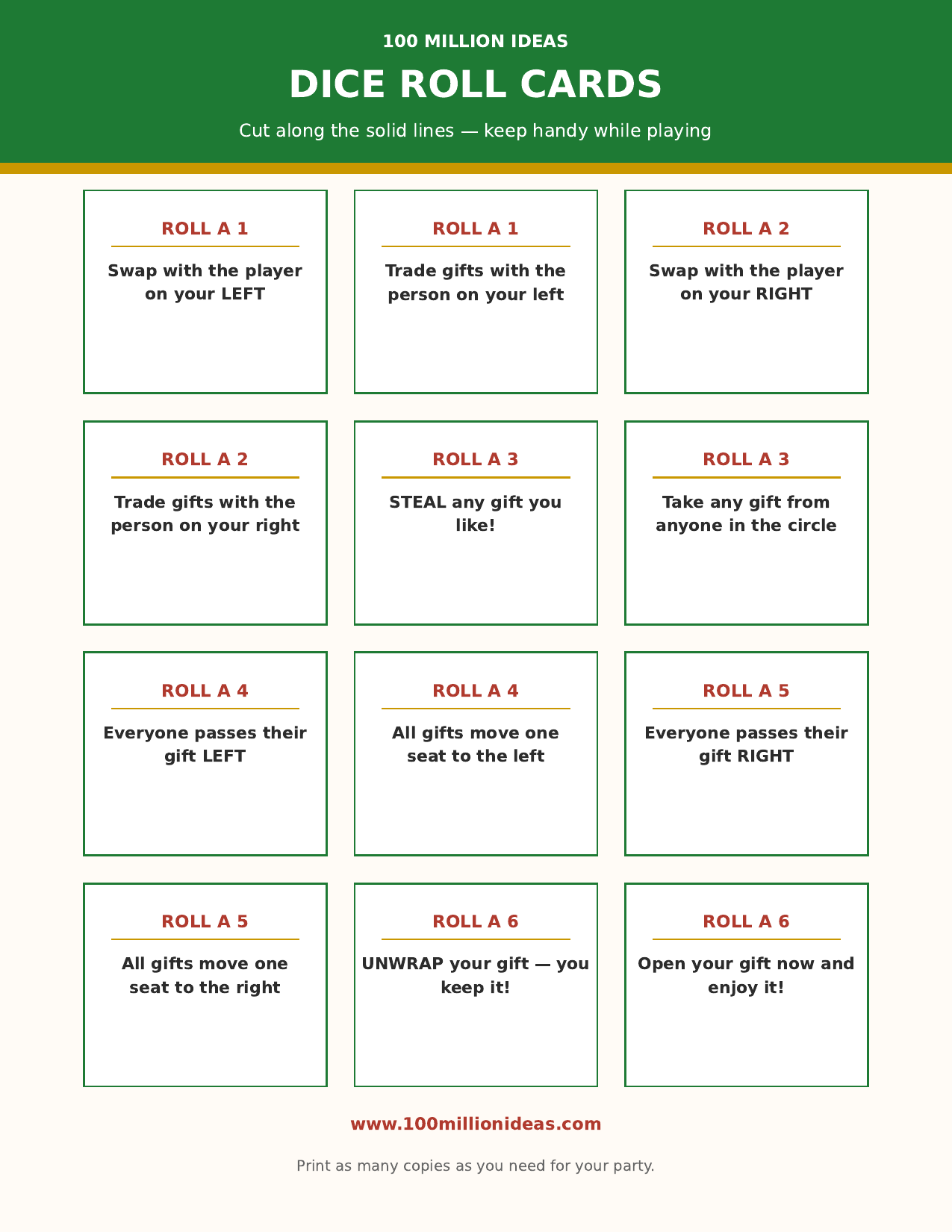
If the children have had their dice game and the adults want one of their own, our December Dice Game is a dice gift exchange for the whole family. Everyone brings a wrapped gift, sits in a circle, and rolls the die: roll a one and swap with the player on your left, roll a two and swap right, roll a three and steal any gift you like, roll a four and everyone passes left, roll a five and everyone passes right, and roll a six and you unwrap your gift — it is yours to keep. It comes with printable roll cards and gift tags, and it is $3 on sale (regularly $5) in our shop.
Get the December Dice Game — $3 (regularly $5)
And if you are planning a gift exchange evening, the Christmas Gift Exchange Games Bundle gathers the December Dice Game and ten more gift exchange games for $9 — everything you need to run a gift swap that people actually enjoy.
Get the Christmas Gift Exchange Games Bundle — $9


