The First Noel Game

There is a moment at every Christmas party when the food is half gone, the kids are getting restless, and someone says, “So… what now?” This is the game for that moment. The First Noel Game is a carol-guessing game built around the oldest Christmas story there is: the night the angels sang, the shepherds watched, and a star led the way. One person hums, sings, or plays the opening of a Christmas carol, and everyone else races to name it. No boards, no pieces, no setup — just voices, a room full of people, and songs most of them have known since childhood.
What makes it work is that it is not really a test. Nobody needs a good singing voice, and nobody needs to know every verse. The game is about recognition — that little spark when three notes in, you suddenly know exactly which song it is and your hand shoots up before anyone else’s. It works at a family dinner table, in a classroom on the last day before break, at a church social, or over a video call with relatives who could not travel. It takes about twenty minutes, it scales from four players to forty, and the only thing you need to bring is a list of carols.
What You Need
Almost nothing, which is half the charm. You need a group of people, a list of Christmas carols everyone is likely to know, and something to keep score with — a scrap of paper, the notes app on your phone, or just a running tally called out loud. A pencil helps if you want players to write answers down instead of shouting them, which is worth doing with bigger groups.
One person takes the role of the song leader for each round. The song leader is the one who hums or sings the opening of the carol. If the song leader is shy about singing, humming works just as well — in fact, humming is often funnier and harder, which makes the guessing more exciting. A phone or a small speaker helps if you would rather play a few seconds of a recording than sing, but it is entirely optional. The game was made to be played with nothing but voices, and it plays best that way.
Before you start, the song leader should quietly pick ten to fifteen carols and write them on a list nobody else can see. Choose songs your group actually knows. The old favourites are the safest picks: the carols people sang in school assemblies and church services, the ones that play in every shop from the first week of December. Mix in a couple of easy ones at the start so everyone gets a point early and relaxes, and save one or two trickier ones for the end. If half your group is under ten, keep the whole list to songs a child would know. If the group is all adults who love Christmas music, you can stretch a little further.

How to Play
Start by splitting into two teams if you have more than six players, or play as individuals if the group is small. Teams keep the game lively because people can confer in a whisper, and a quiet person who knows the answer can nudge their team without having to shout it in front of everyone.
The song leader picks the first carol from the list and gives the group a signal — a clap, or just “Here we go!” — then hums or sings the opening of the song. No words at first, just the tune. Give the players about ten seconds. The first team or player to call out the correct title wins a point for that song. If nobody gets it from the tune alone, the song leader sings the first line with the words, and the point is still up for grabs. If nobody gets it even then, the song leader reveals the answer, everyone groans or laughs, and you move on to the next song.
That is the whole game, and it genuinely is that simple. But a few details make it run smoothly rather than turning into a shouting match. First, decide before the first song how answers are given. With a small group, shouting out is fine. With a larger group, have each team write its answer on a slip of paper and hold it up, or have the team captain be the only person allowed to answer. Second, decide who judges. The song leader is the judge, and their call is final — if a team answers with the wrong title but the right tune, no point. Third, play in rounds of ten songs, then stop and total the scores, even if you plan to play another round. A natural break keeps the energy up and lets people top up their drinks.
Scoring and Winning
Keep it simple: one point for naming the carol correctly. A team or player who names it from the hummed tune alone gets one point, and a team that needs the sung first line also gets one point — there is no need for bonus points, because the real reward is the groan from the other team when someone gets it in three notes.
If you want a little more drama, add a bonus round at the end. For the final song, the song leader hums only the first three notes, and the first person to name it gets two points. It is a small twist, but it has decided more family games than any of us would like to admit, and it gives a team that is behind a genuine chance to catch up. When the last song is done, the team or player with the most points wins. The prize can be anything — first pick of the desserts, the honour of switching on the tree lights, or a small wrapped gift from under the tree.
The “First Noel” Round
The part that gives this game its name is a special round built around the story the carol tells. “The First Noel” is one of the oldest Christmas carols still sung today, and it tells the Christmas story in order: the angel appearing to the shepherds, the shepherds going to Bethlehem, the star shining over the stable, and the wise men following it. In the First Noel round, the song leader asks the group questions about that story, and each correct answer is worth a point.
You can ask things like which animals the shepherds were watching, who the angel appeared to first, what the star was shining over, or who followed the star to Bethlehem. These are questions most people can answer from the carol itself, which is the point — nobody needs to have studied anything. They just need to have listened to the song over the years. Play this round between the singing rounds, or save it for the end as a tiebreaker when two teams are level. It slows the game down in a good way, gives the non-singers a chance to shine, and it reminds everyone why the song is called the First Noel in the first place: it is the story of the very first Christmas night, told as a song.
Who This Game Is For
This is a game for almost any Christmas gathering. It works for families with children aged six and up, because the tunes are familiar and the rules are nothing more than “listen and guess.” It works for a group of adults at a work party, because it takes no equipment and nobody has to move from their seat. It works for a church group or a school class, because the carols are the shared songs of the season and the story round fits naturally into a Christmas celebration.
It is especially good when your group has mixed ages. A six-year-old and a seventy-year-old can both play, because knowing a tune has nothing to do with age. In fact, the older players often have the advantage on the older carols, and the children often have the advantage on the newer songs from films and adverts, which keeps things fair in a way most party games do not. If you have very young children in the group, let them play on a team with an adult and let the team answer together — they will love shouting out the answer when they recognise a tune, and nobody minds that their teammate helped.
Tips for a Great Game
Pick the song leader carefully. The best song leader is not the best singer — it is the person who is most comfortable being a little bit silly in front of a room. They set the tone. If they hum confidently and laugh when they hit a wrong note, everyone else relaxes. If the song leader is nervous, the room goes nervous too. Rotate the role every few songs so nobody is stuck being the performer all night, and so everyone gets a turn at guessing.
Start easy. The first song should be one that at least half the room will know in two seconds. An early win makes people lean in. If the first three songs are all ones nobody knows, the energy drains out of the room and people start checking their phones. Save the obscure carol for the middle of the game, when everyone is warmed up, and never make more than one or two songs genuinely hard.
Keep the pace quick. Ten seconds of humming is enough. If nobody has it by then, sing the first line. If nobody has it after that, move on. A game that stalls on one song loses its sparkle. Ten songs in about fifteen minutes is the right speed, and it leaves everyone wanting one more round rather than watching the clock.
Watch the volume. In a house with sleeping babies or neighbours through a thin wall, a full sing-along can get loud. Humming rounds are your friend here — they are quieter, they are funnier, and they are actually harder to guess, which makes the game better, not worse.
Variations to Try
The actions round. Instead of humming, the song leader acts out the carol without speaking — miming a snowman, a sleigh, a star. It is chaos, it is hilarious, and children are usually far better at it than adults.
The first line only. The song leader sings only the first line of the carol, once, and the players must name it from that alone. This is harder than it sounds, because the first line of many carols sounds like the first line of several others.
The speed round. For the final five songs, give players five seconds instead of ten. It feels like a different game entirely, and it is the round people talk about afterwards.
The video call version. This game works surprisingly well over a video call, which makes it a good choice when family is spread out. One person shares their screen with the list hidden, hums into the microphone, and everyone else types their answer in the chat. The first correct answer in the chat wins the point. Mute everyone except the song leader while the tune is being hummed, or the guesses will give it away.
The carol-writing twist. For a creative group, finish with a round where each team has five minutes to write a new verse to a familiar carol tune, about something that happened that year. It is not scored, it is just for laughs, and it is the part of the night people remember.

Frequently Asked Questions
How many people can play? Four is the minimum for a good game, and there is no real maximum — with more than twelve, split into teams of four or five so everyone stays involved. Two teams of six works well, and three teams of four is even better because it keeps the scoring close.
How long does it take? A round of ten songs takes fifteen to twenty minutes. Most groups play two rounds, with a break in between, for about forty minutes total. You can stretch it to an hour by adding the story round and the actions round, or shrink it to ten minutes by playing a single quick round of five songs.
What ages is it suitable for? Children from about six up can play, because they know the tunes even if they do not know the titles. Younger children can join a team with an adult. There is nothing in the game that is not suitable for any age.
What if nobody knows the carol? It happens, especially with the older carols. The song leader reveals the answer, everyone learns a song they did not know, and you move on. If it happens twice in a row, the song leader should switch to easier songs — the list is a guide, not a test.
Can I play it without singing? Yes. Humming is the default, and you can also play a few seconds of a recording from your phone if nobody wants to sing at all. The guessing is the game, not the performance.
Want the Game Ready to Print?
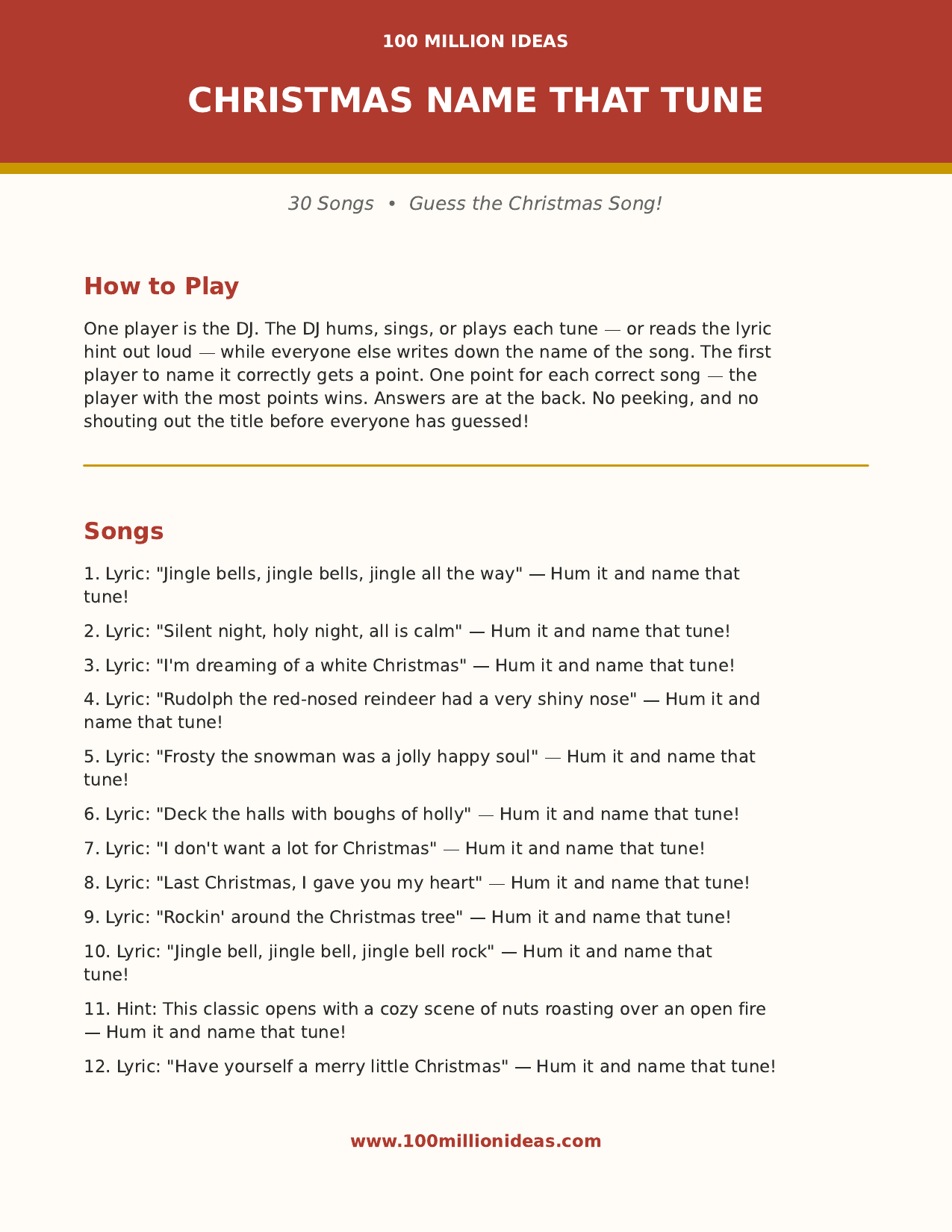
If you love this idea but would rather have the whole game ready to print than build your own carol list, our Christmas Name That Tune printable does exactly that. It comes with 30 Christmas songs, each with a lyric hint or clue, plus a full answer key at the back, so the song leader can run the whole game without preparing anything. It is $3 on sale (regularly $5) in our shop, and it prints beautifully on regular paper.
Get Christmas Name That Tune — $3 (regularly $5)
And if you are planning a whole Christmas games night, the Christmas Games Bundle gathers 24 of our printable games — including Name That Tune, Christmas Trivia, Christmas Bingo, and Christmas Charades — for $17 (regularly $21). One bundle, one download, and your entire evening is sorted.
Get the Christmas Games Bundle — $17 (regularly $21)


