Holiday Survey Showdown

There is a particular kind of energy that fills a room when a survey game starts. Someone reads a question out loud — “Name something people put on top of a Christmas tree” — and suddenly everyone in the room has an answer, everyone is sure their answer is the best one, and everyone is shouting at once. That is the Holiday Survey Showdown: a team game where players guess the most popular answers to fun holiday questions, and the team with the best guesses wins the round.
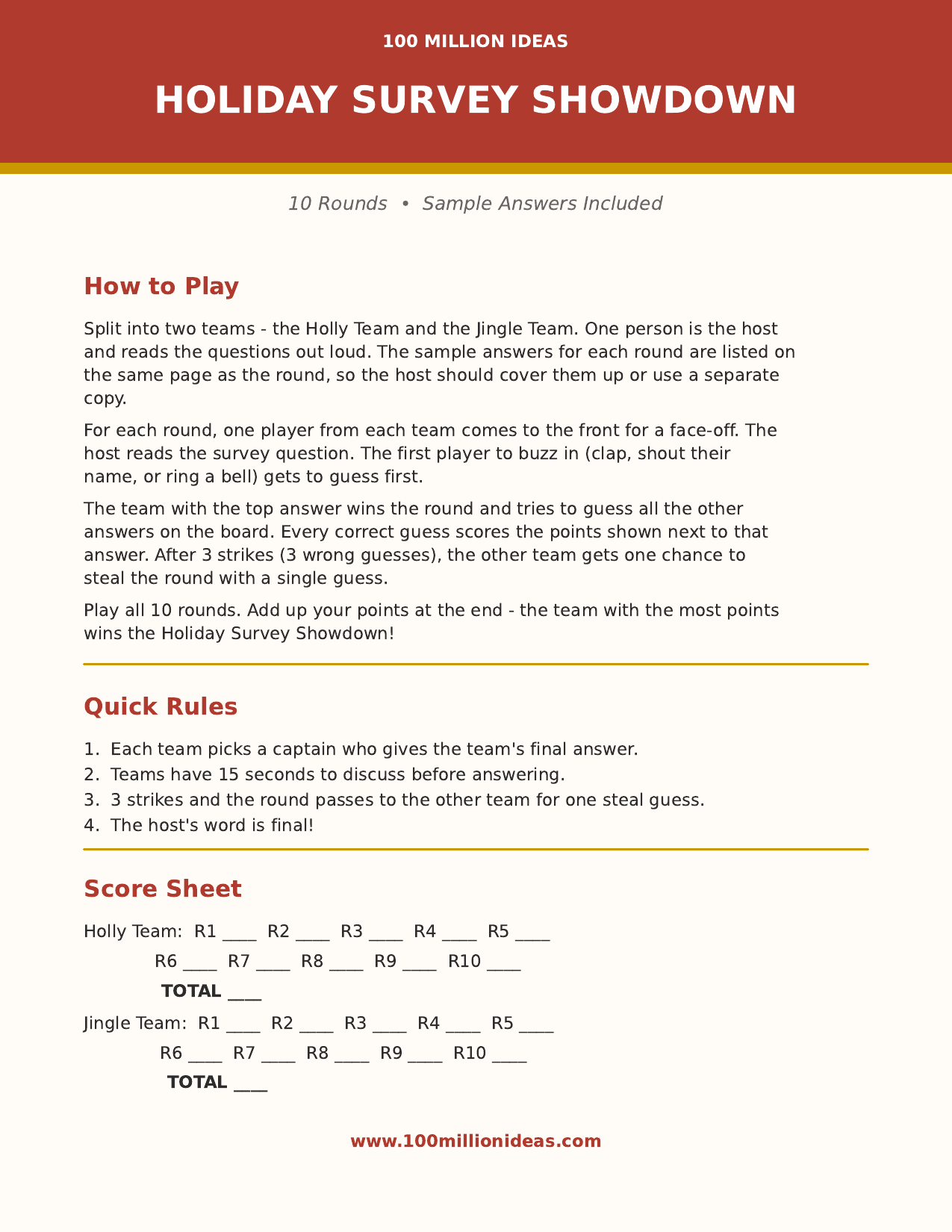
It is a survey-style party game, and the idea is simple. The host asks a question. Each team takes turns guessing answers. The game comes with sample answers for every question — these are example answers written to make the game fun and playable, not the results of any real survey. Points are awarded for guessing the sample answers, and the team with the most points at the end wins. There are no right or wrong answers in the real world here; the fun is in guessing what the sample answers are, and in arguing — lovingly — about whether “hot cocoa” should beat “eggnog.”
This version is built for the holidays. The questions cover both Thanksgiving and Christmas, so it works from late November all the way through December. It is the rare party game that works equally well for a family reunion, an office holiday party, a classroom celebration, or a friends’ night in, because everyone — from a seven-year-old to a grandparent — has opinions about holiday food, holiday movies, and holiday traditions.
At a Glance
- Players: 6 to 30, split into two teams (works best with 8 to 20)
- Time needed: 30 to 45 minutes for a full game
- Ages: 7 and up
- Budget: just the printable game — no other supplies needed
- Best for: family parties, office holiday parties, classroom parties, church groups, friends’ nights
What You Need
- The Holiday Survey Showdown printable. This is the game itself: the question cards, the sample answers, and the score sheets. Everything is ready to print and play.
- Two teams. Split the group as evenly as you can. Mix ages and personalities across both teams — a team of all kids versus a team of all adults is not a fair fight, and it is not as fun either.
- A host. The host reads the questions, reveals the sample answers, keeps score, and keeps the energy up. The host does not play on a team.
- A way to show the answers. A whiteboard, a flip chart, a projector, or simply the host reading the answers aloud all work. If you have a screen, the PowerPoint version of the game lets you reveal answers one at a time with a click, which adds real drama.
- A score sheet and a pen. Or a whiteboard where everyone can see the score. Visible scores make the game more exciting, especially in the final rounds.
- A buzzer (optional). A desk bell, a phone buzzer app, or even a squeaky toy works. It is not required, but a buzzer makes the face-off rounds feel like a real game show.
- A small prize for the winning team. Candy, ornaments, or simply the glory of winning. A prize gives the final round stakes, but keep it small — the game is the reward.
How to Play Holiday Survey Showdown
Step 1: Split into teams and pick captains
Divide the group into two teams and let each team pick a captain. The captain is the person who gives the team’s official answer during the face-off and who makes the final call when the team disagrees. A good captain listens to the team and then decides quickly — the game moves too fast for long debates.
Step 2: The face-off
Each round starts with a face-off. The host reads a question, and one player from each team comes to the front. The host reads the question again, and the first player to buzz in (or raise a hand) gets to answer first. If their answer is one of the sample answers, their team wins control of the round. If it is not, the other player gets a chance to answer. If neither player guesses a sample answer, the host moves to the next player on each team until someone does.
The face-off is the most exciting part of the round, because it is fast and it is public. Pick your quickest thinker for the face-off, not necessarily your most knowledgeable player — speed matters more than depth here.
Step 3: The team round
Once a team wins control, the host goes down the line of that team’s players, one at a time, and each player guesses an answer. Every time a player guesses a sample answer, the team scores a point (or the number of points shown on the game sheet) and the host reveals that answer. Every time a player guesses an answer that is not among the sample answers, the team gets a strike. Three strikes, and the round passes to the other team.
The key skill in the team round is not just knowing good answers — it is knowing when to pass. If a player is stuck, they can say “pass” and the turn moves to the next teammate. Passing costs nothing, and a bad guess costs a strike. Teams that pass wisely do much better than teams that guess wildly.
Step 4: The steal
When a team gets three strikes, the other team gets one chance to steal the round. The opposing team huddles for a few seconds, agrees on a single answer, and the captain announces it. If it is a sample answer, the stealing team takes all the points from the round. If it is not, the original team keeps their points. The steal is the great equalizer — a team that is behind can catch up in a single round, and a team that is ahead can lose a round they thought they had won.
Step 5: Play to a set number of rounds
A full game is usually five to eight rounds, or about 30 to 45 minutes. The host should pick the number of rounds before the game starts and announce it, so the final round feels like a final round. For the last round, double the points — it keeps the game close and makes the ending dramatic. The team with the most points at the end wins.
The Questions
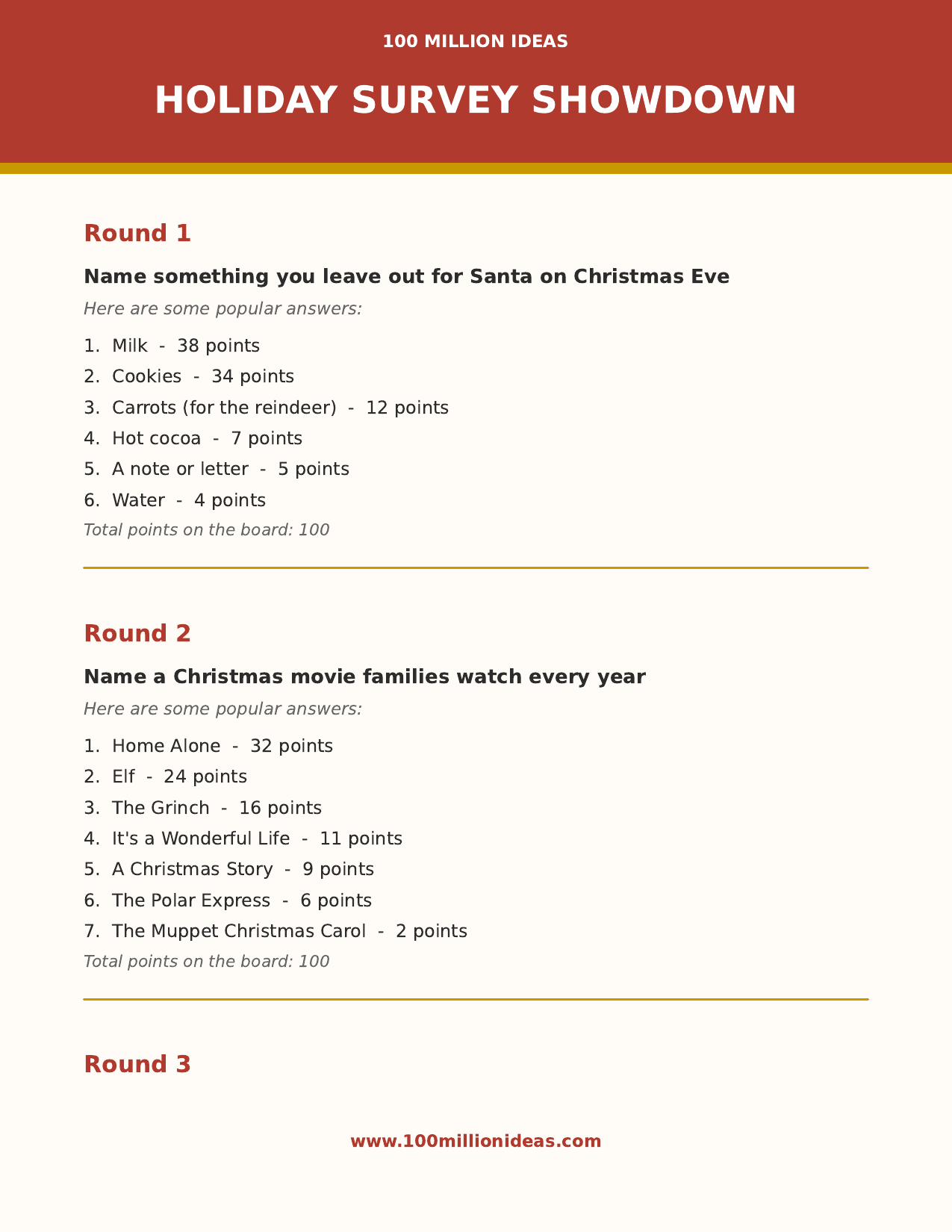
The Holiday Survey Showdown covers both Thanksgiving and Christmas, so you can play it all season long. The questions are written to be fun, not tricky: they ask about things everyone has an opinion on, like holiday foods, traditions, songs, and movies. Here is the flavor of what to expect — these are example questions in the style of the game, and the printable includes the full question set with sample answers:
- Name something people put on top of a Christmas tree.
- Name a food that always shows up at Thanksgiving dinner.
- Name something people do on Christmas Eve.
- Name a Christmas song everyone knows the words to.
- Name something you might find in a stocking.
- Name a reason people love the holidays.
Notice what these questions have in common: they are open enough that many answers are possible, but specific enough that a team can argue about which answer is most likely to be among the samples. That argument — “No, everyone says star, nobody says angel anymore!” — is the heart of the game.
A note on the sample answers: the answers included with the game are sample answers written for play. They are not presented as the results of a survey of real people, and no numbers or percentages are attached to them. The game works because the sample answers are sensible and fun, not because they come from a poll. Do not worry about whether an answer is “really” the most popular one in the world — in this game, the sample answers are the answers, and guessing them is the challenge.
Rules Worth Writing Down
- One answer per turn. Each player gives one answer on their turn, then the host moves to the next player. No shouting out answers from the sidelines — if a teammate shouts an answer, the host can count it as a strike, or simply ignore it and move on.
- Exact matches count. An answer counts if it matches a sample answer or is clearly the same thing (“tree topper” and “star” are different answers; “star” and “a star” are the same). The host decides close calls, and the host’s decision is final.
- Three strikes and the round passes. Strikes are per round, not per game. A team starts each round fresh.
- The steal is one answer only. The stealing team gets a single guess, agreed on together, announced by the captain.
- No phones. Looking up answers is cheating, and it is also unnecessary — the game is about guessing, not knowing. Phones away during play.
Tips for the Host
Keep the pace fast. The game dies when the host pauses to check the answer sheet or to settle a long argument. Know the question before you read it, reveal answers quickly, and move to the next player without delay. A round should take three to five minutes at most.
Be the show. A survey game host is a game-show host. Read the questions with energy. Pause before revealing a sample answer. React when a team guesses a great answer. The host’s enthusiasm sets the tone for the whole room, and a flat host will flatten even the best questions.
Let the teams argue — briefly. The best moments in this game are the thirty-second arguments about whether “candy cane” beats “chocolate” as a stocking stuffer. Let those arguments happen, but cap them. If a team is still debating after thirty seconds, the captain decides and the game moves on.
Use the final round well. Double points in the last round, and pick a question that everyone will have strong feelings about. The final round should feel like a finale, not just another round.
Play with mixed ages. This game is at its best when a seven-year-old and a seventy-year-old are on the same team, because they bring completely different answers. The kid says “presents” and the grandparent says “family,” and both are sample answers. That is the magic of the game.
Tips for Players
Think obvious, not clever. The sample answers are the most natural answers, not the most creative ones. When the question is “Name something people put on a Christmas tree,” the winning guess is “star” or “angel,” not “a tiny replica of the Millennium Falcon.” Clever answers are fun, but obvious answers score points.
Listen to your teammates. When it is not your turn, listen to the answers already given. Repeating an answer that has already been revealed wastes a turn and, worse, can cost a strike if the host counts it as a wrong guess.
Save your best guesser for the steal. The steal is a single answer decided as a team, so it should be the answer your whole team agrees is most likely. Let the captain ask each person for their best guess, then pick the one that comes up most often.
Do not overthink the face-off. In the face-off, speed beats precision. Buzz in fast with your first instinct. Your first instinct is usually one of the sample answers — it is your second and third thoughts that tend to be wrong.
Variations
Thanksgiving only. If you are playing in late November, use only the Thanksgiving questions. The game works just as well with a single holiday theme, and it feels more focused.
Christmas only. Same idea, for December parties. The Christmas questions alone are enough for a full game.
Kids versus adults. Split the room by age for one round only, as a special event. Kids usually win the round about toys and treats; adults usually win the round about food and traditions. It is a fun change of pace, but keep it to one round — a full game of kids versus adults is not fair to either side.
Speed round. For the last round, give each team thirty seconds to shout as many answers as they can. Every sample answer they name scores a point. It is chaotic, loud, and a perfect way to end the game.
Classroom version. The teacher is the host, the class splits into two teams, and the questions are used as a fun review or a holiday celebration. The sample answers make it easy to run without preparation, and the game works well even with thirty students.

Frequently Asked Questions
How many questions do I need for a full game? Five to eight rounds is a full game, so you need five to eight questions. The printable includes far more than that, so you can play several games without repeating a question.
Are the answers based on a real survey? No. The answers included with the game are sample answers written to make the game fun and playable. They are not survey results, and no percentages or respondent counts are attached to them. The game is about guessing the sample answers, not about real-world polling.
What ages can play? Seven and up is a good guideline. Younger children can play on a team with an adult who helps them think of answers. The questions are about everyday holiday life, so most kids will have ideas.
Can I play with a small group? Yes. With six players, split into two teams of three and play the same way. With fewer than six, play as individuals instead of teams — each player guesses on their own turn, and the highest score wins.
Do I need a screen or projector? No. The game works perfectly well with the host reading the questions and answers aloud. A screen makes the reveals more dramatic, but it is a nice extra, not a requirement.
Get the Printable Game
Get the complete game in our shop: Holiday Survey Showdown — $3. It includes the question cards, sample answers, score sheets, and PowerPoint templates so you can reveal answers on screen like a real game show. For the whole collection of gift exchange games, see the Gift Exchange Games Bundle — $9, or browse the full library in the Christmas Games Bundle — $17.
You may like to read!
- Christmas Party Minute to Win It Games for Adults
- Best Christmas Jokes to Read
- Christmas Party Food Ideas
Images:
- Cover: ~/workspace/100millionideas-shop/covers/holiday-survey-showdown.png
- Body: rendered pages of the Holiday Survey Showdown printable (question cards, sample answer sheet); photo of two teams facing off at a party


