Christmas Silly Stories

There is a particular kind of laughter that only happens when a story goes wrong in exactly the right way — when Santa checks his toaster twice, or the Christmas cake is baked by a team of penguins, or the elf on his day off ends up doing something no elf should ever do. Christmas Silly Stories is a fill-in-the-blank storytelling game that creates that laughter on purpose, and it does it with nothing more than a printed sheet, a pen, and a group of people willing to shout out random words.
The game is simple: one person reads a story out loud, but before they start, they ask the other players for words — an adjective here, a plural noun there, a verb ending in “-ing” — without showing anyone the story. The words get written into the blanks, and then the story is read aloud with the players’ words in place. The result is different every single time, and it is funny in a way that no pre-written joke can match, because the humor comes from the people in the room.

At a Glance
- Players: 2 to 20 (one Reader and the rest as word-givers; larger groups work fine)
- Ages: 6 and up — younger children can give words even if they cannot read the story
- Time needed: 10 to 20 minutes for all three stories
- What you need: printed story sheets, a pen, and a Reader with a good reading voice
- Best for: family Christmas Eve, classroom parties, car rides, waiting rooms, and any moment when a group needs cheering up
What’s Included in the Printable
The download is a 3-page PDF with three complete fill-in-the-blank stories, each with its own word list.
Story 1: Santa’s Sleigh Ride. The Reader asks for eleven words first — an adjective, plural nouns, a verb ending in “-ing,” a noun, a verb in the past tense, an exclamation, and a few more — then reads a story about Christmas Eve in Santa’s workshop: Santa checking his list twice, polishing his boots, the reindeer leaping into the air, the sleigh swooshing over rooftops, and a cat guarding a plate of cookies at the very last house. It is the warmest of the three stories, and the best one to start with.
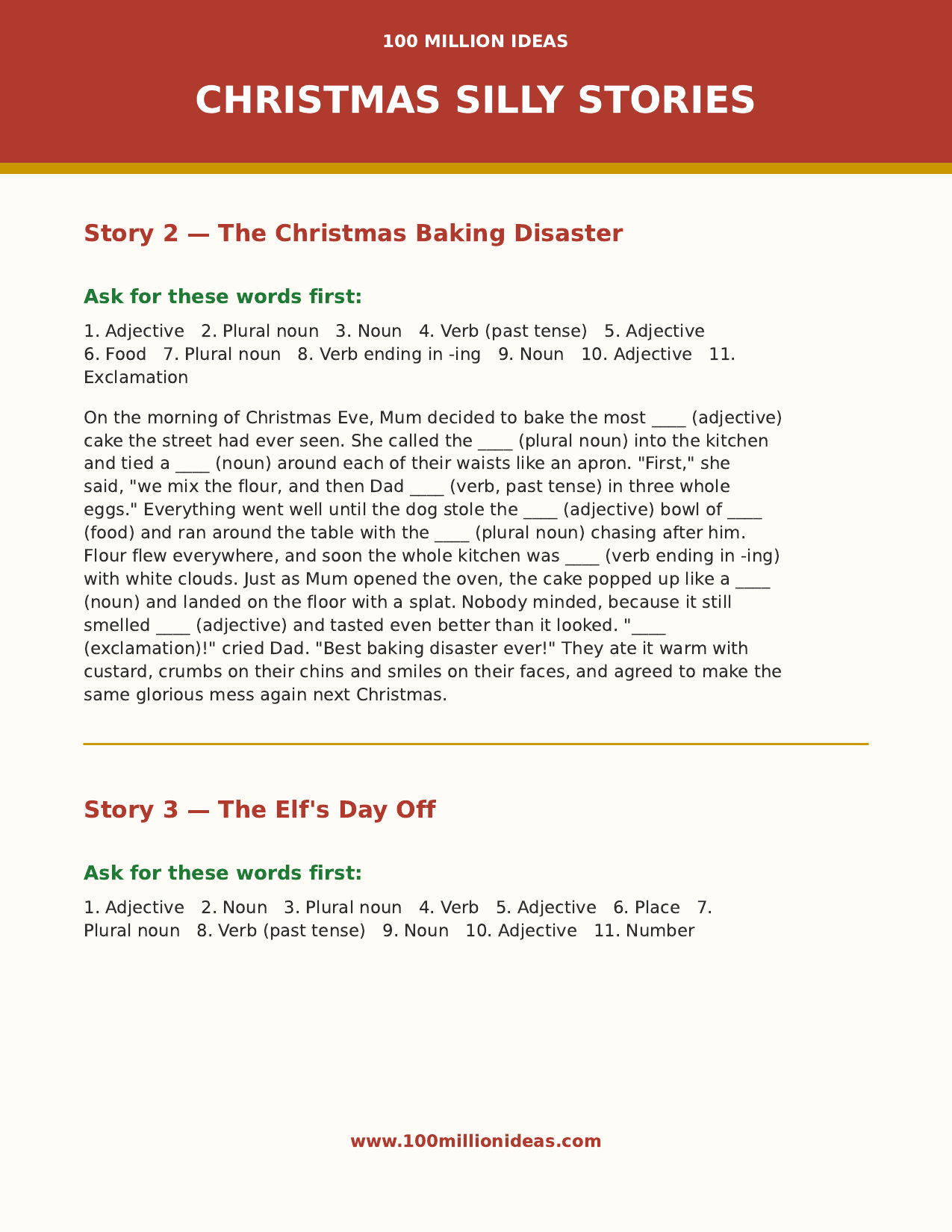
Story 2: The Christmas Baking Disaster. Eleven more words, then a story about a family baking the most ambitious cake their street has ever seen — until the dog steals a bowl of something, flour flies everywhere, and the cake pops out of the oven and lands on the floor. Nobody minds, because it still smells wonderful and tastes even better than it looks. This is the story that gets the biggest laughs from families, because every family has lived some version of it.
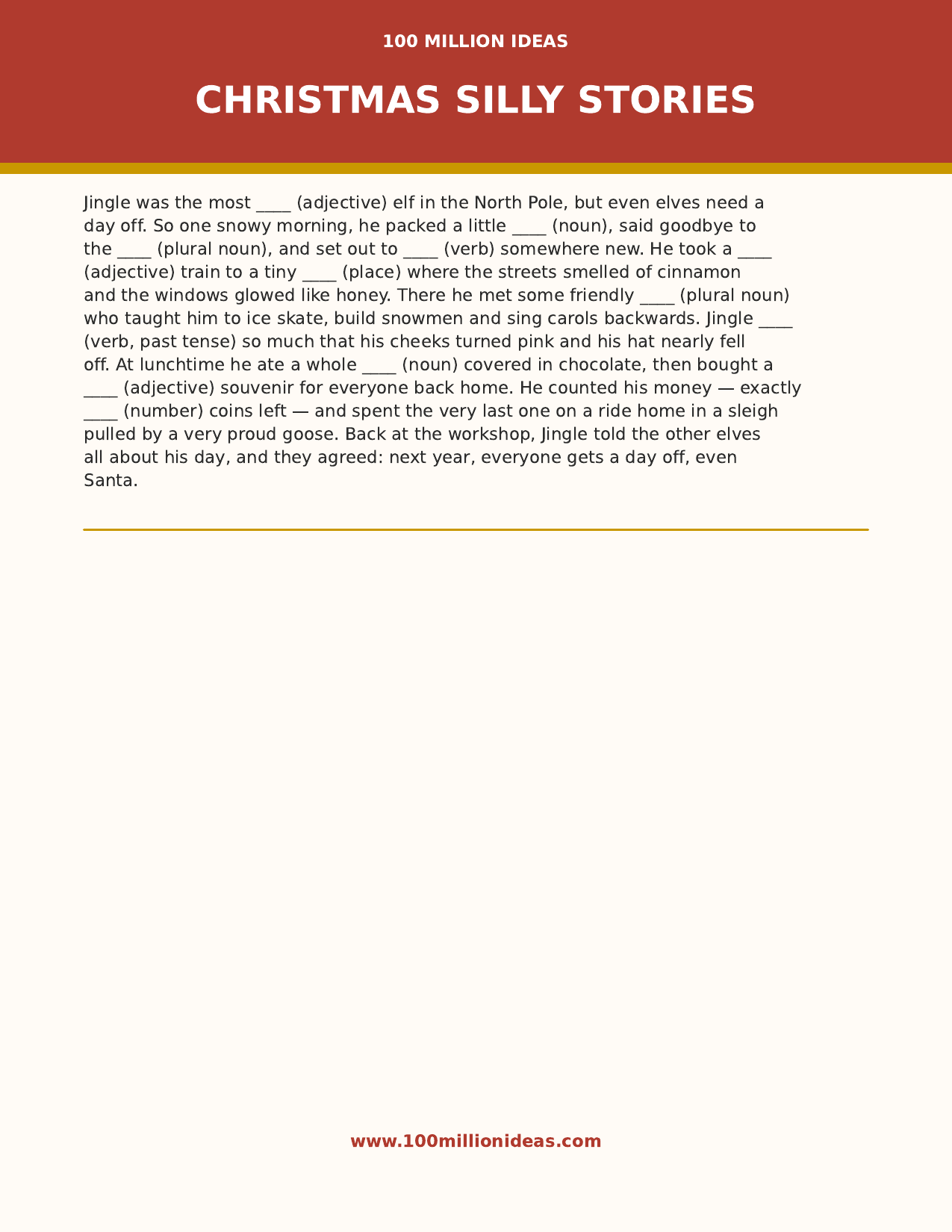
Story 3: The Elf’s Day Off. The third story follows an elf on his rare day off from the workshop, and it is the silliest of the three — the one where the word choices matter most, because the story’s humor depends entirely on what the players invent. Save this one for last, when the group has warmed up and the words are getting braver.
Each story is printed with its word list at the top, so the Reader can collect the words first and then read without stopping to ask. The blanks in the story are marked with the type of word needed — adjective, noun, verb — so the Reader always knows which word goes where.
Get the Printable Game in Our Shop
Get Christmas Silly Stories in our shop — on sale for $3 (regular $5)
The download includes all three stories with their word lists, ready to print as many times as you like. If you are collecting games for children, the Christmas Kid Activities Bundle — $11 includes these stories plus 13 more kid-friendly Christmas activities, which is the easiest way to fill a whole holiday afternoon.
What You Need to Play
- Printed story sheets — one set per group. Only the Reader needs to see the story; the other players only need to hear the questions. Print one copy and you are ready.
- A pen — the Reader writes each word into its blank as it is given. A pencil works too, and it makes the sheet reusable: erase the words, and the story is fresh for the next group.
- A Reader — one person with a clear voice who enjoys performing. The Reader is the most important role in this game, and it should go to someone who likes an audience — a parent, a teacher, an older sibling, or the family member who always ends up telling the stories.
- An audience — everyone else. Their only job is to give words, and then to laugh.
How to Play Christmas Silly Stories
1. Choose a Reader
Pick one person to be the Reader for the first story. The Reader holds the sheet where nobody else can see it. If you have a reluctant Reader, let them choose the story they like best — enthusiasm matters more than experience here.
2. Ask for the words — without showing the story
The Reader reads the word list at the top of the story out loud, one item at a time: “Give me an adjective!” “Give me a plural noun!” “Give me a verb ending in -ing!” The other players call out their answers, and the Reader writes each one into the matching blank.
This is the heart of the game, and it has one strict rule: never show the players the story before the words are collected. The fun comes from the mismatch between the word someone chooses and the sentence it lands in. If players know the sentence, they choose sensible words, and sensible words are not funny.
3. Read the finished story out loud
Once every blank is filled, the Reader reads the whole story from the beginning, with the players’ words in place, slowly and with feeling. Pause before the best lines. Let people laugh. A good Reader treats it like a performance, not a recitation — different voices for different characters, a dramatic pause before the exclamation, and a straight face for the silliest sentence.
4. Vote for the funniest story
After all three stories have been read, the group votes for the funniest one. There is no prize needed — the vote itself is the prize, and the winning story usually gets read again, louder, by popular demand.
5. Swap Readers and play again
A new Reader takes the next story, and the words get sillier each round as the group learns what works. If you have more than three stories’ worth of energy, erase the pencil words and play the same stories again with fresh words — the stories are completely different the second time.
Tips for the Best Words
The quality of the game depends on the quality of the words, and most groups need a little coaching on their first round:
- Silly beats sensible. “Fluffy” is a better adjective than “nice.” “Pickles” is a better plural noun than “presents.” Remind players that the goal is laughter, not correctness.
- Specific beats general. “A purple dragon” is funnier than “an animal.” “Dancing” is funnier than “running.” Encourage players to name the first ridiculous thing that comes to mind.
- Ban the obvious. If someone always answers “poop” for every noun, the game stops being funny after the first story. One gentle house rule — “no bathroom words” — keeps the game fun for mixed ages and for Grandma.
- Let the quiet players go first. The loudest person in the room will happily supply every word. Ask the quietest person first, and the game gets better words and a happier room.
- Mix ages deliberately. Children give gloriously random words. Adults give cleverly wrong ones. A group with both gets the best stories.
Tips for the Reader
- Read slowly. The most common Reader mistake is rushing. The audience needs a second to picture each sentence before the next one arrives.
- Pause before the exclamation. Every story has an exclamation in it. Pause, look up, and then deliver it. The pause is what makes the room laugh.
- Do the voices. Santa sounds different from the elf, and the elf sounds different from the cat. You do not need to be good at voices — you need to be willing, and willingness is funnier than talent.
- Do not peek at the words while collecting them. Write each word in its blank without reading the sentence around it. If the Reader laughs while collecting, the players know something good is coming, and the surprise is spoiled.
Variations to Try
- Car ride edition: the driver is the audience, a passenger is the Reader, and the stories fill a long drive to Grandma’s house. Print the sheets before you leave — this is the rare car game that needs no screen.
- Classroom edition: the teacher is the Reader, and each child supplies one word in turn, going around the room. It works as a grammar lesson without feeling like one: children learn what adjectives, nouns, and verbs are because they need the words to play.
- Write your own: after playing all three stories, challenge the group to write a fourth. One person writes a short Christmas story with blanks, and the group fills it in. The homemade stories are often the funniest of all, because they include family jokes and local details.
- Christmas Eve tradition: read one story per year as part of the Christmas Eve routine — one before dinner, one after, one before bed. By the third year, the family has favorite words and running jokes, and the game becomes a tradition rather than an activity.
- Party favor version: print one story per guest, fold it into a party favor bag with a pencil, and let guests take it home. It is a favor that actually gets used, usually on the car ride home.
Who This Game Is For
Silly Stories is the most flexible game in this collection, because it needs no table, no board, and no equipment beyond a sheet of paper. For families, it is the game that works when the children are too excited to sit still and the adults are too tired to run anything complicated — one person reads, everyone else shouts words. For teachers, it is a stealth grammar lesson: children learn parts of speech by using them, and the class stays engaged because every answer changes the story. For party hosts, it is the perfect gap-filler — the game you pull out while the food is being served or while you wait for the last guest. And for long car rides, it is genuinely one of the best screen-free options there is.
Frequently Asked Questions
What ages can play? Children from about six up can give words, even if they cannot read — they just need to know what an adjective or a noun is, and the Reader can explain with an example. (“An adjective is a describing word — like fluffy, or purple, or enormous!”) Older children and adults can be the Reader.
How long does it take? About five minutes per story, including collecting the words — so 15 to 20 minutes for all three. As a car game, it stretches naturally to fill the journey.
Do I need to know grammar to play? No. The word list tells the Reader what to ask for, and a one-sentence explanation is enough: an adjective describes something, a noun is a person, place, or thing, a verb is an action. Children pick it up within the first story.
Can I play with just two people? Yes. One person is the Reader and the other gives all the words. It works well as a one-on-one game with a child — and it is a lovely way to spend ten minutes on Christmas morning while the rest of the house wakes up.
Can the same story be played twice? Absolutely, and it should be. The story is the same, but the words are different, so the second version is a completely different story. Erase pencil words between rounds, or print a fresh sheet.
Is it suitable for a classroom? Yes — it is one of the best classroom games in this collection. It teaches parts of speech, it involves the whole class, and it needs no technology. The stories are clean and family-friendly, with nothing that needs editing for school use.