Christmas Trivia

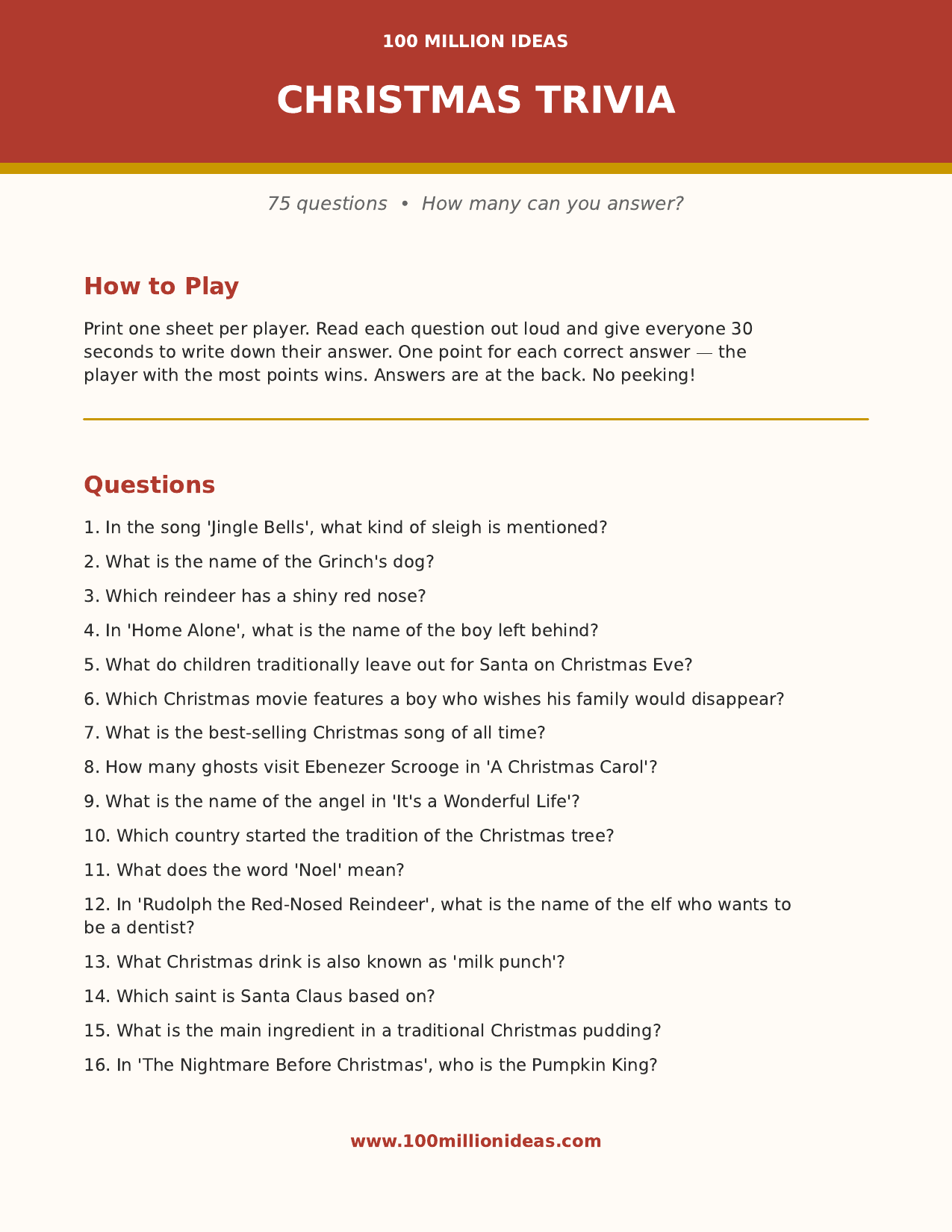
There is a particular kind of silence that falls over a room during a good trivia question. Everyone is thinking at once, nobody wants to say their answer out loud in case it is wrong, and then someone whispers an answer and half the room nods while the other half shakes their heads. Christmas Trivia is built to produce that silence seventy-five times in a row. It is a set of seventy-five questions covering Christmas songs, films, traditions, food, and stories, printed with an answer key at the back, and it is the closest thing to a guaranteed hit that a Christmas party game can be.
The reason trivia works so well at Christmas is that everyone arrives with a different store of Christmas knowledge. One guest knows every Christmas film by heart. Another knows the carols. Another knows the food traditions. Another knows the stories. No single player is good at all of it, which means the lead changes hands constantly and the final result stays uncertain until the last question. That is what keeps a room engaged for a full game instead of drifting away after ten minutes.
At a Glance
- Players: 2 to 30, solo or in teams
- Ages: 8 and up can manage the questions alone; little ones have the most fun answering alongside an adult teammate
- Time needed: 30 to 45 minutes for all 75 questions
- Supplies: one printed question sheet per player, a pen or pencil each, and a timer if you want to enforce the 30-second limit
- Best for: family Christmas parties, friends’ quiz nights, classroom parties, office holiday parties, and Christmas Eve
What You Need to Set Up
Print one question sheet per player, or one per team if you are playing in teams. Hand out pens or pencils. Choose a quizmaster: this is the person who reads the questions out loud, keeps the time, and reads the answers at the end. The quizmaster can be the host, or you can rotate the role every fifteen questions so that everyone gets a turn at playing too. If the quizmaster is also playing, they should have their sheet marked by someone else at the end.
Decide before you start whether you are enforcing the 30-second limit per question. The printable recommends 30 seconds per question, and it is a good limit: long enough to think, short enough to keep the game moving. For a relaxed family game, you can drop the timer entirely and let the quizmaster move on when the room looks ready. For a competitive quiz night, enforce it strictly and use a phone timer the whole room can hear.
Agree on the scoring as well. One point per correct answer is the standard rule, and the player or team with the most points at the end wins. Also agree on what counts as correct before the first question: an exact answer is required for names, but a close answer may be acceptable for questions about numbers or descriptions. The quizmaster decides, and their decision is final, which is worth saying out loud before you begin.

How to Play
1. Hand out the sheets. Each player or team gets a printed question sheet and a pen. Players write their answers on the sheet as the quizmaster reads each question.
2. The quizmaster reads each question out loud. Read each question clearly, and read it twice: once for everyone to hear, and once more slowly so nobody misses a detail. Seventy-five questions is a long game, so the quizmaster should keep a steady pace and avoid long pauses between questions.
3. Players have 30 seconds to write their answer. This is the recommended time per question. Players write one answer per question. If they are unsure, they should guess: a guess can score, and a blank never can.
4. No conferring, unless you are playing in teams. In solo play, each player answers alone. In team play, teams can discuss quietly before writing their answer, which is half the fun of playing in teams.
5. Check the answers at the end. When all seventy-five questions have been asked, the quizmaster reads out the answers from the answer key at the back of the printable. Players swap sheets with a neighbour to mark them, or mark their own while the answers are read. One point per correct answer.
6. Announce the winner. Add up the scores and crown the winner. If two players tie, the quizmaster asks a tie-breaker question on the spot: the first tied player to answer correctly takes the win.
The seventy-five questions span the whole of Christmas. There are questions about songs and carols, about the films everyone watches every December, about the characters from the classic Christmas stories, about food and drink traditions, and about where different customs come from. That range is deliberate: it means a player who knows nothing about films can still score well on the traditions questions, and a player who has never read a Christmas story can still do well on the songs. Nobody is ever completely out of the game.
A Few Sample Questions to Try
To give you a flavour of the game, here are a few sample questions in the same spirit as the printable. These are not from the game itself, but they show the kind of knowledge the game tests:
- How many reindeer pull Santa’s sleigh, not counting Rudolph?
- What do families traditionally hang by the fireplace for Santa to fill?
- Which Christmas plant are people supposed to kiss underneath?
- In the story of the Nutcracker ballet, what does the Sugar Plum Fairy rule over?
- What is the main spice that gives gingerbread its warm flavour?
If your group answered most of those without hesitating, they will enjoy the full game. If they found them tricky, they will enjoy it even more, because the game is at its best when the answers are just out of reach.
Tips for the Quizmaster
The quizmaster sets the tone for the whole game, so these details matter more than they look. Read each question at a steady pace, and do not rush the first ten: the room needs time to settle into the rhythm of the game. Do not react to answers as they are given, because a raised eyebrow or a smile can give away whether a popular answer is right or wrong. If a player asks you to repeat a question, repeat it exactly as written rather than rephrasing it, because a rephrased question can accidentally give away a clue. And keep the scoring transparent: read the answers slowly at the end, give everyone time to mark, and let anyone challenge a mark they think is unfair before the winner is announced.
Tips for Players
Write your first instinct and move on. Trivia rewards the answer you knew immediately far more often than the answer you reasoned your way to after thirty seconds of doubt. If a question is about a film you have seen, picture the scene rather than trying to recall the fact directly: the name you are looking for is often attached to an image in your memory. If a question is about a number, guess a round number rather than a precise one, because most Christmas numbers in stories and songs are round ones. And if you are playing in a team, say your answer out loud even if you are unsure: the quietest team member often holds the answer nobody else has.
Variations to Try
Team quiz night. Split the group into teams of three or four and let each team submit one answer per question. Team play suits larger parties and office events, because it keeps everyone involved without the pressure of playing alone, and the discussions inside each team are often the most entertaining part of the evening.
Halves. Play the first half of the questions before dinner and the second half after, with the scores announced at dessert. Splitting the game like this keeps it from dominating the evening, and it gives players something to look forward to after the meal.
Themed rounds. The quizmaster can group the questions by theme and announce each round as it begins: a songs round, a films round, a food round, and a traditions round. Themed rounds let players brace themselves for their weak subjects and enjoy their strong ones, and they make the game feel like a proper quiz night.
Kids’ table. Run a separate, smaller game for children using the easiest questions, or let children play in teams with adults. Children who are allowed to contribute an answer their team would not have known are far more likely to stay engaged for the whole game.
Speed round finish. Play the last ten questions as a speed round, with only ten seconds per question instead of thirty. It is a lively way to end, and it often overturns the leaderboard, because speed favours a different kind of player than careful thinking does.
Get the Printable Game in Our Shop
Get Christmas Trivia in our shop — on sale for $3 (regularly $5)
The printable includes all 75 questions with a full answer key at the back, so the quizmaster does not need to know the answers in advance or prepare anything beyond printing. It prints cleanly on ordinary home printer paper, in colour or black and white, and you can print as many copies as your party needs.
Quiz lovers who want more than one night’s worth of questions should look at the Christmas Games Bundle — 24 games for $17: this trivia set is one of twenty-four games in the bundle, and the per-game cost is far below the single-game price.
Who It’s For
Christmas trivia is the most versatile game in the collection, because it adapts to any group simply by changing how you play it. As a solo game it suits a family that loves a challenge; as a team game it suits an office party where nobody wants to be singled out; as a halves game it suits a long Christmas dinner where the game needs to fit around the meal rather than replace it. It works for children around eight and up, for teenagers who think they know everything about Christmas films, and for grandparents who have been watching the same Christmas stories for fifty years and remember details nobody else does.
It is particularly good for a friends’ Christmas quiz night, where the group wants a structured activity that lasts most of the evening and gives everyone something to talk about afterwards. The one setting where it needs care is a very large group, where reading questions aloud to thirty people can be hard to hear: in that case, play in teams and let each team work from its own printed sheet at its own pace.

Frequently Asked Questions
How many questions are in the game? Seventy-five questions, with a full answer key at the back of the printable.
How long does a full game take? Thirty to forty-five minutes for all seventy-five questions, depending on how strictly you enforce the 30-second limit and how much discussion you allow between questions.
What ages can play? Children around eight and up can usually play solo. Younger children do best on a team with an adult, where they can contribute the answers they know without having to answer every question themselves.
Do we have to play all 75 questions? No. Play as many as you like. Twenty-five questions make a complete short game, and the rest are ready for the next party.
What if two players tie? The quizmaster asks a tie-breaker question on the spot, and the first tied player to answer correctly wins. A shared win is also fine for a relaxed family game.
Is there an answer key? Yes, the printable includes a full answer key at the back, so the quizmaster can run the whole game without knowing the answers in advance.


