Christmas Shout-Out Game

Some party games ask you to be clever. This one asks you to be fast and loud. Christmas Shout-Out is a team shouting game: one player reads out a category — “Things you hang on a Christmas tree!” — and their team has sixty seconds to shout out as many answers as they can. Every answer that matches the list on the sheet scores a point. There is no thinking time, no writing, no turn-taking. Just a room full of people yelling “ornaments! candy canes! tinsel! lights!” while the clock runs down and the other team tries to keep count.
It is the simplest game in our Christmas collection, and it is the one that produces the most noise. That is not an accident. The game is built on a truth about parties: people have more fun shouting answers together than they do sitting quietly and thinking. The categories are all things everyone knows — tree decorations, stocking fillers, Christmas treats, things Santa says — so nobody is ever stuck. The challenge is not knowing the answers. The challenge is getting them out of your mouth before the time runs out.
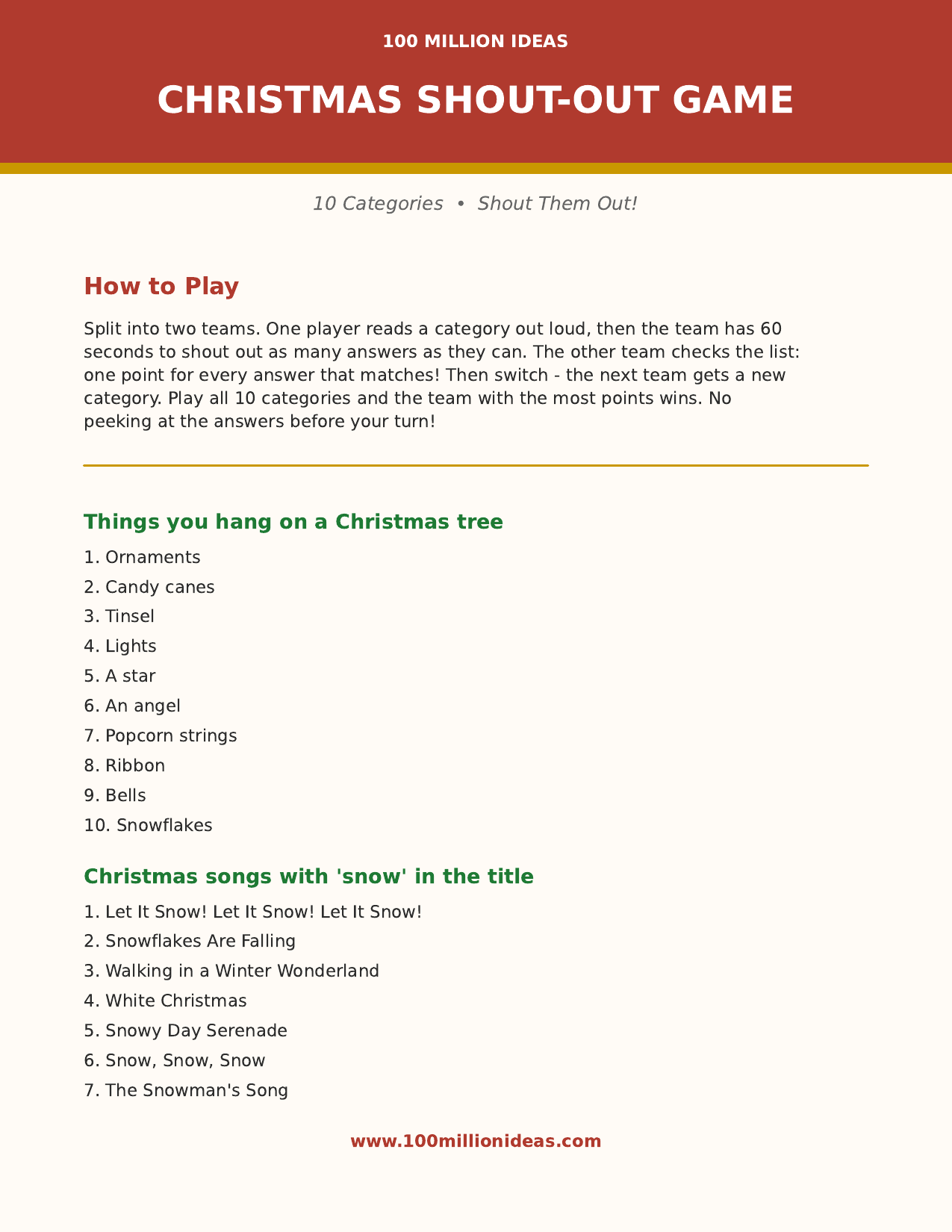
What Is the Christmas Shout-Out Game?
The game has ten categories, and each one comes with a list of ten answers. The host — or the opposing team — holds the list, and the playing team shouts. Here is how a round actually sounds. The category is “Things you hang on a Christmas tree.” The timer starts. Someone shouts “Ornaments!” — one point. “Candy canes!” — one point. “Tinsel!” “Lights!” “A star!” “An angel!” “Popcorn strings!” “Ribbon!” “Bells!” “Snowflakes!” Ten answers, ten points, and the whole round took about twenty seconds because once people start, they cannot stop.
But it does not always go that smoothly. The category “Christmas songs with ‘snow’ in the title” is where confident teams discover that they know fewer snow songs than they thought. Everyone gets the obvious ones, and then there is a pause, and someone shouts a song that does not have snow in the title at all, and the whole team laughs, and the clock is still running. That pause, and what happens in it, is the game.
The ten categories cover the whole of Christmas: things you hang on a tree, snow songs, things you find in a stocking, Christmas movies the whole family loves, things Santa says or does, Christmas treats and sweets, things you see at a Christmas market, ways to decorate your house, things that make Christmas feel magical, and reindeer names, real and made-up. Every category is something a person who has celebrated Christmas even once can answer. There are no trick categories and no obscure knowledge. The game tests speed and teamwork, not trivia.
What You Need
The printed game is five pages. The first page explains the rules and starts the first category, and the ten categories with their full answer lists run across the five pages. Print the whole thing and keep it with the host, or give the answer lists to the team that is not playing — they are the checkers, and they need the list in front of them.
You need a timer set to sixty seconds. A phone timer is perfect, and a kitchen timer works too. If you have a big, visible timer — a tablet propped up where everyone can see it — use that, because watching the seconds disappear adds to the excitement in a way a hidden timer does not.
You need a way to keep score. A piece of paper on the fridge, a whiteboard, or a running tally called out by the host all work. And you need two teams. Split the room in half, roughly evenly, and you are ready.

How to Play
Split into two teams. The game works with as few as three players per team, and it is at its best with four to six per team. More than eight per team and the shouting gets hard to follow, so if you have a very large group, split into three or four teams and play in rotation instead.
One player from Team A reads the first category out loud, or the host reads it — either works, but having a player read it keeps everyone involved. The moment the category is read, the timer starts, and Team A has sixty seconds to shout out as many answers as they can. They can shout in any order, they can shout at the same time, and they can shout the same answer twice — it only counts once, and the checkers will sort it out.
Team B holds the answer list and checks each shouted answer against it. One point for every answer that matches the list. Answers that are not on the list do not score, even if they are perfectly good answers — that is the rule, and it is the rule that keeps the game fair, because the list is the same for both teams. When the sixty seconds are up, the host calls time, the points for that category are counted, and the turn passes to Team B, who gets the next category.
Play through all ten categories, alternating teams, and the team with the most points at the end wins. A full game takes about twenty to twenty-five minutes, which includes the time spent arguing about whether a shouted answer should have counted. That arguing is part of the game, and the host’s decision is final.
Scoring and Winning
One point for every answer that matches the list, up to ten points per category. The teams alternate categories, so each team plays five of the ten, and the most a team can score is fifty points. In practice teams land somewhere between twenty and forty — nobody gets all ten answers in every category, and the snow songs category alone has humbled many confident teams.
The scoring has a subtlety worth knowing about: because the checkers are the opposing team, they have a reason to be strict, and the playing team has a reason to complain. That tension is fun, but it needs a referee. The host is the referee. If Team A shouts an answer that is close to a listed answer but not quite the same — say they shout “fairy lights” and the list says “lights” — the host decides. Our advice is to be generous: if the answer is clearly the same thing in different words, give the point. The game is about having fun, not about winning an argument over synonyms.
Ties are common, because the scores are usually close. If the game ends level, play a tiebreaker: one category, thirty seconds instead of sixty, and the team with the most answers in that category wins. Choose the tiebreaker category in advance and keep it hidden, so neither team can prepare.
The prize should match the energy of the game: something small and silly. The winning team picks the Christmas film for the evening, or the losing team has to sing a carol of the winners’ choosing. A game this loud does not need a serious prize.
Who This Game Is For
Christmas Shout-Out is the most inclusive game in our collection, because it asks nothing of a player except that they know what Christmas is. Children from about seven up can play, and they are often better at it than adults, because their answers are immediate — they do not stop to think about whether an answer is good enough, they just shout it. Adults, by contrast, lose points by pausing to consider. Put a child on each team and the game balances itself.
It is ideal for a large family gathering, a work party, a classroom, a church social, or any group where you need a game that gets everyone involved at once. It works for people who do not know each other well, because shouting answers together is a fast way to break the ice, and it works for people who have known each other for years, because the game quickly turns into a competition about who knows Christmas best.
It is also the best game in the collection for a group that includes people who are not comfortable with reading or writing, because there is nothing to read and nothing to write. The category is read out loud, the answers are shouted out loud, and the score is kept by the host. Everyone can play, and everyone can contribute.
The one group it does not suit is a group that needs quiet — if there are babies sleeping in the next room, or neighbours who have already complained, pick a quieter game. This one is loud by design, and it would be a shame to play it at half volume.
Tips for a Winning Team
Shout the obvious answers first. This sounds like strange advice, but it is the most common mistake in the game. Teams lose points because someone shouts an unusual answer while the obvious ones are still unspoken, and then the clock runs out with “ornaments” never said. Start with the answers everyone knows, get the easy points on the board, and then reach for the unusual ones with the time that is left.
Do not stop to discuss. The moment a team starts debating whether something counts, the clock is eating their score. Shout first, sort it out later. If an answer is wrong, it costs nothing — it just does not score. But the ten seconds spent discussing it costs the team two or three answers they could have shouted instead. The teams that win are the ones that keep shouting until the timer stops.
Appoint a caller. In a team of five, it helps to have one person whose job is to keep the answers coming — to point at people, to call out “what else, what else,” to fill the silences. The caller does not need to know the answers. They just need to keep the team talking. Teams with a caller score noticeably more than teams without one, because the caller stops the team from going quiet at the exact moment when the easy answers run out.
Listen to your own team. In the noise, it is easy to shout an answer someone else has already shouted. That wastes time and it does not score twice. The best teams develop a rhythm: one person shouts, another person shouts something different, and nobody repeats. It takes a round or two to find that rhythm, which is why the first category is usually the lowest scoring.
Variations to Try
The thirty-second sprint. For the last three categories, cut the time to thirty seconds. The game changes completely — the easy answers fly out, the hard ones never get said, and the team that stays calm wins. It is a strong finish to the evening.
The quiet version. If the room needs to stay quiet, play the game in writing instead. Give each team a sheet of paper and sixty seconds to write down as many answers as they can. It is the same game, the same categories, and the same scoring — but it is silent, and it works at a dinner table while people are eating.
The reverse round. The host reads out an answer — “candy canes” — and the teams have to shout the category it belongs to. It is harder than it sounds, because many answers could belong to more than one category, and it makes a good tiebreaker.
The kids’ categories. For a group of young children, ignore the printed answer lists and accept any sensible answer. The category “Things you hang on a Christmas tree” has far more than ten good answers, and a child who shouts “a snowman decoration” has earned a point even if it is not on the list. The list is a tool, not a law.
The homemade categories. After playing through the ten printed categories, let each team invent a new one and write ten answers for it. Then swap lists and play the other team’s category. The categories people invent — “Things you find in the bottom of a Christmas stocking,” “Reasons Dad falls asleep after lunch” — are often funnier than the printed ones, and this round turns the game into something that belongs to your family alone.

Frequently Asked Questions
How many people can play? Three per team is the minimum, and the game is best with four to six per team. With more than sixteen players total, split into three or four teams and rotate through the categories so every team gets a turn.
How long does it take? About twenty to twenty-five minutes for all ten categories, including the time spent counting and arguing. You can play a shorter game with five categories in about ten minutes.
What if a team shouts an answer that is not on the list but is a good answer? It does not score. The list is the same for both teams, which is what makes the game fair. The host can be generous about wording — “fairy lights” for “lights” — but an answer that is not on the list in any form does not get a point.
Can children play? Yes, from about seven up. Younger children can play on a team with an adult and shout the answers they know. The categories are all things a child knows, and children are often the fastest shouters in the room.
Do we need to use the printed answer lists? Yes, for scoring. The lists are what make the game a game rather than a free-for-all. But for young children, or for a casual game where nobody cares about the score, you can accept any sensible answer and just enjoy the shouting.
Can I play it over a video call? Yes. The host reads the category, unmutes one team, and the team shouts their answers while the other team checks the list. It is slightly harder to follow than in person, because people talk over each other, but it works, and it is one of the better video call games because everyone is involved at the same time.
Get the Printable Game
The Christmas Shout-Out Game printable includes all ten categories with their full answer lists, ready to print and play. It is $3 on sale (regularly $5) in our shop.
Get the Christmas Shout-Out Game — $3 (regularly $5)
And if you are planning a full Christmas games night, the Christmas Games Bundle includes 24 of our printable games for $17 (regularly $21) — Shout-Out, Christmas Trivia, Christmas Bingo, Christmas Charades, and twenty more.
Get the Christmas Games Bundle — $17 (regularly $21)