Christmas Would You Rather

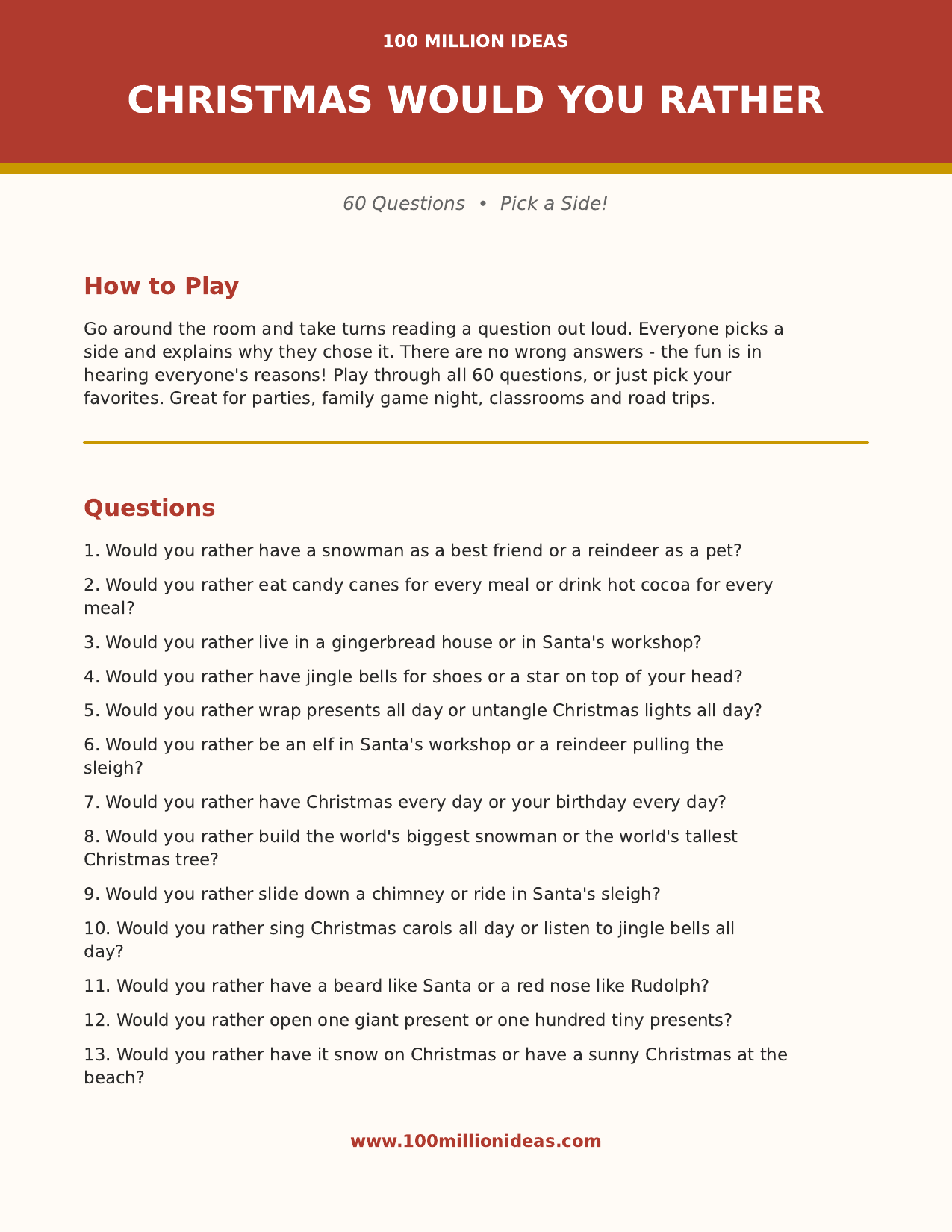
Every Christmas party reaches a point where the conversation needs a spark. Someone has to say something interesting, or the evening drifts into small talk about the weather and the traffic. Christmas Would You Rather is that spark in game form. It is a set of sixty festive either-or questions, and the rules could not be simpler: read one out loud, everyone picks a side, and then everyone explains why. There are no wrong answers, no points to keep track of, and no way to lose. The fun is entirely in hearing people’s reasons, and the reasons are almost always better than the questions.
The questions are the kind that sound simple until you actually have to choose. Would you rather have a snowman as a best friend or a reindeer as a pet? Would you rather live in a gingerbread house or in Santa’s workshop? Would you rather eat candy canes for every meal or drink hot cocoa for every meal? Each one takes about five seconds to read and can produce five minutes of argument, which is a very good return on a very small investment. That is why this is one of the easiest games to run at a Christmas gathering, and one of the hardest to stop once it starts.
At a Glance
- Players: 2 to 30, or any size group that can hear each other
- Ages: 5 and up; the questions are written so children and adults can both answer them
- Time needed: 10 minutes for a quick round, 30 to 45 minutes for all 60 questions
- Supplies: one printed game sheet (the host reads from it) and nothing else; no pens, no timer, no preparation
- Best for: family Christmas parties, friends’ nights in, classroom parties, car journeys, Christmas dinner, and office holiday lunches
What You Need to Set Up
There is almost no setup, and that is a genuine feature rather than a lack of one. Print one copy of the game sheet for whoever is reading the questions. That person can be the host for the whole game, or you can pass the sheet around and let a different person read each question. Passing it around works especially well with children, because everyone gets a turn in the spotlight and nobody is stuck reading for half an hour.
Arrange the seating so everyone can hear the reader and see each other. A circle of chairs works, a dinner table works, and a living room full of sofas works too. The only arrangement to avoid is one where half the group is in another room: the game depends on everyone hearing the same question at the same time and reacting together. If your party is spread across rooms, bring everyone together for the game, even if it is only for ten minutes.
How to Play
1. Read a question out loud. Take the questions in order, or jump around the sheet and pick the ones that suit your group. Either way works, and skipping around is a good option if you have already played the game before and want fresh questions.
2. Everyone picks a side. There are only ever two options, so nobody can sit on the fence. Each player chooses one and commits to it. For larger groups, a show of hands works well: the reader counts how many people chose each side, which often produces a satisfying surprise when the split is closer than anyone expected.
3. Everyone explains why. This is the heart of the game. Go around the group and let each person give their reason, or let a few volunteers speak if the group is large. The explanations are where the humour lives: a perfectly sensible question can produce a completely absurd justification, and the best moments of the game are usually the ones where someone defends a ridiculous choice with total conviction.
4. Move on to the next question. There is no scoring, so there is nothing to add up and no winner to declare. Play as many questions as you like: ten makes a nice quick game, thirty fills a comfortable half hour, and all sixty will carry a whole evening if the group is in the mood.
5. End whenever the energy dips. Because there is no score and no finish line, you can stop at any point without leaving anything unresolved. If the conversation has taken off on its own, let the game end and let the conversation run. The game has done its job.
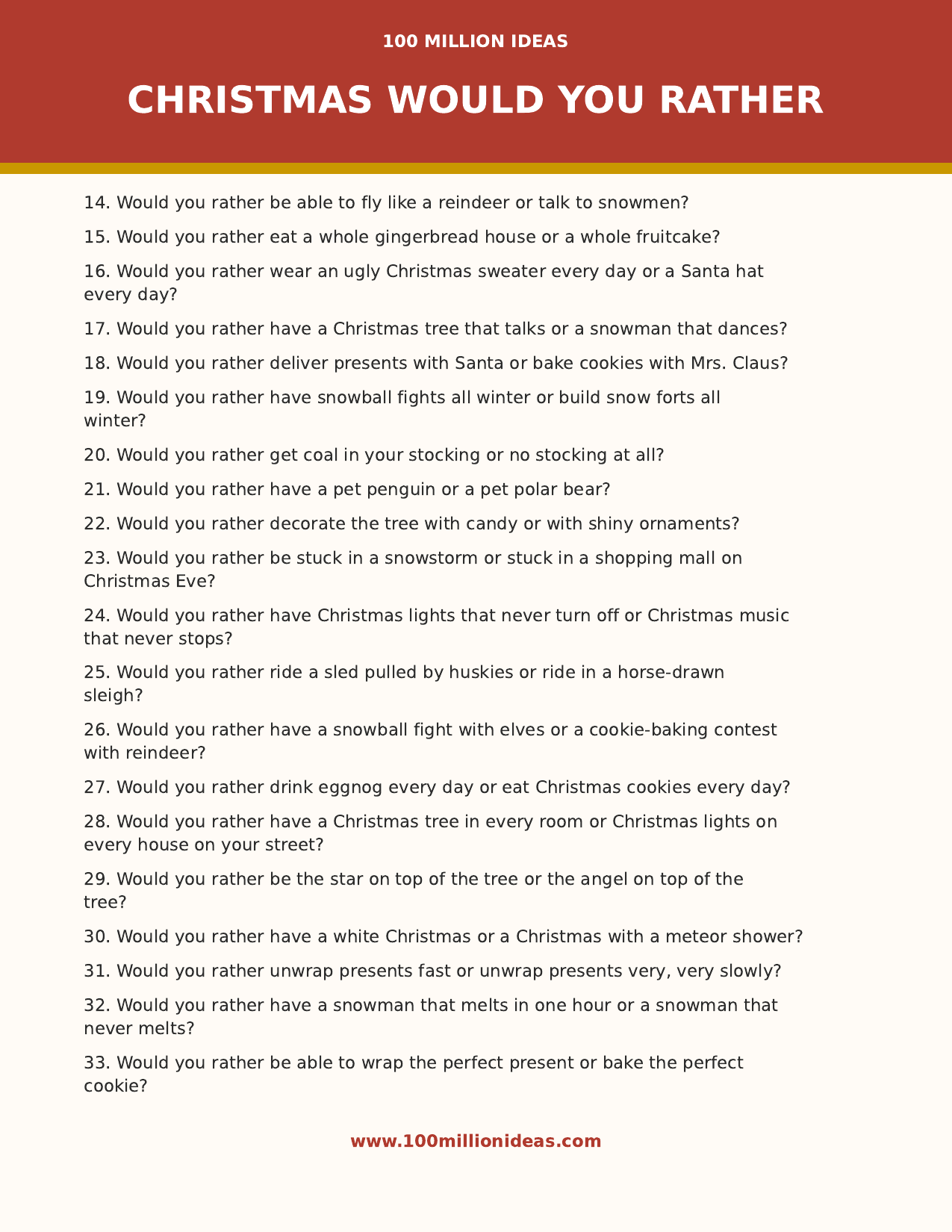
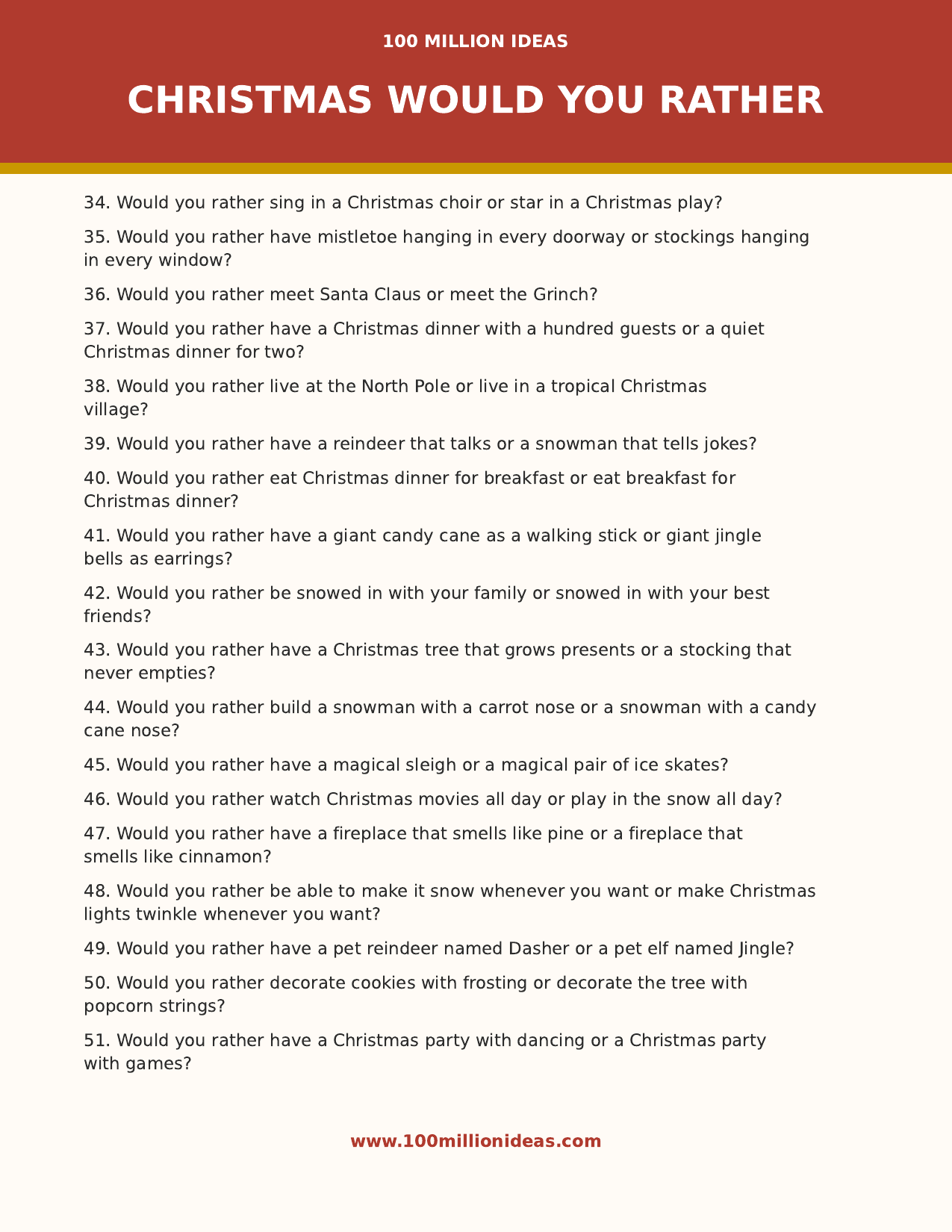
The sixty questions in the printable cover the whole of Christmas: snowmen and reindeer, gingerbread houses and Santa’s workshop, candy canes and hot cocoa, wrapping presents and untangling lights, being an elf and being a reindeer, Christmas every day and birthdays every day. The questions are deliberately balanced so that neither option is obviously better, because a question with an obvious answer is not a question at all. The best questions in the set are the ones where the room splits evenly and neither side can believe the other side chose what it did.
How to Get the Most Out of It
A would-you-rather game lives or dies on the discussion, so the host’s job is not to read questions quickly but to keep the conversation going. These habits make a real difference.
Ask follow-up questions. When someone gives an interesting reason, ask them one more question about it. If a player says they would rather live in a gingerbread house, ask them what they would do when it rains. If someone chooses to be an elf, ask them which job in the workshop they would want. One follow-up question often produces a better answer than the original question did.
Let the quiet players speak first. In a large group, the loudest voices will happily fill every silence. Going around the circle in turn, and starting with a different person each round, makes sure everyone gets heard, including the guests who would never volunteer.
Do not rush. The temptation is to race through the questions to get to the next one, but the game is at its best when a single question is allowed to breathe. If a question has produced a good discussion, stay with it. There are sixty questions on the sheet and you do not need to finish them all.
Keep it kind. Would-you-rather questions are at their best when they are playful rather than personal. If a question touches a sore spot for someone in the group, move on quickly and without comment. The game should make everyone feel included, not singled out.
Variations to Try
This or that voting. For a large party, turn each question into a vote: everyone stands on one side of the room or the other depending on their answer. It gets people moving, it makes the split visible instantly, and it is a good option for a party where guests have been sitting down for a while.
Speed round. Read questions quickly and give each player only a few seconds to answer, with no explanations allowed. It is fast, funny, and a good way to burn through a dozen questions in five minutes when time is short.
Kids’ host. Let a child be the reader. Children love being in charge of a game, and reading the questions out loud is a job they can do well even if they are too young to answer the trickiest ones themselves. Give them the sheet and let them pick which questions to ask.
Write your own. After playing through the printed questions, invite the group to invent their own. The best player-invented questions are usually the ones about the specific people in the room, and they are often funnier than anything printed, because they come from shared memories and private jokes.
Car journey version. This game needs no table, no pieces, and no writing, which makes it ideal for a long drive to visit family at Christmas. One passenger reads the questions, everyone in the car answers, and the miles pass far more quickly than they would in silence.
Christmas dinner version. Read one question between courses. It gives the table something to talk about during the natural pauses in a long meal, and it keeps the conversation going without anyone having to work at it.
Get the Printable Game in Our Shop
Get Christmas Would You Rather in our shop — on sale for $3 (regularly $5)
The printable includes all 60 questions on a clean, easy-to-read sheet, so the host can read straight from the page without preparing anything. It prints cleanly on ordinary home printer paper, in colour or black and white.
And if your family ends up playing this one on the drive home, in the car, and again at dinner, the Christmas Games Bundle — 24 games for $17 is worth a look: it bundles this game with twenty-three others for less than buying them singly.
Who It’s For
This is the most inclusive game in the Christmas collection, because it asks nothing of its players except an opinion, and everyone has one. It suits family parties where the age range runs from five to eighty-five, because a five-year-old can answer these questions just as confidently as an adult, and the adults are often more entertained by the children’s answers than by their own. It suits classroom parties, where a teacher needs a game that the whole class can play at once with no materials and no preparation. And it suits office holiday lunches, where a game that requires performing or revealing personal information would make people uncomfortable, but a light-hearted either-or question feels safe and fun.
It is also the best game in the collection for situations where other games will not work: in a car, at a dinner table, in a room with no table at all, or at a party where guests are arriving at different times and you need something that latecomers can join halfway through without missing anything.
Frequently Asked Questions
How many questions are in the game? Sixty questions, all printed on the game sheet.
Do we need to keep score? No. There are no wrong answers and no points. The game is about the discussion, not the result. If your group likes a competitive edge, you can award a point to the funniest reason for each question, but it is entirely optional.
Can young children play? Yes, this is one of the best Christmas games for young children. The questions use simple ideas that children understand, and there is no reading or writing required from the players, only from the person reading the questions.
How long does it take? As long as you want. Ten questions take about ten minutes. All sixty with full discussion can take 45 minutes or more. Stop whenever you like: there is no finish line to reach.
What if someone cannot decide between the two options? Encourage them to pick one anyway, even if it is a coin toss. The game only works if everyone commits to a side, and the funniest answers often come from people who chose at random and then had to defend their choice.
Can we play it in the car? Yes, it is ideal for car journeys. One passenger reads the questions and everyone in the car answers. No materials are needed at all.


