Christmas Light Scavenger Hunt
This post may contain affiliate links. As an Amazon Associate I earn from qualifying purchases.
There is a particular kind of magic in driving slowly through a neighbourhood in December, windows down despite the cold, while the whole car scans the houses for the next display. Someone spots a blow-up snowman and shouts, someone else argues it does not count because it is deflated, and the driver is told, very firmly, to slow down because there might be a reindeer with a red nose on the next street. A Christmas light scavenger hunt turns that ordinary December drive into a proper game, and it is one of the few Christmas activities that genuinely works for every age at once — toddlers point and shout, teenagers keep score with great seriousness, and adults get to enjoy the lights without anyone asking them to plan anything.
The idea is simple: a checklist of thirty things to spot, from a house outlined in white lights to a dog in the yard wearing a Christmas sweater, and a set time to find as many as you can. It works as a slow evening walk around your own neighbourhood, as a car tour of the best-lit streets in town, or as a competition between two cars racing to complete the list first. It needs almost no preparation, it costs nothing beyond the petrol, and it gets everyone out of the house and looking at the same thing at the same time, which is rarer than it sounds in December.
How the Hunt Works
Each player or team gets the same checklist of thirty displays to spot. The list covers the full range of what people actually put up in December: different styles of lights, such as a house with only blue lights, a house with red and green lights, and a house with icicle lights; yard displays, such as a blow-up snowman, a Santa on a roof, a reindeer with a red nose, a nutcracker soldier, and a penguin decoration; window displays, such as a Christmas tree glowing in a front window and a window with a Christmas village; and the delightful oddities, such as a mailbox wrapped like a gift, a house with a giant bow on it, a house playing Christmas music, and a house where every single window glows. There is also a Grinch decoration, a house with a projector light show, a train decoration, a gingerbread house decoration, a candy cane path along a driveway, and a house with a holiday countdown sign — thirty items that reward looking carefully rather than just driving past.
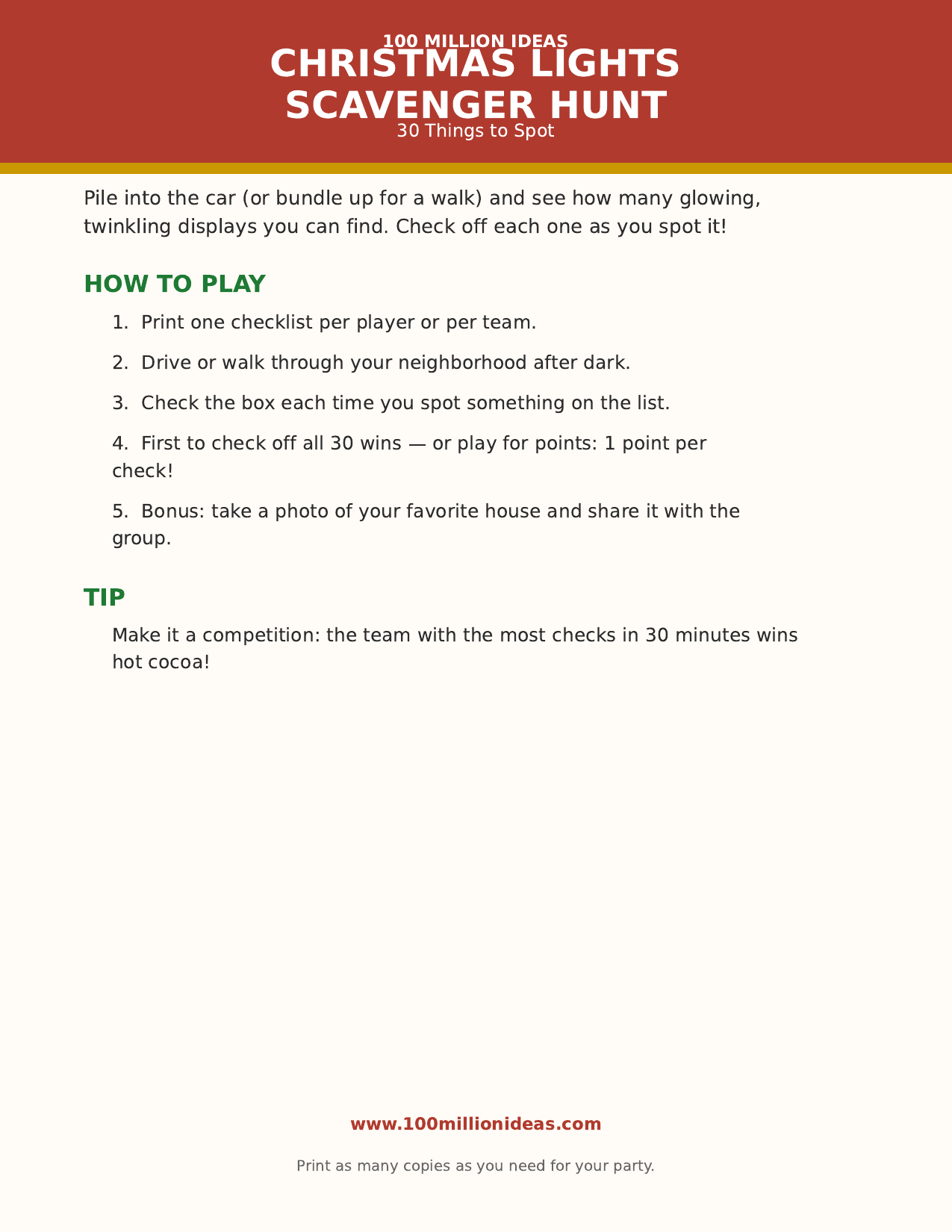
Players check off each item as they spot it, and each check is worth one point, for a maximum score of thirty. The printable suggests playing for points, one point per check, and the player or team with the most checks wins — or, if you prefer, the first to check off all thirty takes the prize. In practice, a full thirty is rare on a single outing, because some items, like the dog in a Christmas sweater or the house with a light-up snow globe, genuinely depend on luck. That is fine: a score in the high teens is a good night, and anything over twenty means you picked an excellent neighbourhood.
What You Need
The checklist is the main thing. Print one per player, or one per team if you are playing in teams, and bring a pen for each one — pencils are better for a car, since they do not roll off laps the way pens do. Bring a clipboard or a hard book for each player if you are walking, because a floppy sheet is hard to write on in gloves. Dress warmly, with hats and gloves, because even a twenty-minute walk in December feels long once you stop moving to look at a house.
If you are walking after dark, give each person a flashlight. It helps with reading the checklist, watching where you step, and staying visible to drivers. A small rechargeable flashlight is ideal because it is bright, light, and easy to carry: this Energizer TAC500 Rechargeable LED Flashlight, 2-pack is a handy size for a pocket or a coat, and the two-pack means two people can have one each. If you are driving, a flashlight is still useful for the passengers reading the list in a dark car.
For the driving version, you need a driver who is not playing — this is important, and it is covered properly in the safety section below — plus a navigator in the front seat who reads the list aloud and keeps the score. A phone with a map is useful for finding the best-lit streets in advance, and a thermos of hot chocolate for the journey home turns the end of the hunt into a small ritual of its own.

How to Play, Step by Step
Start by choosing your route before you leave the house. If you know your area, pick the streets with the most decorated houses — ask neighbours or check a local community page for the streets that go all out each year. If you do not know the area well, drive towards the older, established neighbourhoods first, since they tend to have more elaborate displays than new estates. Allow thirty to forty-five minutes for the hunt itself, and tell everyone the time limit before you start so nobody is surprised when it ends.
Hand out the checklists and pens, and read through the list together before you set off. This takes two minutes and it matters, because people will spend the first ten minutes asking what counts as a snowman family if they have not heard the list. Agree on the tricky calls in advance: a snowman family means three or more snowmen together, a house with only blue lights means blue lights and nothing else, and a Santa on a roof means an actual Santa figure, not a Santa-shaped light outline. The printable’s own tip suggests making it a competition, with the team that finds the most in thirty minutes winning hot cocoa — that thirty-minute version is a good default for families with younger children, because it keeps the pace brisk and the ending in sight.
Then set off. If you are walking, stay together as a group and let the children lead — they spot things adults walk straight past. If you are driving, go slowly, with hazards on if you are crawling along a residential street, and let the navigator call out items as they are spotted. The driver should not be looking at houses; their job is the road. When someone spots an item, they call it out, the navigator confirms it, and everyone with a checklist marks it off. There is no penalty for a wrong call beyond the gentle mockery of the rest of the car, which is usually punishment enough.
At the end of the time, everyone adds up their score out of thirty. Announce the winner, and if two players or teams tie, the tiebreaker is simple: the first to spot the next item on a five-minute extension round takes it, or the group votes on who found the hardest single item. Then go home, make the hot chocolate, and let everyone argue about whether the deflated snowman should have counted. It should not have, but the argument is part of the tradition now.
Staying Safe on a Night Hunt
A light scavenger hunt happens after dark, in the cold, often on streets with traffic, so safety is not a footnote — it is part of the plan. If you are walking, stay together as one group, keep children within sight at all times, and cross roads only at corners or crossings, never between parked cars. Wear something light-coloured or reflective if you have it, and carry a flashlight not just for the checklist but so that drivers can see you. Stick to pavements and well-lit streets, and go out in the early evening rather than late at night, when the displays are on, the streets are still busy, and everyone is more alert.
If you are driving, the driver does not play. That is a hard rule, not a suggestion: the driver’s eyes stay on the road, and the passengers do the spotting, the reading, and the scoring. Drive slowly, keep your headlights on, and pull over properly if you want to stop and look at a display — do not stop in the middle of the road, and do not let passengers lean out of windows. Keep the volume down when you pass houses late in the evening, and respect that the people inside those houses are living their normal lives while you admire their decorations.
Watch the weather and the ground. Icy pavements are the most common real hazard on a December walk, so wear shoes with grip, take short steps on any surface that looks wet and shiny, and skip the walk entirely if the pavements are iced over — the lights will still be there tomorrow. If anyone in the group is cold, tired, or has had enough, head home. The hunt is supposed to be fun, and a miserable, freezing child will not remember the lights, only the cold.
Variations for Different Groups
The walking version is best for families with younger children and for neighbourhoods where the displays are close together. It is slower, more sociable, and it lets children run ahead a few steps to the next house — within sight, always — which keeps their energy up. The driving version is better for older children and adults, for cold nights, and for covering a larger area with the best displays, including the streets across town that everyone talks about.
For a competitive group, try the timed race: two cars or two walking teams, the same thirty-minute limit, and the most checks wins. Give each team the same starting point and a rough boundary, such as a named set of streets, so the race is fair. For a gentler version, drop the time limit entirely and treat the list as a December-long challenge: keep the checklist on the fridge, take it with you whenever you go out in the evening, and see how many you can find before Christmas Day. This works beautifully for families who go out most evenings anyway, because the hunt becomes a habit rather than an event.
Add a photo bonus if your group enjoys it: the printable suggests taking a photo of your favourite house and sharing it with the group, and that is a lovely way to end the evening. One bonus point for the best photo, voted on by the group, gives the photographers something to aim for — but remind everyone to take photos from the pavement or the car, never from someone’s garden, and never to include people in the frame.
Tips for the Best Night Out
Go out in the early evening, roughly between five and seven, when the lights are on, the displays are at their best, and the streets still have people about. Later than that, some houses switch their displays off, and earlier than that, you lose the full effect of the lights against the dark. A clear, cold evening is ideal; a rainy one is not, because nobody enjoys a scavenger hunt with wet feet and a soggy checklist — if it rains, drive instead of walking, or save the hunt for the next clear night.
Pick your neighbourhood with intent. The best hunting grounds are streets where several houses have gone all out, because the list rewards density — you need a lot of houses to find thirty different things. A single street of spectacular displays will usually give you fifteen to twenty items on its own, and a second street nearby will give you the rest. If your own street is quiet, it is worth driving ten minutes to a better one.
Bring the hot chocolate with you or plan it for when you get home. The printable’s suggestion of hot cocoa for the winning team is a good one, but honestly, everyone deserves hot chocolate after a December night out, winners and losers alike. Make it the closing ritual: home, lights off, cocoa in hand, checklists spread on the table, and the argument about the deflated snowman reopened one final time.

Frequently Asked Questions
How long does a light scavenger hunt take? Thirty to forty-five minutes is right for most groups. The printable suggests a thirty-minute competition, which works well for families with younger children. If you are driving across town to the best streets, allow an hour including travel.
Can we do it on foot, or do we need a car? Both work. Walking is better when the displays are close together and the group includes young children; driving is better for cold nights, older children, and covering a larger area. The checklist is the same either way.
What ages is it suitable for? All ages. Toddlers enjoy pointing at lights even if they cannot keep score, children from about five up can manage their own checklist with help, and teenagers and adults enjoy the competition. It is one of the rare Christmas activities where nobody is too old or too young.
What if we cannot find all thirty items? That is normal — a full thirty is rare on a single outing. A score in the high teens is a good night, and anything over twenty is excellent. Treat it as a reason to go out again on another street, not as a failure.
Is it safe to walk around neighbourhoods after dark? Yes, with the basics covered: stay together, keep children in sight, use pavements and crossings, carry a flashlight, wear something visible, and go in the early evening rather than late at night. Skip the walk if pavements are icy.
Can we play it more than once? Absolutely. Different streets give you different items, and the list is hard enough that a second outing in a new area feels fresh. Many families turn it into a December tradition, hunting a new neighbourhood each weekend.
Get the Printable Game
Get the printable game in our shop: Christmas Lights Scavenger Hunt — $3 (regular $5) — a 3-page printable with the full 30-item checklist, how-to-play instructions, and space to keep score. Print one per player or per team and take it with you tonight.
Running a whole season of games? The Christmas Games Bundle — $17 (regular $21) includes this scavenger hunt along with more than twenty other printable Christmas games, from bingo and trivia to charades and the indoor riddle hunt, so you have a game ready for every December evening.