Christmas Word Search

There is a particular kind of quiet that only a word search can create. The tree lights are on, somebody is humming in the kitchen, and everyone at the table has their head bent over the same page, pencils moving, eyes scanning. A Christmas word search is one of the simplest activities you can put in front of a group of people — and one of the few that genuinely works for a seven-year-old, a teenager, and a grandparent at the same time.
This printable set gives you three full Christmas word searches, each with its own word list and its own answer key. Print one puzzle per person, hand out pencils, and you have an activity that fills ten unhurried minutes or a whole competitive round, depending on how you play it. It needs no explanation, no setup, and no cleanup. That is exactly why it belongs in your Christmas plans.
What’s Inside the Printable
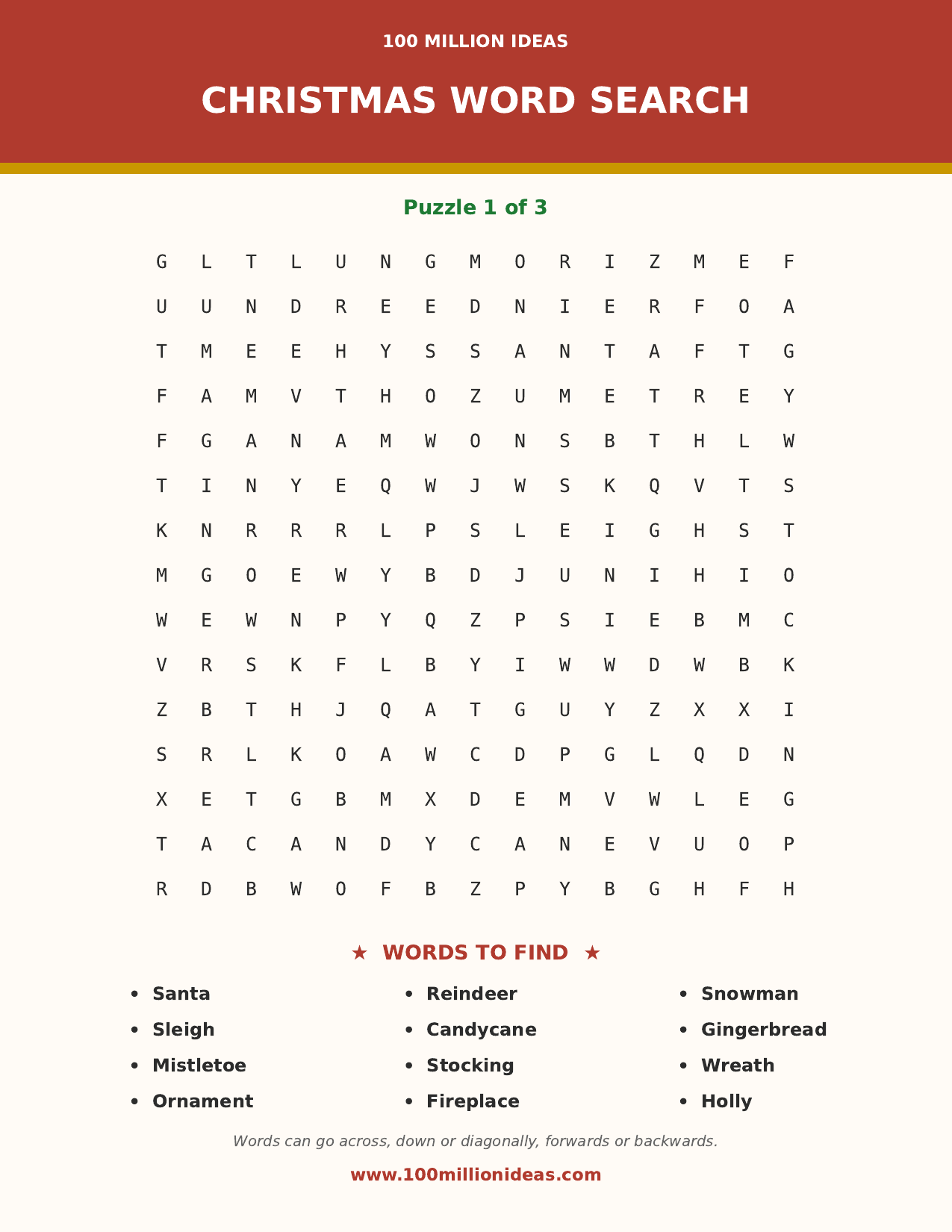
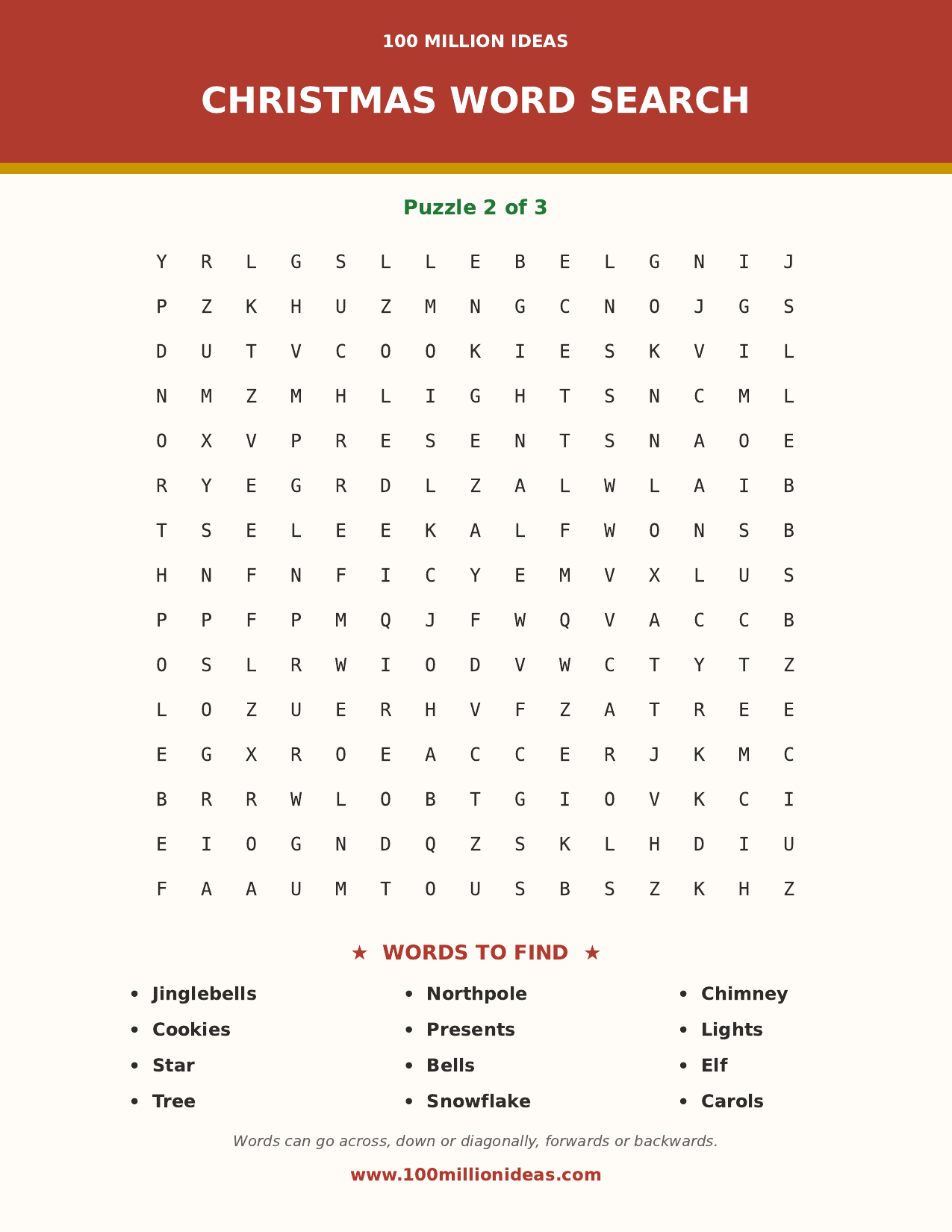
The download is six pages long: three puzzle pages and three matching answer key pages. Each puzzle hides twelve Christmas words in a square letter grid. Words can run across, down, or diagonally, and they can read forwards or backwards, so even the obvious words take a moment to spot.
Puzzle 1 is the gentle warm-up. Its twelve words are Santa, Reindeer, Snowman, Sleigh, Candycane, Gingerbread, Mistletoe, Stocking, Wreath, Ornament, Fireplace, and Holly — the classic vocabulary of the season, the words even the youngest players will recognise. Puzzle 3 turns the difficulty up a notch with Jinglebells, Northpole, Chimney, Cookies, Presents, Lights, Star, Bells, Elf, Tree, Snowflake, and Carols. Puzzle 2 sits in between, with its own word list, so the set works as a natural progression: start easy, build confidence, then finish with a puzzle that makes everyone concentrate.
Every puzzle has its answer key printed on a separate page, with the hidden words circled in the grid. That matters more than it sounds. When the answer key sits on the same page as the puzzle, somebody always peeks. Keeping them apart means you can hand out the puzzles freely and keep the keys with you until the round is over.

How to Play
The basic way to play needs no rules at all. Give each person a printed puzzle and a pen or pencil. Read the word list at the bottom of the page together, then everyone searches the grid for the words, circling each one as they find it. The first person to find all twelve wins — or, if you prefer a calmer version, everyone simply works at their own pace until the page is finished.
A pen is fine for confident adults, but a pencil is the better choice for children, because a wrong circle can be erased and the search can continue. A highlighter works beautifully too: one colour for the words found, and the grid stays readable underneath. If you are playing with a group, give everyone the same colour so nobody can tell at a glance who is ahead.
One practical tip from experience: read the word list out loud before anyone starts. It sounds unnecessary, but it stops the same three questions coming up later — how to spell “gingerbread”, whether “candycane” is one word, and what a word like “mistletoe” means. A thirty-second read-through saves five minutes of interruptions.
Playing Solo
A word search is one of the best solo Christmas activities there is. It is the thing you hand to one child while you wrap presents, or the page you take to the waiting room, or the quiet ten minutes you give yourself with a cup of tea on Christmas Eve. For a solo player, the goal is simply to finish: find all twelve words, check the answer key, and enjoy the small satisfaction of a completed grid. If you want a personal challenge, time yourself on Puzzle 1, then try to beat that time on Puzzles 2 and 3.
Playing as a Race
If your group likes competition, a word search race is easy to run and genuinely exciting. Hand out the same puzzle to everyone at the same moment, count down from three, and the first person to circle all twelve words and call out “done” wins. Check their page against the answer key before declaring a winner — in the excitement, people do circle words that are not quite there.
For a fairer race with mixed ages, give the younger players Puzzle 1 and the older players Puzzle 3 at the same time. Everyone finishes at roughly the same moment, and nobody feels outmatched. Small prizes make it better: the winner picks the next Christmas song, gets the first candy cane, or chooses the film for the evening.
Playing as a Team
Teams work wonderfully for word searches, especially at a party where not everyone knows each other. Split into teams of two or three and give each team one puzzle. One person scans across, one scans down, one hunts for diagonals. Teams talk, point, and argue good-naturedly about whether that really is “sleigh” or just wishful thinking. Give teams ten minutes and see who finds the most words. If two teams tie, the tiebreaker is the fastest to find a word you name on the spot — “first team to find Wreath wins.”
Who This Is For
This set is aimed at children aged about seven and up, but it is honestly for everyone. Younger children around five or six can play Puzzle 1 with a little help — an adult can read the word list and point them toward the first letter of each word, and the thrill of finding “Santa” on their own is worth the effort. Older children and adults will find Puzzle 1 relaxing and Puzzles 2 and 3 a proper challenge, especially the backwards and diagonal words.
It works in more settings than you might expect. At home, it fills the waiting time before dinner or while the turkey rests. In a classroom, it is a ready-made December activity that needs no preparation — print a class set, and you have a calm twenty minutes. At a Christmas party, it is the activity you put on the table while guests arrive, so nobody stands around awkwardly. In a church hall or community group, it works as a quiet table activity between the louder games. And on a long car journey to visit family, a printed puzzle and a pencil beat a screen every time.
When to Use It
Word searches are at their best in the in-between moments of Christmas — the gaps that every celebration has. Use one while dinner is cooking, while you wait for the last guests to arrive, during the quiet afternoon on Christmas Day when everyone is full and a little sleepy, or on the morning of Christmas Eve when the children are too excited to sit still but need something to do with their hands.
They also make a lovely stocking filler in a different sense: print the set, fold it into a card, and tuck it into a stocking or a Christmas Eve box with a new pencil. It costs almost nothing, and it gives a child something to do on Christmas morning that is not a screen.
Tips for a Better Game
Print the puzzles at 100 percent scale on plain white paper. Do not use the “fit to page” setting if it shrinks the grid, because the letters get small and hard to read, especially for older players. One puzzle per page is the right size; two puzzles squeezed onto one sheet is a false economy.
If you plan to use the puzzles more than once — in a classroom, for example — print them on slightly heavier paper or slip each puzzle into a clear plastic sleeve and hand out dry-erase markers. The puzzles wipe clean and can be used year after year. The same trick works for a party: laminate a few copies and reuse them at every Christmas gathering.
Keep the answer keys separate until the round is finished. If you are running a race, hold the key yourself and check the winner’s page. If children are playing on their own, let them check their own work at the end — finding a word they missed is part of the fun, not a failure.
For younger players, suggest a strategy. The best way to search a grid is to pick one word, find its first letter, and check every matching letter until the word appears. Random scanning feels faster but wastes time. Teaching a child that one small trick turns a frustrating puzzle into a satisfying one.
Variations to Try
Once you have played the puzzles straight through, there are several ways to make them fresh again. Try a relay: one player finds one word, then passes the puzzle to the next player, and the team finishes when all twelve words are found. Try a backwards-only round where players may only circle words that read backwards or diagonally — it is much harder than it sounds. Try a silent round where nobody may speak, which turns a noisy room quiet in seconds and is perfect for winding children down before bed.
You can also pair the word search with a second activity. The player who finishes first reads the words they found and has to use three of them in a Christmas sentence. Or each word found earns a point, and the points buy clues in another game. The puzzles are a starting point, not just a one-time activity.
Frequently Asked Questions
How long does one puzzle take? Most adults finish a puzzle in about five to ten minutes. Children take a little longer, usually ten to fifteen minutes, and a full set of three puzzles fills a relaxed half hour. As a race, a single puzzle takes about five minutes from the countdown to the winner calling out.
What ages is this word search suitable for? Children aged seven and up can play independently. Five- and six-year-olds can play Puzzle 1 with an adult reading the word list and helping them spot first letters. Adults enjoy it too, especially Puzzles 2 and 3, where the diagonal and backwards words keep it interesting.
Do I need anything besides the printout? Just a pen or pencil per player. A pencil is best for children, and a highlighter is a nice touch for adults. No other supplies are needed.
Can I reuse the puzzles? Yes. Print them on card or slip them into clear sleeves and use dry-erase markers, and the same set will last for years. Without that, simply reprint — the file is yours to print as many times as you like for your own family or classroom.
What if someone cannot find a word? That is what the answer keys are for. Let them search for a few more minutes first, then show them the key for that one word only. There is no shame in it — the backwards words hide well, even for adults.
Get the Printable in Our Shop
Get the printable game in our shop: Christmas Word Search — $3
The full set — three puzzles plus three answer keys — is available as an instant download in our shop for $3. Print as many copies as you need for your family, your classroom, or your party. If you are collecting quiet activities for the kids, the Kid Activities Bundle — $11 includes this word search along with our other printable activity sets, so you can stock up on calm Christmas entertainment in one go.
You may like to read!
- Christmas Party Food Ideas
- Best Christmas Jokes to Read
- Ultimate Christmas Kids Bucket List
- Christmas Family Bucket List Ideas
- Fun Healthy Holiday Snacks
Images:
- Cover: ~/workspace/100millionideas-shop/covers/christmas-word-search.png
- Body images: rendered pages of ~/workspace/100millionideas-shop/files/christmas-word-search.pdf — page 1 (Puzzle 1 grid), page 3 (Puzzle 2 grid), page 5 (Puzzle 3 grid); answer key pages 2, 4, 6 only if showing solutions.


