Christmas Recall

This post may contain affiliate links. As an Amazon Associate I earn from qualifying purchases.
Put twenty Christmas objects on a tray, give everyone sixty seconds to look at them, cover the tray, and ask them to write down everything they remember. It sounds like a game for children. It is not. It is a game that humbles confident adults, because memory is not about intelligence — it is about attention, and attention is the first thing to go in a busy room full of people talking, eating, and reaching for another mince pie.
Christmas Recall, also known as the Yuletide Recall Game, is a memory game built around a tray of Christmas things: a candy cane, a snow globe, a red stocking, a gingerbread man, a gold star tree topper, a string of fairy lights, a green wreath with a red bow, a toy drum, a blue glass bauble, a chocolate Santa, a wooden nutcracker soldier, a pair of jingle bells, a pine cone, a plush reindeer, a Santa hat, a tin of shortbread, a paper snowflake, a candle in a brass holder, a small toy train, and a Christmas cracker. Twenty items, sixty seconds, and then the tray disappears. What you remember, and what you forget, will surprise you.
The game takes about fifteen minutes, needs nothing but the printed sheets, and works for any group from four players to forty. It is quiet, which makes it the perfect game for the part of the evening when the loud games have finished and people want something calmer. It is also one of the few party games where the person who wins is not the loudest or the fastest, but the one who looked the hardest.
What Is Christmas Recall?
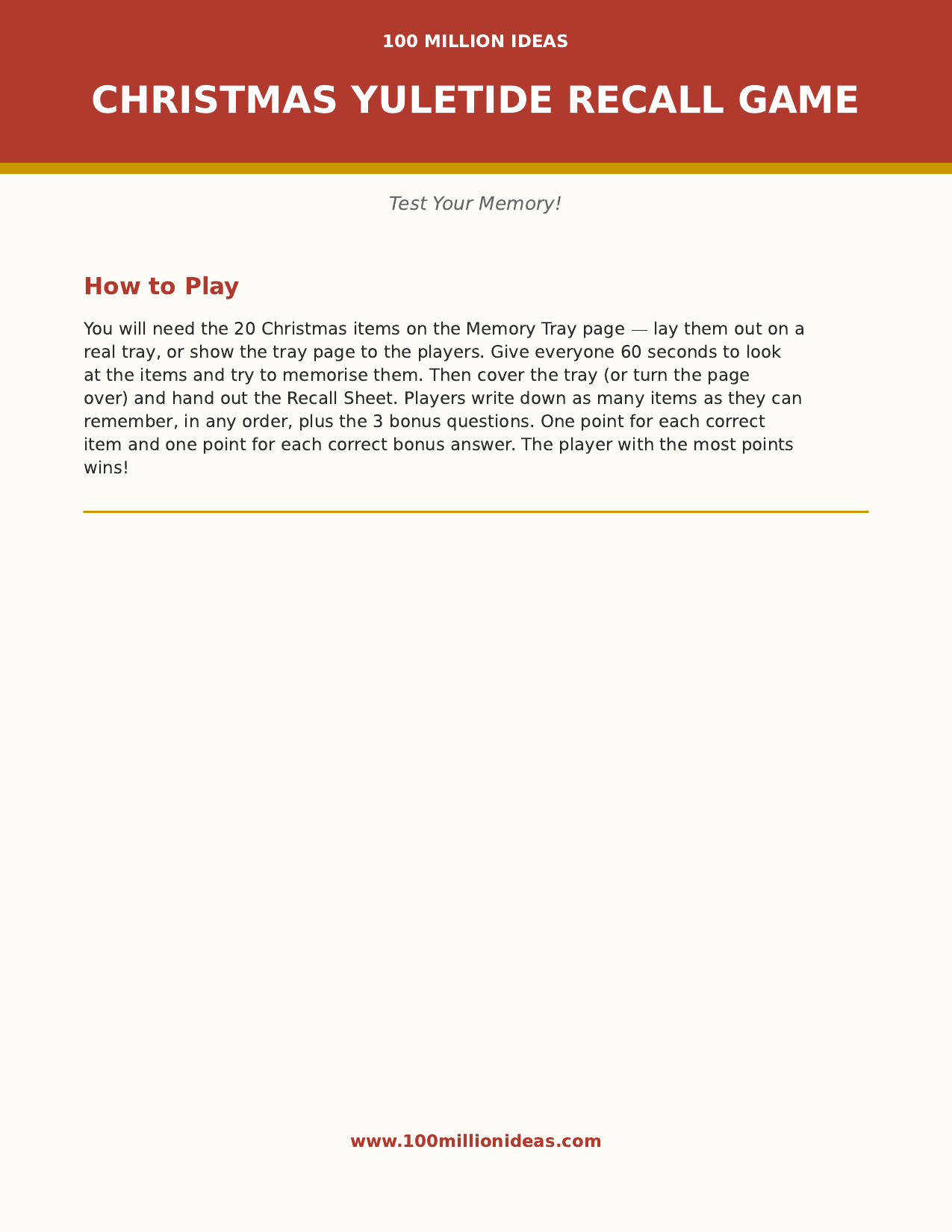
The game has three parts: a memory tray page showing twenty Christmas items, a recall sheet with twenty blank lines, and three bonus questions. The host shows the tray to the players for sixty seconds. Then the tray is covered or turned over, the recall sheets are handed out, and the players write down as many of the twenty items as they can remember, in any order. One point for each correct item, and one point for each correct bonus answer. The player with the most points wins.
The bonus questions are what make the game interesting, because they test a different kind of memory. They ask not just what was on the tray, but what it looked like: what colour was the bow on the wreath, what animal was the fourteenth item, what colour was the glass bauble. A player who remembers that there was a wreath but cannot remember the colour of its bow gets one point and misses another. It rewards the players who really looked, rather than the ones who glanced and guessed.
The twenty items are all things you would find in a house at Christmas, which is why the game works so well. Nobody needs to learn anything new. The challenge is purely in the remembering, and the items are familiar enough that every player starts on equal footing. A child who has just helped decorate the tree and a grandparent who has decorated fifty trees both know what a bauble looks like. The difference is in who paid attention for those sixty seconds.
What You Need
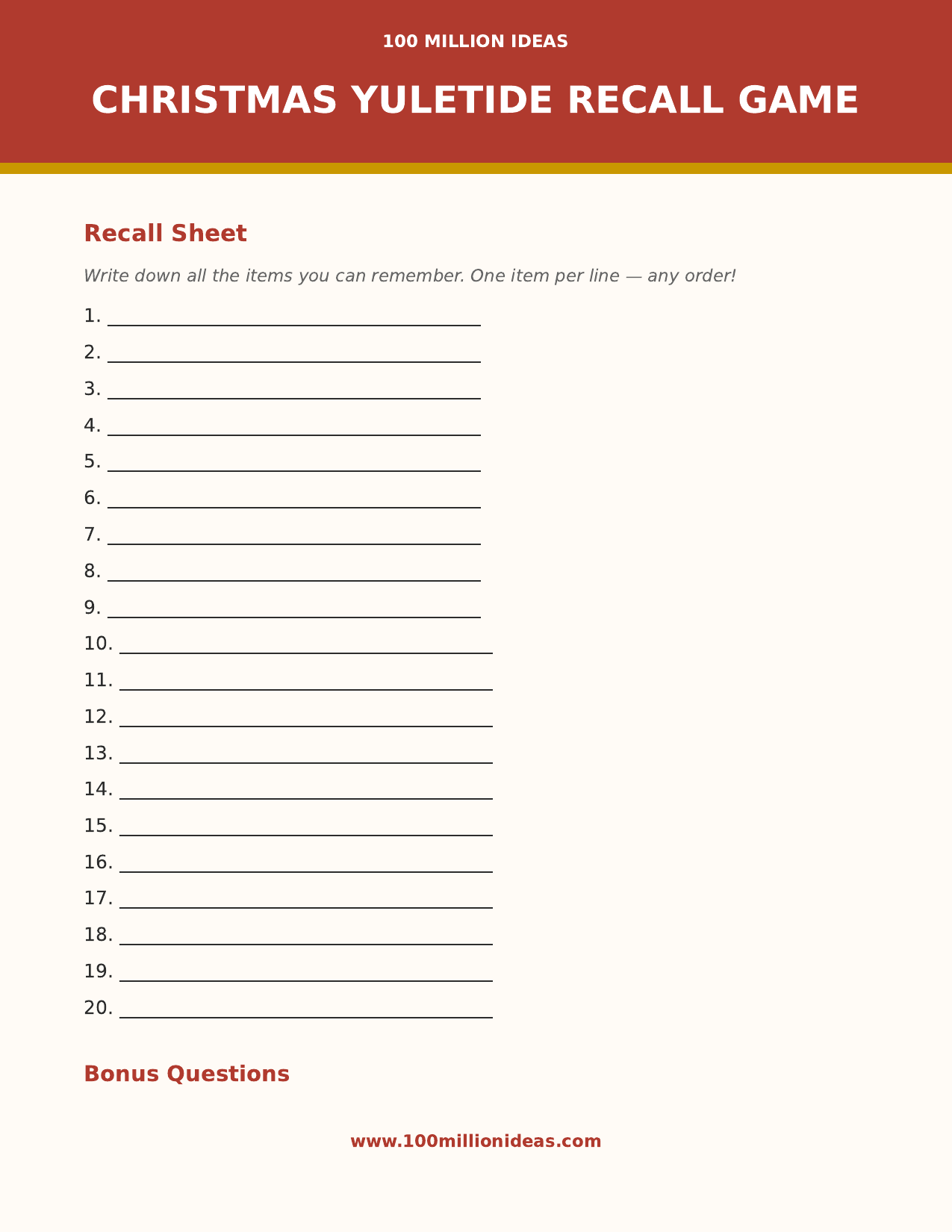
The printed game, which is five pages: the instructions, the memory tray page, the recall sheet, the bonus questions, and the answer key. Print one recall sheet per player, and print one memory tray page for the host to show the group. The bonus questions can be printed on the same sheet as the recall sheet, or read out loud by the host after the players have finished writing — either works, but printing them on the sheet is simpler, because it means the host does not have to remember them.
You need a pencil or pen per player, and a timer set to sixty seconds. A phone timer is fine. You also need something to cover the tray page with — a tea towel, a sheet of paper, or just turning the page face down. If you are playing with a real tray of objects instead of the printed page, you need a cloth large enough to cover the tray.
You can play the game in two ways: with the printed tray page, or with a real tray of real objects. The printed page is easier, because everything is laid out for you and the answer key matches it exactly. The real tray is more fun, because the objects are three-dimensional and people can pick them up in their minds. If you play with a real tray, gather the objects from around your house — a candy cane from the tree, a bauble, a pine cone from the garden, a pair of jingle bells — and arrange them on a tray or a baking sheet. Keep the printed answer key beside you so you can mark the scores, and remember that the bonus questions in the printed game refer to the printed tray, so you will need to write your own bonus questions for a real tray. Something like “what colour was the bauble” or “how many bells were there” works well.
If you need jingle bells for your tray and do not have any in the house, a bulk pack of craft bells is inexpensive and useful for all sorts of Christmas decorating afterwards. A pack like this 100-piece set of 1-inch jingle bells in red, green, gold, and silver gives you plenty for the tray, plus spares for gift wrapping, wreaths, and children’s crafts.

How to Play
Start by handing out the recall sheets face down, and tell the players not to turn them over yet. Then show the memory tray page to the group. If you are using the printed page, hold it up where everyone can see it, or pass it around. If you are using a real tray, place it in the middle of the table where everyone can see it. Start the timer. The players have sixty seconds to look at the twenty items and try to memorise them.
Sixty seconds is shorter than it sounds. The first ten seconds are spent looking at the tray as a whole. The next twenty are spent noticing individual items. The last thirty are spent panicking, because the player has realised they have only really noticed six things and there are fourteen more. That panic is the game. Tell the players when there are ten seconds left, so they can take one last look at the items they have not yet memorised.
When the timer goes off, cover the tray. Turn the page over, or cover the real tray with a cloth, and do not let anyone peek. Then tell the players to turn over their recall sheets and start writing. They write down as many items as they can remember, in any order, one per line. There is no time limit on the writing — let them take as long as they need, which is usually three or four minutes. When everyone has finished, read out the bonus questions and let them write their answers underneath.
Then mark the scores. Read out the twenty items from the answer key, slowly, and let each player tick the ones they got right. One point for each correct item, and one point for each correct bonus answer. The maximum score is twenty-three: twenty items plus three bonus questions. In practice, most players score between eight and fourteen, and a score above seventeen is genuinely impressive. The player with the most points wins.
Scoring and Winning
The scoring is generous by design. Spelling does not matter — if a player writes “nutcracker” instead of “wooden nutcracker soldier,” it counts. If a player writes “lights” instead of “string of fairy lights,” it counts. The game is about remembering what was there, not about writing a catalogue description. If a player writes something that is close but not quite the item — “red hat” for the Santa hat — the host decides, and the host should be generous.
The bonus questions are worth the same as an item: one point each. They are the difference between a good score and a winning score, because most players remember the items but forget the details. The player who noticed that the bow on the wreath was red, that the fourteenth item was a reindeer, and that the bauble was blue is the player who was really looking, and the bonus questions reward that.
If two players tie, the tiebreaker is simple: the player who remembered the most items in the correct order wins. Or, if you want something quicker, ask both players to name the item they think was in the middle of the tray. The one who gets it right wins. Decide the tiebreaker before the game starts, so the ending is clean.
Who This Game Is For
Christmas Recall is at its best with players aged eight and up, because it needs the kind of focused attention that younger children find hard to sustain for a full minute. Children aged eight to twelve are often the best players, because they look at things the way the game asks them to — carefully, and without assuming they already know what is there. Adults, by contrast, tend to glance at the tray, think “I know what Christmas looks like,” and then discover that they remember six items and have invented four more.
It works for families, for classrooms, for church groups, and for work parties. It is especially good for a group that includes older relatives, because it is a game where a grandparent’s careful attention can beat a teenager’s speed. It is also a good game for a group that includes someone who does not like loud, competitive games, because it is quiet, individual, and there is no shouting.
It is one of the best games for a classroom at Christmas, because it is genuinely educational without feeling like it. Teachers use memory tray games because they build observation and recall, and this one does it with Christmas objects that children are already excited about. It takes fifteen minutes, it needs no preparation beyond printing, and it leaves the class calmer than most party games do.
Tips for Remembering More
The players who score highest do not have better memories. They have better strategies, and the strategies are simple enough to teach in thirty seconds before the game starts. The first is to group the items: look for the food (candy cane, gingerbread man, chocolate Santa, shortbread), the tree decorations (star topper, bauble, fairy lights, jingle bells), the soft things (stocking, plush reindeer, Santa hat, paper snowflake), and the rest. Four groups of five is much easier to remember than twenty separate items.
The second strategy is to look for colour. The tray has a red stocking, a blue bauble, a red bow, a gold star. Colour is a strong memory hook, and the players who note the colours are the ones who answer the bonus questions correctly.
The third strategy is to tell yourself a story as you look. The Santa hat is next to the shortbread because Santa eats shortbread. The nutcracker stands guard over the chocolate Santa. It does not matter whether the story is true. What matters is that it links the items together, and linked items are easier to remember than isolated ones.
The fourth strategy is the simplest: keep looking. The players who do worst are the ones who look at the tray for twenty seconds, decide they have seen enough, and look away. The tray is there for sixty seconds. Use all sixty. Every second you spend looking is another item you might remember.
Variations to Try
The kids’ version. For children under eight, show only ten items instead of twenty, and give them ninety seconds instead of sixty. You can do this by covering half the printed tray page with a piece of paper, or by putting only ten objects on a real tray. Ten items is the right number for a young child: enough to be a challenge, few enough to be achievable.
The team version. Split into teams and give each team one recall sheet. The team works together to write down as many items as they can remember, which means they can pool their memories — one person remembers the bauble, another remembers the drum, and together they get both. Team scores are usually higher than individual scores, and the discussion afterwards, when the team realises they all forgot the pine cone, is half the fun.
The real tray version. Replace the printed page with a tray of real objects from around the house. It is more work to set up, but it is a better game, because real objects have weight and texture and smell, and those are all memory hooks. Use the printed answer key as your guide for how many items to include, and write three bonus questions of your own about the details of your objects.
The speed version. For a group that has played before, cut the viewing time to thirty seconds. It is a noticeably harder game, and the scores drop by about a third, which makes the players who have a strategy stand out even more.
The progressive version. Play three rounds with the same tray, but each round you remove one item while nobody is looking. The players have to spot what is missing, not just what is there. It is a different skill, and it is surprisingly hard — most people cannot tell you what was on the tray, let alone what has been taken off it.
Frequently Asked Questions
How many people can play? Four is the minimum, and there is no real maximum. With more than twenty players, hand out the sheets and show the tray page on a screen or pass it around the room so everyone gets a proper look.
How long does it take? About fifteen minutes: one minute of looking, three or four minutes of writing, and five minutes of marking and discussing the answers. The discussion afterwards — “I cannot believe I forgot the snow globe!” — often takes as long as the game itself, and it is the best part.
What ages is it suitable for? Children from about eight up can play the full game. Younger children can play the kids’ version with ten items and more time. There is nothing in the game that is unsuitable for any age.
Can I play it with a real tray instead of the printed page? Yes, and it is a better game that way. Gather twenty Christmas objects, arrange them on a tray, and use the printed recall sheet and answer key structure. Just remember to write your own bonus questions, because the printed ones refer to the printed tray.
What if someone peeks at the tray while writing? Cover the tray properly and the problem does not arise. If someone does peek, the host should disqualify their score for that round — but say it with a smile, because the game is meant to be fun, and a peek is usually a sign that someone is enjoying themselves too much rather than cheating.
Can I play it over a video call? Yes. Share the tray page on screen for sixty seconds, then stop sharing and let everyone write their answers on paper at home. It works well, and it is one of the better video call games because the looking and the writing are both silent.
Get the Printable Game
The Christmas Yuletide Recall Game printable includes the memory tray page with all twenty items, the recall sheet, the three bonus questions, and the full answer key. It is $3 on sale (regularly $5) in our shop.
Get the Christmas Yuletide Recall Game — $3 (regularly $5)
And if you are planning a full Christmas games night, the Christmas Games Bundle includes 24 of our printable games for $17 (regularly $21) — Yuletide Recall, Christmas Trivia, Christmas Bingo, Christmas Charades, and twenty more.
Get the Christmas Games Bundle — $17 (regularly $21)