Christmas Quiz Board
Some quiz games feel like school. This one feels like a game show in your living room. A big board with five categories and five point values, two teams, a host with the answer key, and a steal rule that keeps everyone involved even when it is not their turn — that combination is why this format has survived decades of party games. The Christmas Quiz Board takes that structure and fills it with Christmas questions, so the game is about the holiday everyone is already thinking about.
What makes it work as a party game, rather than just a list of questions, is the board itself. Choosing a category and a dollar value is a decision, and decisions are fun. A team that is behind can gamble on a $500 question. A team that is ahead can play it safe. And the steal rule means a wrong answer is not a dead moment — it is the other team’s chance. If you have ever watched a room go quiet while a team debates a $500 question, you know exactly the feeling this game creates.
At a Glance
- Players: 4 to 20 (two teams; larger groups split into two big teams)
- Ages: 8 and up — younger children can play on a team with adults
- Time needed: 25 to 35 minutes for a full board
- What you need: the printed board and question sheets, a pen for scorekeeping, and a host
- Best for: family game night, office holiday parties, classroom quizzes, and Christmas Eve with competitive relatives
What’s Included in the Printable
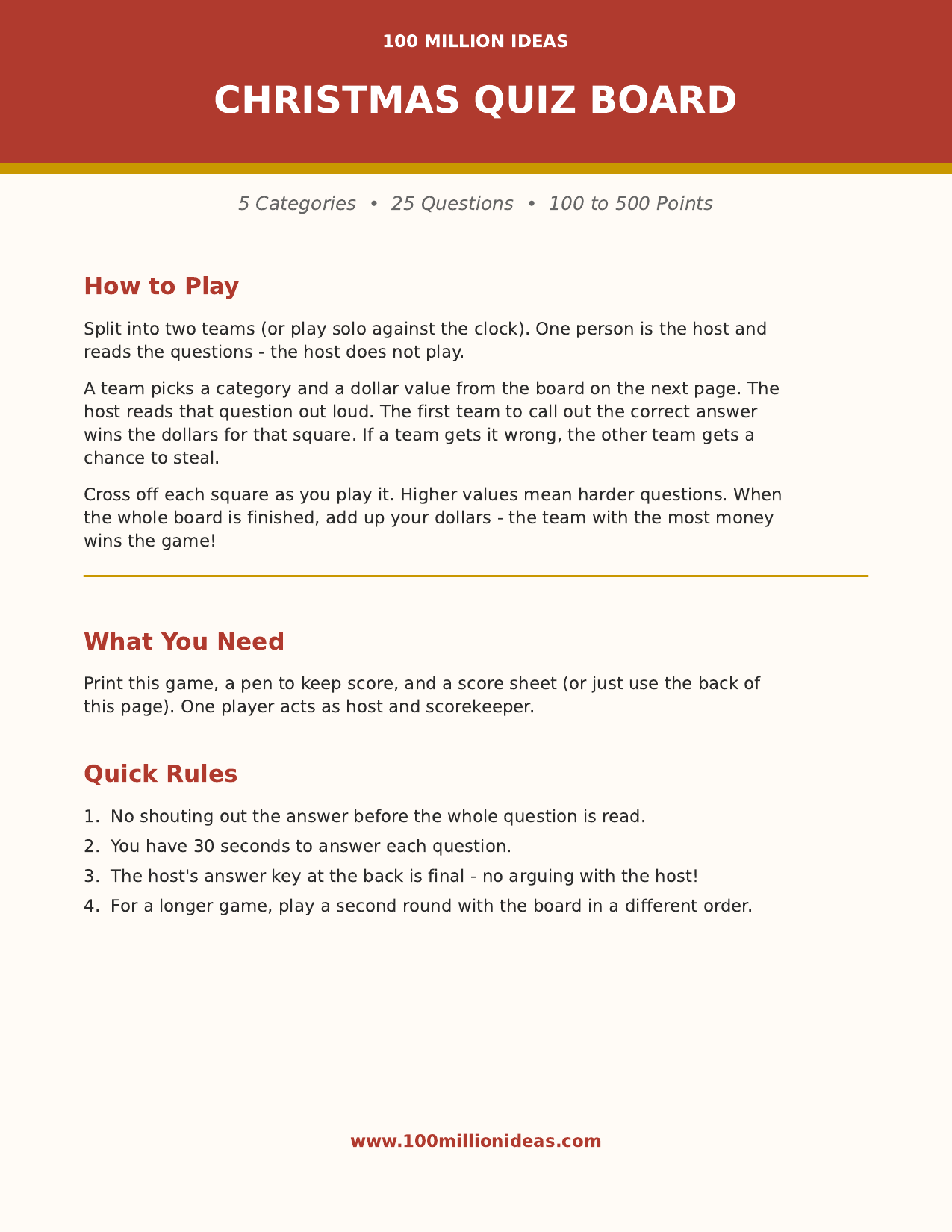
The download is a 6-page PDF plus a PowerPoint version of the board, so you can play it on paper around a table or project it on a screen for a bigger room.
The board: 5 categories, 25 questions. The five categories are Christmas Movies, Santa’s Workshop, Christmas Carols, Deck the Halls, and Sweet Treats. Each category has five questions worth $100, $200, $300, $400, and $500. The higher the value, the harder the question — a $100 question is something most of the room will know, and a $500 question is the kind that makes a team huddle and whisper.
The question sheets. Every question is written out in full, organized by category and value, so the host can run the game from the printed sheets without memorizing anything.
The answer key. A complete answer key sits at the back of the pack, with the correct answer for all 25 questions. The host keeps this; nobody else sees it until scoring is done.
The PowerPoint board. If you have a TV or a projector, the included PowerPoint shows the board on the big screen, which changes the feel of the game completely — it becomes a show, and the room watches the board the way an audience watches a stage. This is the version to use for an office party or a classroom.
Get the Printable Game in Our Shop
Get Christmas Quiz Board in our shop — on sale for $3 (regular $5)
The download includes the printable board, all 25 questions, the answer key, and the PowerPoint version for playing on a screen. Hosting a whole game night? The Christmas Games Bundle — $17 includes this quiz board and 23 more Christmas games — enough to fill an entire evening without repeating a game.
What You Need to Play
- The printed board and question sheets — print the board on one page and lay it where everyone can see it, or project the PowerPoint. Print the question sheets for the host only.
- A pen and paper for scorekeeping — or the back of any spare page. One person keeps the running totals where everyone can see them; a visible score makes the game ten times more exciting.
- A host — one person who reads the questions and does not play. This is the most important ingredient. The host sets the pace, enforces the time limit, and settles disputes with the answer key.
- Two teams — split the room as evenly as you can. If one team has all the Christmas film experts, rebalance before you start. Mixed teams are more fun than stacked ones.
How to Play Christmas Quiz Board
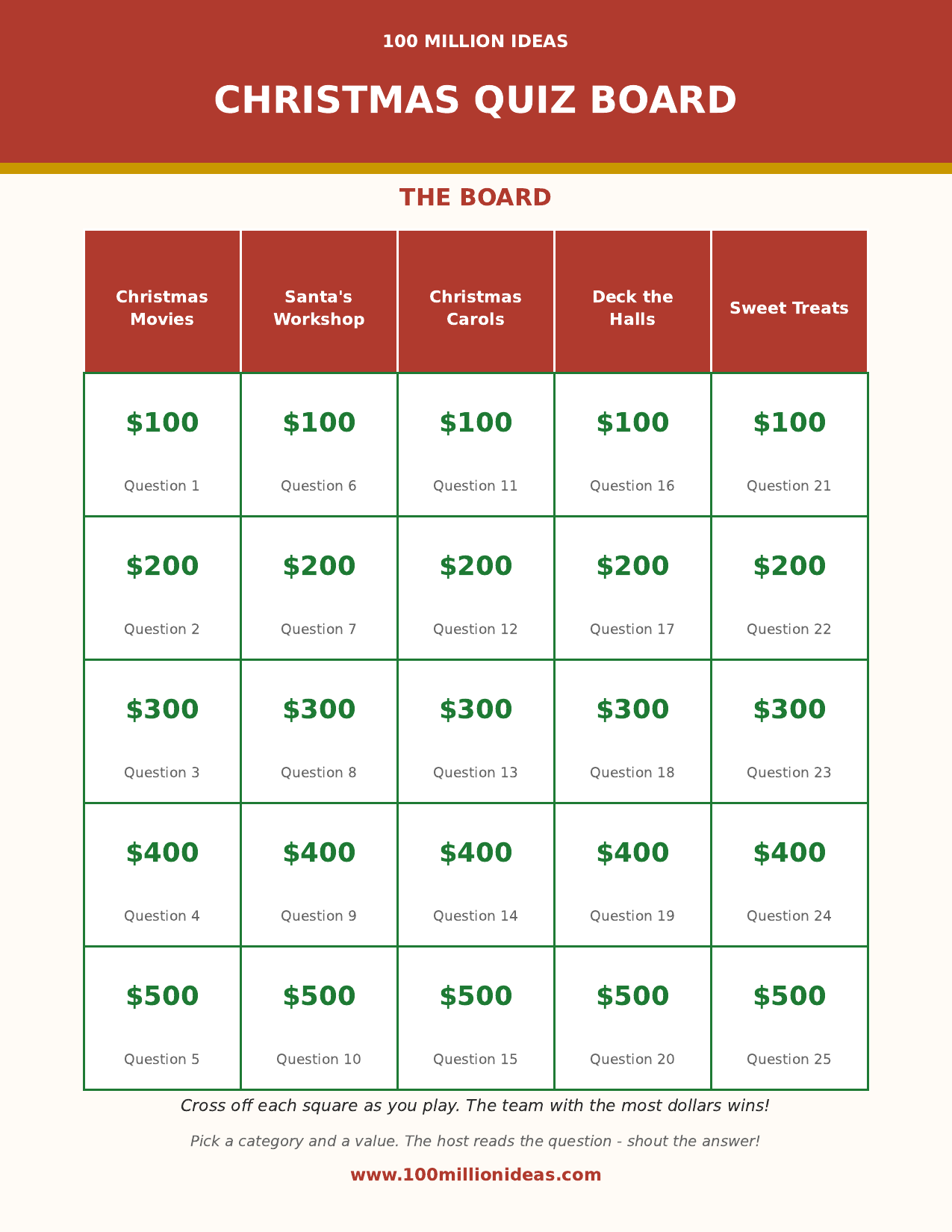
1. Split into two teams and pick a host
Two teams of roughly equal size, and one host who reads the questions and keeps score. The host does not play and does not answer. If your group is small — four people, for example — play as two teams of two. If your group is large, two big teams of ten work fine, as long as each team picks one spokesperson to give the final answer.
2. Put the board where everyone can see it
Lay the printed board on the table, or project the PowerPoint on the TV. Cross off each square as it is played, so the board shows at a glance which questions are left and which categories are running low.
3. Teams take turns choosing
The team that goes first picks a category and a dollar value — for example, “Christmas Carols for $300.” The host reads that question out loud, once, in full. The team has 30 seconds to agree on an answer, and the spokesperson gives it.
4. Correct answers win the dollars; wrong answers can be stolen
If the team’s answer is correct, they win the dollars for that square and the scorekeeper adds it to their total. If the answer is wrong, the other team gets one chance to steal — they discuss briefly and give their answer. If they are right, they win the dollars. If they are wrong too, nobody scores and the host reveals the correct answer before moving on.
5. Play until the board is finished
Teams alternate picks until every square on the board has been played. Add up the dollars. The team with the most money wins the game — and, if you are playing for a prize, the honor of choosing the next game.
The Rules That Keep It Fair
These rules are worth stating out loud before the first question, because they prevent nearly every argument a quiz game produces. The first three come printed in the pack itself:
- No shouting out the answer before the whole question is read. The host finishes the question, then the team discusses. Anyone who blurts an answer out of turn gives the other team a free clue.
- 30 seconds per question. The host counts it down. Without a time limit, a $500 question can eat five minutes while a team debates. With one, the pressure is part of the fun.
- The host’s answer key is final. No arguing with the host. If the answer key says it, that is the answer. This rule sounds stern and it is the reason the game stays friendly.
- One spokesperson per team. The team discusses, but one person gives the final answer. This stops two people on the same team answering at once with different answers.
Tips for Hosting a Great Game
- Read the questions slowly and clearly. The most common hosting mistake is rushing. Read the question once at a normal pace, pause, and read it once more if anyone asks. A question nobody heard is a question wasted.
- Keep the score visible. Write the running totals on a whiteboard, a big piece of paper, or the TV screen. A visible score creates the drama — teams can see exactly how far behind they are and start gambling on the $500 questions.
- Play a second round with the board in a different order. The questions are the same, but the order changes the game: teams that avoided a category the first time have to face it the second time. If your group wants a longer evening, this is an easy way to get one.
- Let the losing team pick the next game. It softens the loss, it keeps the evening moving, and it stops the winners from choosing a game they are already good at.
- For a classroom, use the PowerPoint and split the class into two big teams. The screen version works beautifully with thirty children, and the steal rule means even the quieter children stay engaged, because their team’s chance can come at any moment.
Variations for Different Groups
- Solo against the clock: one player works through the board alone, with 30 seconds per question, and the score is the number of dollars earned. Compare scores across family members over the evening — it becomes a leaderboard.
- Kids versus adults: children pick from the $100 and $200 rows, adults from the $300 to $500 rows. The different difficulty levels even the game out, and the children win more often than the adults expect.
- Speed round: cut the discussion time to 15 seconds for the last five questions. The game gets louder, faster, and funnier — save this for the end, when everyone is warmed up.
- Themed team names: let each team name itself something Christmassy — the Reindeer, the Elves, the Snowmen. It is a small touch and it makes the scoreboard more fun to look at.
Who This Game Is For
The quiz board is the best choice in this collection for a group that likes to compete but does not want anything physical or performative. For an office party, it is ideal: it needs no acting, no singing, and no personal sharing, and it works for twenty people as easily as for six. For a family Christmas Eve, it settles the question of who knows the most about Christmas — and gives the losers a full year to prepare a rematch. For teachers, it is a ready-made classroom quiz that runs itself once the host has the sheets: five categories, a clear structure, and an answer key that ends every dispute.

Frequently Asked Questions
How many people can play? Four to twenty works well as two teams. Below four, play solo against the clock. Above twenty, split into more teams and take turns, or play the PowerPoint version with the whole room as two big teams.
How long does a full game take? About 25 to 35 minutes for the whole board, including discussion time. A second round adds another 25 minutes.
Can younger children play? Children from about eight up can play on a mixed team, where the adults handle the harder questions and the children take the $100 and $200 rows. Under eight, they are better as audience members with a small job — scorekeeper’s assistant is a popular one.
Do I need the PowerPoint, or is the printed board enough? The printed board is enough for a table of up to about ten people. For a bigger room, a classroom, or an office party, the PowerPoint on a screen is much better, because everyone can see the board at once.
What happens if both teams get a question wrong? Nobody scores. The host reveals the correct answer, crosses off the square, and play passes to the next team.
Can we play with three teams? Yes — take turns in rotation, and let either of the other two teams steal if the answering team gets it wrong. The first team to call out gets the steal, which adds a nice bit of urgency.