Christmas Picture Word Game
Some party games are loud. This one is quiet in the best way: a room full of people leaning over a sheet of paper, muttering word pairs under their breath, and then suddenly laughing out loud when the answer clicks. The Christmas Picture Word Game is a set of 30 puzzles where each answer is a Christmas word or phrase broken into two pieces. Say the pieces together — “snow” plus “man,” “jingle” plus “bells” — and the answer appears. It sounds easy. It is not, and that gap between sounding easy and actually being easy is exactly what makes it fun.
The puzzles work because they use a different part of your brain than trivia does. Trivia asks what you know. These puzzles ask you to hear something: two ordinary words that become a Christmas word when you put them together. Children are often better at them than adults, because children are less embarrassed about sounding words out loud — and sounding them out is the whole trick.
At a Glance
- Players: 1 to 30 (play solo, in pairs, or as a whole room)
- Ages: 7 and up — readers of any age can play; younger children can play with a partner
- Time needed: 10 to 20 minutes, depending on how you play it
- What you need: printed puzzle sheets, pens, and the answer key
- Best for: classroom parties, family game night, stocking-stuffer games, quiet time at a gathering, and party favors
What’s Included in the Printable
The download is a 4-page PDF with 30 picture-word puzzles and a full answer key.
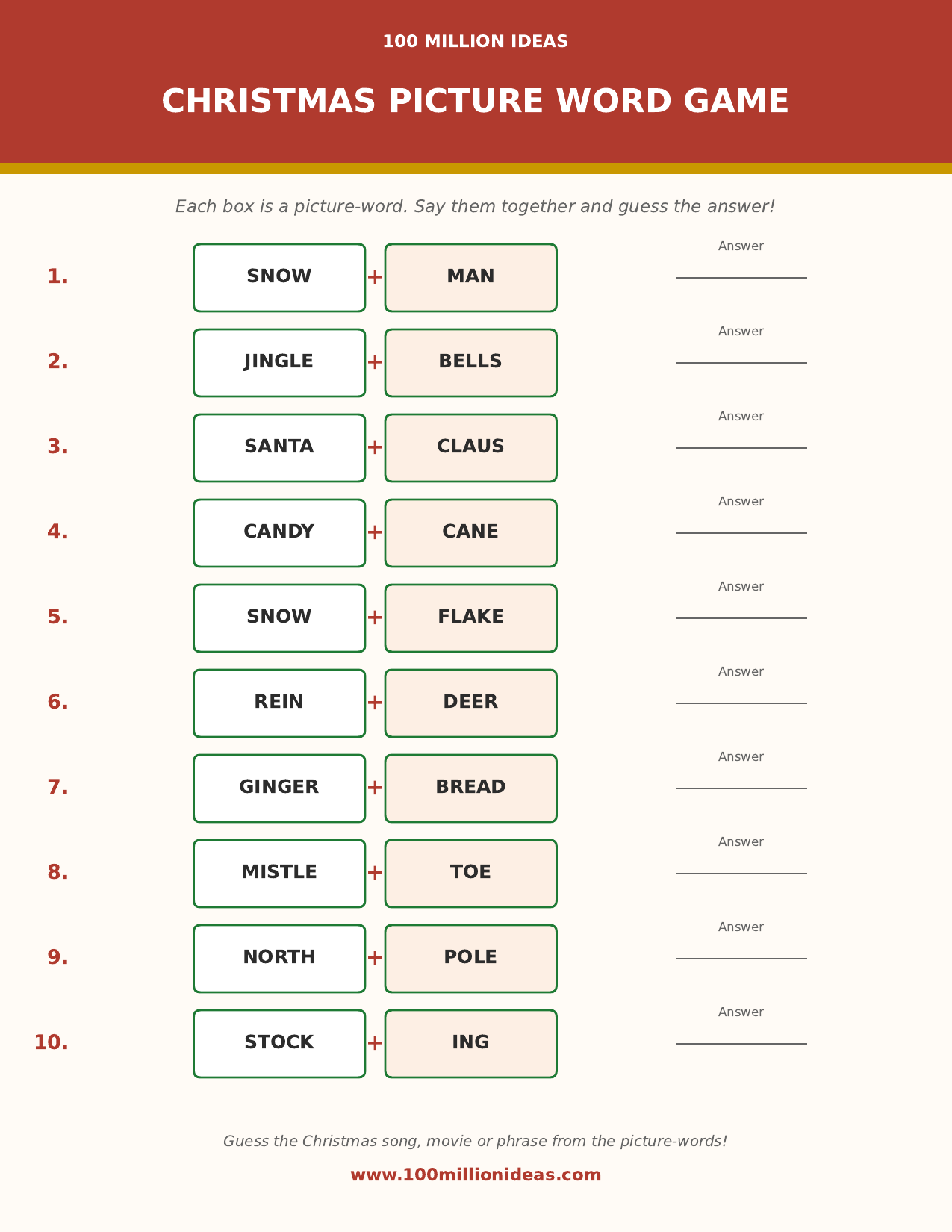
Each puzzle shows two word pieces in a box — for example, SNOW + MAN, JINGLE + BELLS, SANTA + CLAUS, CANDY + CANE, SNOW + FLAKE, REIN + DEER, GINGER + BREAD, MISTLE + TOE, NORTH + POLE, and STOCK + ING — with a blank line beside it for the answer. The pieces are printed large and clear, so the sheet is easy to read even in a dim living room or a crowded classroom.
The 30 puzzles cover the Christmas vocabulary everyone knows: snowmen and reindeer, candy canes and stockings, mistletoe and gingerbread, carols and wreaths, sleigh bells and star-topped trees. The answers are all familiar words and phrases — the challenge is not knowing them, it is spotting them when they are split in half.
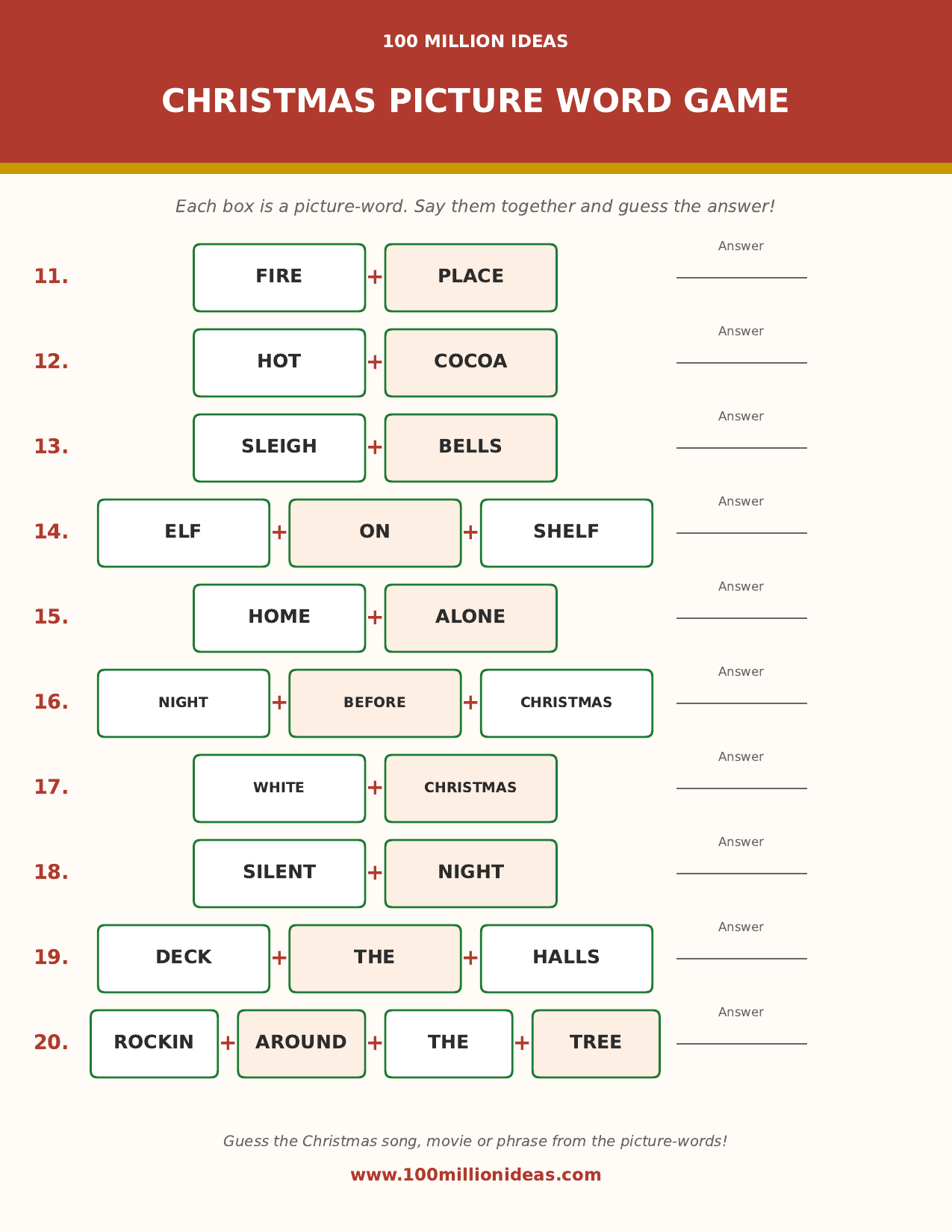
The last page is the answer key, with every puzzle solved: Deck the Halls, Rockin’ Around the Christmas Tree, Frosty the Snowman, Rudolph the Red-Nosed Reindeer, The Twelve Days of Christmas, Star on Top of the Tree, Christmas Wreath, Jingle Bell Rock, Cookies and Milk for Santa, Santa Down the Chimney, Gift Wrap, Holly Jolly Christmas, and the rest. Keep the key with the host and out of sight until scoring time.
Get the Printable Game in Our Shop
Get Christmas Picture Word Game in our shop — on sale for $3 (regular $5)
The download includes all 30 puzzles and the answer key, ready to print as many times as you need. If you want a full shelf of Christmas games for the season, the Christmas Games Bundle — $17 includes this game plus 23 more, which is the cheapest way to build a party-game collection in one go.
What You Need to Play
- Printed puzzle sheets — one per player, or one per team. Print on regular paper; these are working sheets, meant to be scribbled on.
- Pens or pencils — one per player. Pencils are the better choice for younger children, who will want to erase and retry.
- The answer key — printed separately and kept by the host, or checked on screen at the end.
- A timer (optional) — a phone timer is enough. Timed rounds make the game competitive; untimed play makes it relaxing. Both are good, for different moments.
How to Play Christmas Picture Word Game
1. Hand out the sheets face down
Give every player a puzzle sheet and a pen. Ask everyone to wait until you say go — the start matters more than it sounds, because the fastest players will finish the easy ones in seconds and you want a fair start.
2. Explain the one rule
Each box has two word pieces. Say them together, out loud or in your head, and write down the Christmas word or phrase they make. That is the entire game. Demonstrate one if the group is new to it: “SNOW plus MAN — snowman!” One example is enough; after that, people understand.
3. Play in the format that fits your group
Solo race (best for a party game): everyone works alone, and the first person to finish all 30 correctly wins. Give a time limit of 15 minutes so the game has an ending — anyone who finishes early can help check answers.
Team challenge (best for families and classrooms): split into teams of three or four, one sheet per team. Teams have to agree on each answer before writing it down. This version is louder and more fun, and it lets younger children contribute the answers they spot while older players handle the tricky ones.
Quiet table game (best for a gathering with mixed energy): leave the sheets on a table with pens, no timer, no winner. People drift over, solve a few, and wander off. It works beautifully at an open-house party or a family gathering where some people want a game and others want to talk.
4. Score with the answer key
When time is up, the host reads the answers out loud and players mark their own sheets — or swap sheets with a neighbor and mark each other’s. One point per correct answer, out of 30. Announce the top scores; ties are settled with a single tiebreaker puzzle read aloud, first correct answer wins.
5. Read the funniest wrong answers out loud
This is optional and it is the best part of the game. Wrong answers to word puzzles are often funnier than the right ones, and sharing them (with the player’s permission) turns scoring into comedy. Keep it kind — the joke is the puzzle, never the person.
Tips for Running It Well
- Say the pieces out loud. The single best piece of advice for this game is also the simplest: if you are stuck, say the two pieces together slowly, out loud. The answer is usually a sound, not a spelling — you hear it before you see it.
- Do the easy ones first. The puzzles are not arranged by difficulty, so a player who gets stuck on number three can waste five minutes on it. Tell players to skip any puzzle that does not click immediately and come back to it. The skipped ones are often obvious on the second look.
- Pair a younger child with an older player. A seven-year-old will solve the picture-word puzzles about snowmen and reindeer faster than most adults, and the adult will handle the longer phrases. It is one of the few games where the pairing genuinely helps both players.
- Use it as a classroom filler. Teachers: this is a genuinely useful ten-minute activity for the last day before the holiday break. It needs no setup, no equipment beyond the sheets, and it keeps a whole class busy and quiet at exactly the moment when quiet is hardest to achieve.
- Print it as a stocking stuffer. Fold a puzzle sheet and a small pencil into a stocking or a party favor bag. It costs almost nothing, it is screen-free, and it gives children something to do on Christmas morning while the adults are still waking up.
Variations to Try
- Speed round: five minutes, most correct answers wins. Fast, tense, and very funny when the answers are read out.
- Relay: teams line up, and one player at a time runs to the table, solves one puzzle, and tags the next player. It turns a quiet thinking game into a noisy physical one — best for a classroom or a youth group with energy to burn.
- Build your own: after playing, challenge players to invent a new puzzle using the same trick — split a Christmas word into two pieces. The best player-created puzzles can be added to next year’s game, and children love seeing their own puzzle in the set.
- Advent calendar game: cut the puzzles apart and put one behind each door of an advent calendar, or hand one out each morning in December. By Christmas Eve the family has solved all thirty.
Who This Game Is For
This is the quiet game in the collection, and that is its strength. For families, it is the game you play when half the room wants to rest and the other half wants something to do — everyone can join in at their own pace. For teachers, it is a ready-made, zero-prep classroom activity that actually teaches something: breaking words into parts and hearing how sounds combine. For party hosts, it is the filler that saves the evening — the thing you put on the table when the main game ends early, or while the food is being served. And for anyone making party favor bags or stockings, a printed puzzle sheet is a gift that costs pennies and gets used.

Frequently Asked Questions
What ages can play this game? Children from about seven up can play independently, since the game needs reading. Younger children can play on a team with a parent or older sibling who reads the pieces out loud for them.
How long does it take? A solo race takes 10 to 15 minutes for most players. A team game takes about 15 to 20 minutes with discussion. As an untimed table game, it can run all evening.
Is it too easy for adults? No — and that is the surprise of this game. Adults are often slower at it than children, because adults try to solve the puzzles by thinking, while children solve them by saying the words out loud. The 30 puzzles include several that will stump a room full of grown-ups.
Can I play it with a large group? Yes. Print one sheet per player for a race, or one per team for a team game. With thirty players, the team version works better — six teams of five is a lively, manageable game.
What if someone finishes much earlier than everyone else? Let them be the answer-checker, or hand them a blank sheet and challenge them to invent three new puzzles of their own. Both keep them busy without spoiling the game for slower players.
Can I reuse the sheets? You can reprint them as often as you like from the same download. If you want to reuse the same physical sheets, slip them into clear plastic sleeves and use dry-erase markers.


