25 Closet Shelf Organization Ideas for 2026
If your closet shelves look tidy for a day and then slide back into chaos, you are far from alone. You fold the sweaters, stack the jeans, and step back feeling pleased with yourself.
Then, a few days later, it has all come undone. Clothes lean into one another, small things vanish toward the back, and suddenly the whole shelf feels messy again.
Most people assume they simply need to organize better, but the real issue is that open shelves give your belongings nothing to hold them in place.
The good news is that you do not need a brand-new closet. With the right storage containers, you can keep everything tidy, separated, and simple to reach for much longer.
In this article, you will find 25 clever closet shelf organization ideas for 2026. These solutions will help you build a cleaner, more practical space in your home.
Let’s jump in!
What Are the Best Storage Containers for Closet Shelves?
When your closet shelves keep turning into untidy piles, the shelf itself is rarely the real problem.
Everything sits in open stacks with nothing to keep it in place. Storage containers solve this by giving every type of item a home of its own.
Fabric bins work wonderfully for clothes such as t-shirts and leggings, keeping soft, delicate pieces grouped together.
Save this article for later! 👇👇

Clear plastic bins let you see what is inside without digging through heaps. Woven baskets are ideal for holding small things like scarves and jewelry.
Shelf dividers also stop folded stacks from toppling into each other. When every item has its own container, your shelves stay tidy and easy to clean.
Shoe Cubes
Sneaker piles turn messy fast when pairs sit loose on open shelves. Clear shoe cubes fix that by giving every pair a space of its own.
Setting them on the top shelf keeps shoes protected and visible, while freeing the bottom of the closet for clothing.
Because the fronts are see-through, you can spot the right pair quickly without opening a stack of boxes.
This arrangement works best on long closet shelves, where there is room to line things up side by side.
When you own a lot of sneakers or heels, they stay organized for longer, since each pair can slide in and out without disturbing the rest.

Photo credit: @rose_home_organizing
Double Hanging
Closets feel crowded when everything competes for the same stretch of one rod. A two-level system solves that problem.
And you do not need a larger closet. Short tops stay on the upper rod while skirts or folded bottoms hang neatly underneath.
It keeps everything visible and removes that cramped, cluttered feeling. Setting it up is simpler than you might expect.
Just add a second rod, or use a basic adjustable one. It works best when you do not own many full-length outfits.
Once you have split things up this way, you will be surprised by how much extra space you actually had all along.

Photo credit: @closetsbydesign
Display Shelves
Luxury bags and accessories often get lost inside packed closets, making it easy to forget what you even own.
Upper display shelves fix that by giving special pieces a safe, visible home. When you place structured bags, hats, and statement shoes side by side instead of stacking them, they look far neater.
This kind of setup works best with glass-front cabinets or open cubbies.
Putting it near the top of the wardrobe keeps everyday clothes below and turns the top into a display zone.
Accessories that stand upright, stay easy to reach, and remain visible while you get dressed make the whole collection feel more organized.
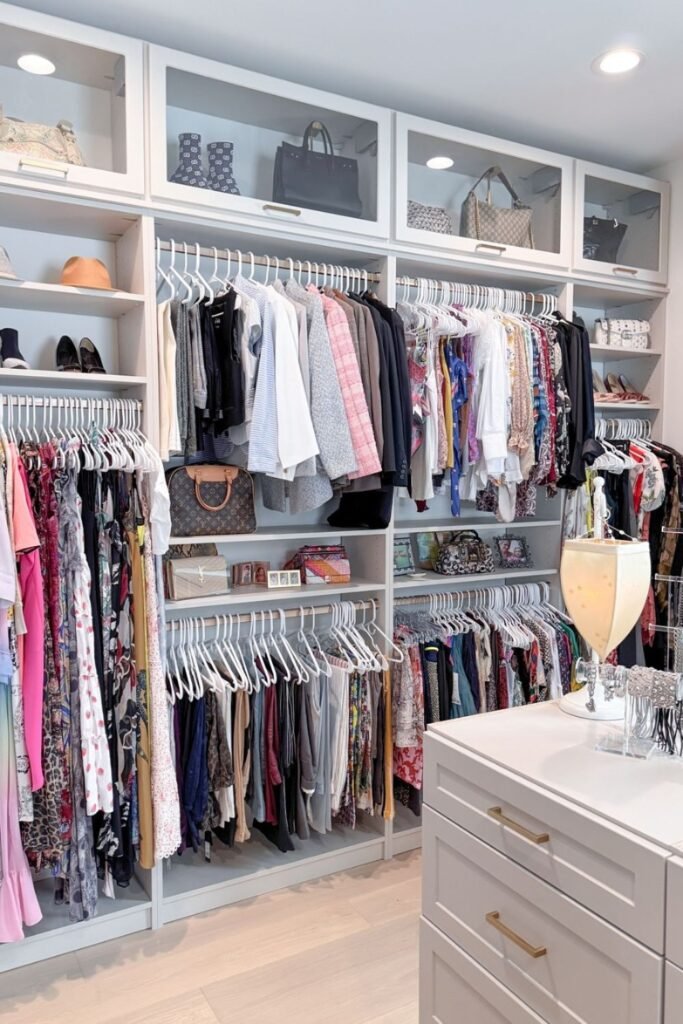
Photo credit: @organizingforlife
Shoe Cubbies
The unused space above a clothing rod can quietly become one of the most useful storage spots in the closet.
Little nooks on the top shelf are perfect for shoes that would otherwise end up on the floor.
Each pair slips into its own compartment, so you can see and grab them easily. Narrow compartments suit heels, flats, and sandals, since they keep pairs standing upright instead of stacked.
This design works well in closets with a tall shelf above the hanging rod.
Adding simple divider boxes quickly turns that empty strip into a tidy shoe wall that keeps the rest of the closet neat.

Photo credit: @extraspace
Shoe Towers
Floor space vanishes quickly when shoes pile up in random corners of the closet. Vertical shoe towers solve that by turning narrow side sections into organized storage.
One pair fits on each shelf, keeping everything easy to see and reach instead of jumbled in piles.
Tall sections are great for sneakers, flats, and heels that usually wind up on the floor.
The best place to set this up is along the walls of the closet, where the vertical space often sits empty.
Slim shelves stacked from bottom to top create a tidy shoe wall that keeps footwear orderly, while the middle of the closet stays free for drawers or folded clothes.

Photo credit: @inspiredclosets
Color Sections
Clothing becomes much simpler to manage once similar shades sit together instead of mixing randomly along the rod.
Arranging shirts and jackets in color order creates natural sections that help the closet look calmer and easier to scan.
With light colors on one side and dark pieces on the other, it is easy to find what you want without sliding hangers back and forth.
To set this up, first sort your clothes into simple color families such as whites, neutrals, blues, and blacks.
The folded stacks on the shelf below can be arranged the same way so the whole section looks neat. Getting ready takes less time because you know exactly where each piece belongs.

Photo credit: @thesortstory
Cube Zones
Open cube shelves work best when every section has a clear purpose instead of becoming random storage.
When sweaters, activewear, accessories, and bags each have their own cube, keeping track of them is simple.
Woven baskets stop little things from sliding around or making a mess of the space. To recreate this layout, give each container a category, so the stacks stay consistent and easy to maintain.
Middle cubes are great for everyday clothes because they sit at eye level.
Organized cubes make a big closet easy to navigate, turning the wall into simple zones where everything has a defined place to return to after use.

Photo credit: @organizedvt
Heel Shelves
Large shoe collections quickly take over closet floors unless each pair has a clear spot. Tall vertical shelving creates dedicated rows where you can easily see and grab heels, sandals, and flats.
If you space each shelf just right, you cannot stack pairs on top of each other, which keeps shoes from getting scuffed or lost at the back.
Narrow shelves are great for closet walls, since they can hold a lot of pairs without taking up much space.
To set this up, measure the height of your shoes and adjust the spacing between the shelves so each row matches one category.
Your daily favorites can sit at eye level, while seasonal pairs move up or down, keeping the shoes you use most close at hand.

Photo credit: @visionandhammer
Category Cubes
Closet walls become far easier to manage once every section holds a specific type of item.
Separate cubes for folded sweaters, handbags, and accessories keep everything from getting mixed up on one shelf.
Open compartments above the hanging rods make it easy to see items and put them back in their proper place after using them.
Modular closet systems with vertical dividers already built in are ideal for recreating this setup.
Folding knitwear into neat stacks keeps those cubes clean, and handbags or clutches stay upright so they do not lose their shape.

Photo credit: @aartedeorganizarpersonal
Accessory Cubes
Favorite accessories often end up hidden in drawers, which makes them easy to forget. Open cube shelves solve that problem by keeping handbags, hats, and statement shoes out in the open yet still properly organized.
When structured pieces are piled together, they do not hold their shape as well as when they stand upright in their own compartments.
Placement works well above hanging clothes, where larger shelves would otherwise sit empty.
To recreate this idea, give each cube a different type of accessory so that everything has a set place.

Photo credit: @sortednola
Denim Stacks
Jeans become surprisingly easy to manage once every shelf holds only one type of fold. Stacking denim by shade keeps darker pairs together, while lighter washes sit in their own section, which makes it easier to find the pair you want.
This solution works best with wide shelves, because folded pants need room to lie flat without slipping off the side.
To put this up, fold each pair the same way so the stacks stay stable. If you leave small gaps between piles, they will not fall into each other.
This whole wall of shelves puts big pieces of denim into neat rows that stay that way even with everyday use.

Photo credit: @omaha_neat
Shoe Shelves
Footwear often becomes the biggest source of closet clutter once pairs start stacking on the floor.
While lighter washes are in their own section, which makes it easier to find the pair you desire. This solution works best with wide shelves, because folded pants need some space to sit flat without falling off the side.
To put this up again, you need to fold each pair the same way so that the stacks stay stable. If you leave little spaces between piles, they won’t fall into each other.
This whole wall of shelves puts big pieces of denim into neat rows that keep that way even when you use them every day.

Photo credit: @marianamachadoorganizer
Lit Shelves
Closet shelves become far more useful once lighting highlights each section. Built-in lights above the shelves make it easy to find folded clothes, purses, and accessories without digging through piles.
Soft lighting also helps define distinct areas, so each shelf feels intentional instead of cluttered.
This technique works well in deeper closets, where things hide in shadows near the back.
Putting small LED strips or puck lights under each shelf instantly brightens the whole space.
Everyday items like sweaters and handbags are easy to find, and decorative boxes on the top shelf give the closet a polished finish that keeps it looking orderly and balanced.

Photo credit: @inside_our_nightingale_home
Purse Shelf
Handbags often lose their shape when they sit in crowded drawers or get stacked on top of each other.
Dedicated purse shelves fix that by giving each bag plenty of room to stand up straight. Because nothing rubs against them, structured bags stay in better shape.
Placement works best on upper shelves, where things do not need to be reached every day but can still be seen.
It is easy to recreate this arrangement: just place one or two bags on each shelf and avoid filling the space too tightly. Smaller clutches can go in beautiful baskets, while larger handbags can stand on their own.
A neat row of bags not only improves how the closet looks, it also keeps your collection protected.

Photo credit: @theorganizedorange
Labeled Baskets
Small items can quickly scatter across closet shelves unless everything has a defined container.
The challenge is solved by grouping similar items together in woven baskets with simple labeling.
Each basket makes it easy to find pajamas, swimsuits, accessories, or seasonal things, because it clearly shows what goes inside.
This approach works especially well on upper shelves, where loose clothes would normally pile into messy mounds.
Using matching baskets keeps the closet looking neat, and the labels make it easy to know where everything belongs.

Photo credit: @thecontainerstore
Label Boxes
Upper closet shelves work much better when storage boxes clearly show what belongs inside.
Labeled fabric bins keep hats, gloves, and other seasonal items separate from the regular clothes below.
Soft storage boxes slide on and off shelves easily, so they are great for things you only need a few times a year.
To set this up, group similar things together and place them in separate containers. Clear labeling on the front stops you from having to search for things later.
Neutral boxes also make the closet look cleaner, because everything shares the same style and they hide small items that would otherwise make the space look messy.
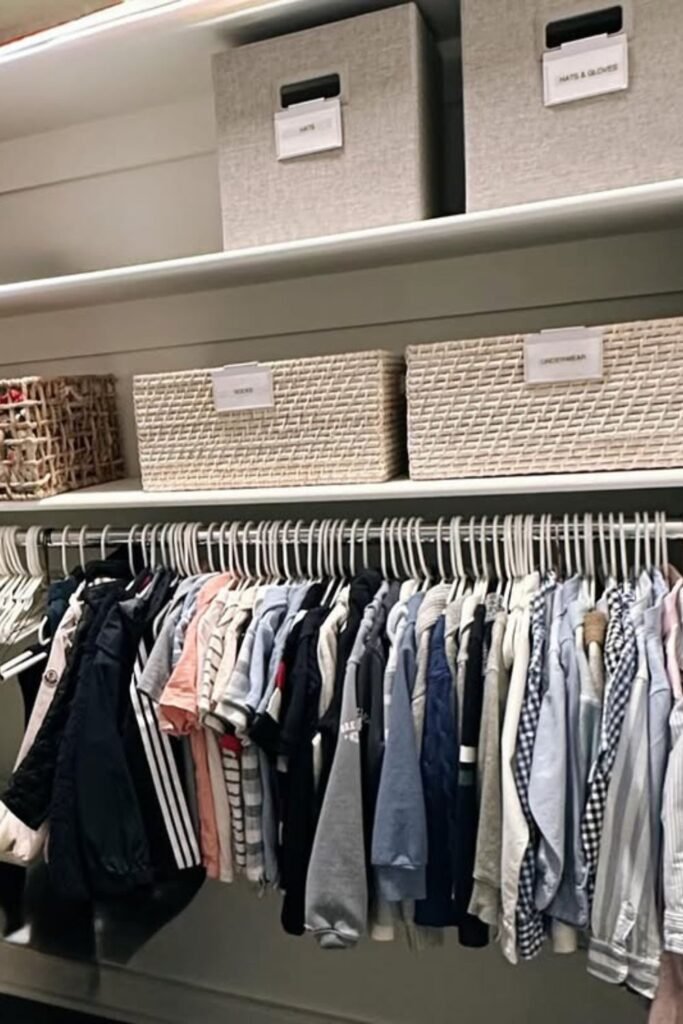
Photo credit: @ctc.home
Uniform Folds
Closet shelves stay neat much longer when every piece of clothing is folded the same way. Uniform folding creates stacks that sit flat and stable instead of leaning or slipping apart after a few days.
This method works best with t-shirts, sweatshirts, and other casual items, because they stack easily and do not take up too much shelf space.
To start this system, fold everything into rectangles that are all the same size. Shorter stacks keep clothes from falling over when you pull something out of the middle.
These kinds of shelves are much easier to keep clean, because everything goes back to its neat place after laundry day.
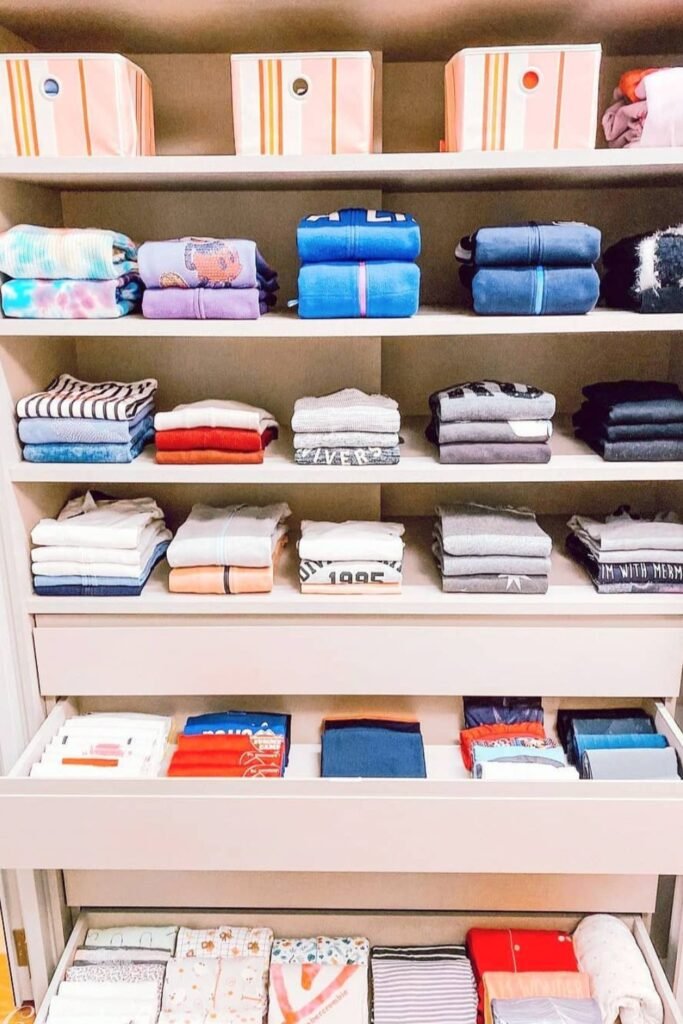
Photo credit: @bestoforganizing
Shoe Wall
Large shoe collections become easier to manage once one full section of the closet is dedicated to footwear.
Vertical shelving turns an empty wall into neat rows where every pair can be seen and kept apart. Instead of stacking on the floor, heels, sandals, and flats line up neatly.
This protects delicate shoes and makes it easier to plan outfits. It works best in tall closet corners, where shelves can run from the floor to almost the ceiling.
Changing the spacing between the shelves makes it possible for different types of shoes to fit comfortably.
Everyday shoes should stay at eye level, while special-occasion heels can shift to higher rows, keeping the shoes you reach for most within easy grasp.

Photo credit: @tsgnewportbeach
Closet Columns
Large closets feel much easier to manage once the space is divided into clear vertical sections.
Tall columns create separate spaces for folded clothes, drawers, and shoes, so they do not have to fight for the same shelf.
On one side, stacks of sweaters and pants stay neat, while on the other side, a small column of shoe shelves keeps shoes off the floor.
This setup works best in reach-in closets that are not very deep but are tall. Built-in drawers in the middle give you extra storage for small clothing items like socks or undergarments.
Organized columns make the closet work like a system, with a designated position for each type of item.

Photo credit: @closetconnections_
Fabric Cubes
Loose clothing and small accessories tend to scatter across shelves unless they are contained in something structured.
Fabric cube bins make it easy to keep workout gear, scarves, or seasonal outfits together in separate areas.
Soft bins slide in and out effortlessly, so they are great for narrow vertical shelves that could otherwise get messy.
This setup works best in tall side sections of a closet, where you can stack many cubes from top to bottom.
Using the same bins keeps the area looking clean while still hiding the mess inside. To keep things in order, give each cube a category.

Photo credit: @closetsbydesign
Open Shelves
Extra closet space often goes unused when shelves are hidden behind doors or crowded with random items.
Open shelving changes that by turning each area into a visible storage space for shoes, clothes, and accessories.
When sweaters, handbags, and heels are folded and displayed in plain sight instead of hidden away in drawers, they are easier to find.
This setup works well on long closet walls, where the vertical sections can repeat in a neat pattern. Placing only a few things on each shelf makes the room feel less cluttered.
Well-organized open shelves make it easier to choose clothes every day, because you can see and reach everything at a glance.
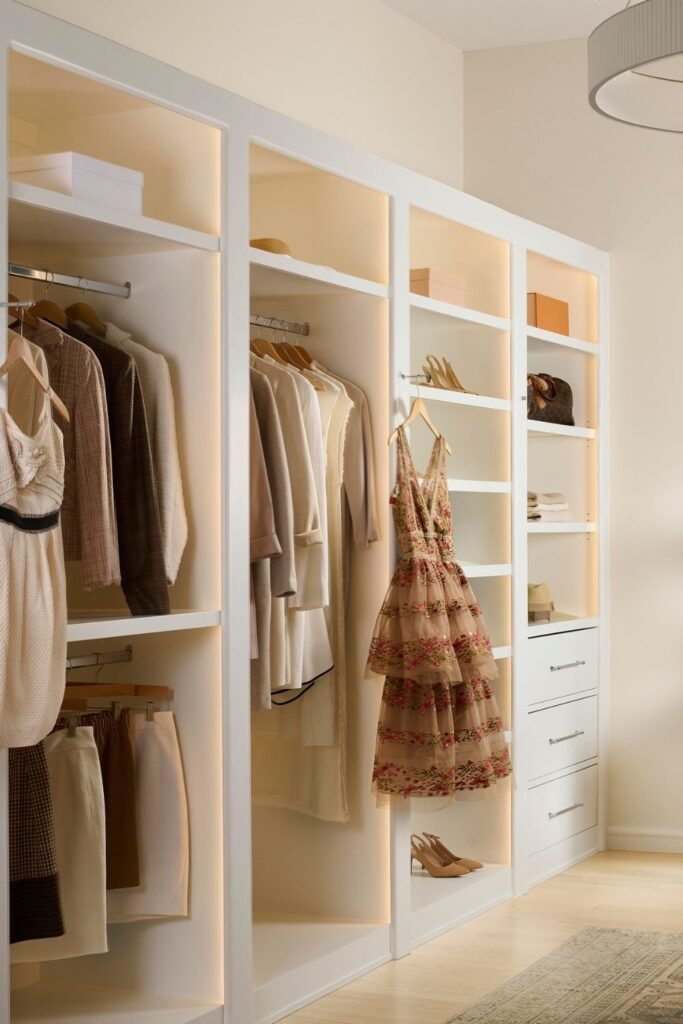
Photo credit: @revashelf
Color Rows
Outfits become easier to choose when clothing is arranged by color instead of random order. Bright pieces, neutrals, and darker tones each create their own division along the hanging rod, which makes the closet look much more organized right away.
Color rows also help you keep track of what you own at a glance, so you do not buy the same color twice.
To recreate this idea, start by sorting garments into simple color groups like whites, pinks, blues, and patterns.
You can keep the whole closet looking balanced by placing folded sweaters or handbags on the shelves above them in the same color scheme.
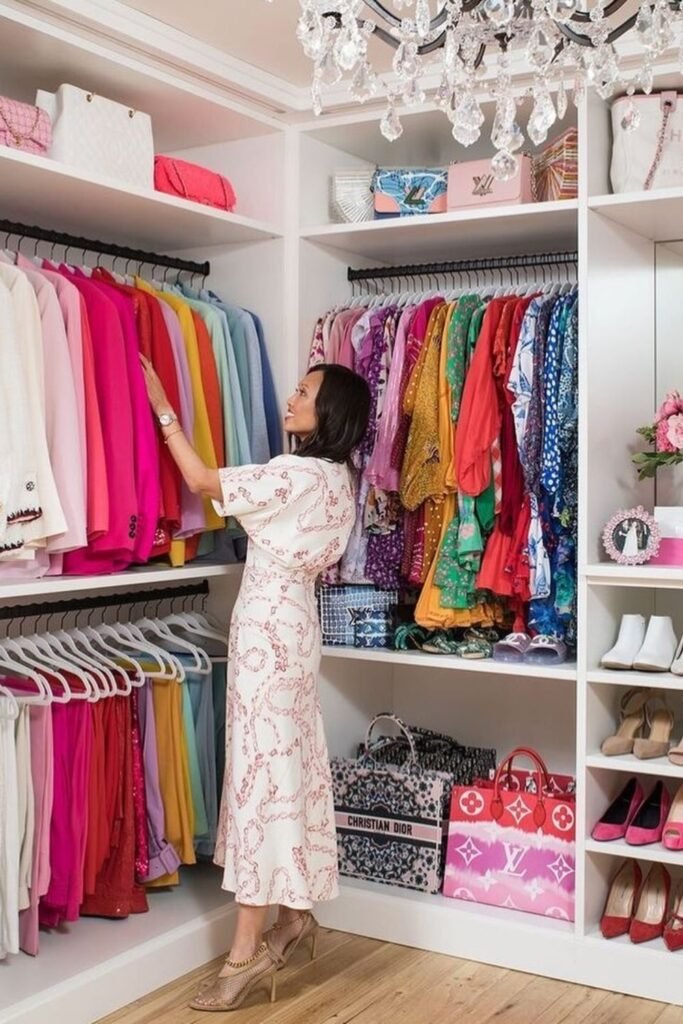
Photo credit: @laclosetdesign
Display Drawers
Accessories often disappear inside deep drawers, where items pile on top of each other. Shallow display drawers solve that problem by spreading jewelry, belts, and small accessories over a level surface where everything stays visible.
These sliding trays are great for hanging clothes, since they use space that would otherwise sit empty.
To set this up, add pull-out organizers or tray-style drawers that open easily. Soft dividers in the trays keep fragile things from shifting around.
Organized display drawers make it easier to pick accessories quickly while keeping smaller items safe and in order.

Photo credit: @thatorganizedhome
Shelf Sections
Closet shelves stay far more organized when each section holds a specific type of item instead of mixing everything together.
One row can hold folded sweaters, another can hold trousers, and a third shelf can carry handbags so they stand upright and are easy to reach.
Putting clear divisions on shelves stops stacks from spreading all over the room. This plan works best in closets with large shelves, where many different types of things normally compete for the same space.
First, give each item of clothing its own shelf so everything has a set place to go.
When the shelves are organized, you know exactly where to find and return each thing, which makes daily routines easier.

Photo credit: @clarkansaslove
Drawer Rows
Small clothing items easily turn into clutter when they are stacked deep inside one drawer. The problem is fixed by using several shallow drawers that arrange things into neat rows where everything can be seen.
It is much easier to keep track of socks, underwear, and accessories when each drawer holds just one type of item.
Pull-out drawers placed below hanging rods make use of vertical space that would otherwise sit empty.
This technique works well in closet sections where there is extra space under the clothes racks. Simple folding methods that make items stand up let you see all the pieces at once.
Rows of organized drawers make daily tasks go faster, because nothing gets lost at the bottom.

Photo credit: @cheilaorganizer
FAQs
How do you keep closet shelves from becoming messy again?
When stacks are too big or things do not have a place to go, closet shelves tend to get messy. Smaller stacks and easy-to-use storage containers make a significant difference.
Shelf dividers, baskets, or fabric bins can help keep garments from sliding into each other by keeping each category separate.
Also, leaving some free space on each shelf helps keep everything in order, because shelves that are packed too full fall apart quickly after being used every day.
What should go on the top shelf of a closet?
Items that are not used every day do best on the top shelves. Seasonal clothes, travel bags, extra bedding, or storage boxes fit well in that space, because you do not need to reach them very often.
When you use labeled bins or storage baskets, it is easier to find things when you need them and keep them tidy.
Also, keeping lighter things on the top shelf makes them safer to reach and move around.
You may like to read!
