Christmas Bingo

This post may contain affiliate links. As an Amazon Associate I earn from qualifying purchases.
There is a reason bingo shows up at almost every Christmas party, classroom celebration, and family night: it works for everyone in the room at the same time. A five-year-old can play it next to a grandparent, nobody has to read long instructions, and a whole game takes about ten minutes. The only thing that usually goes wrong is the cards themselves — the free ones floating around online are often blurry, repeat the same few layouts, or run out after ten players. This Christmas Bingo set was built to fix exactly that.
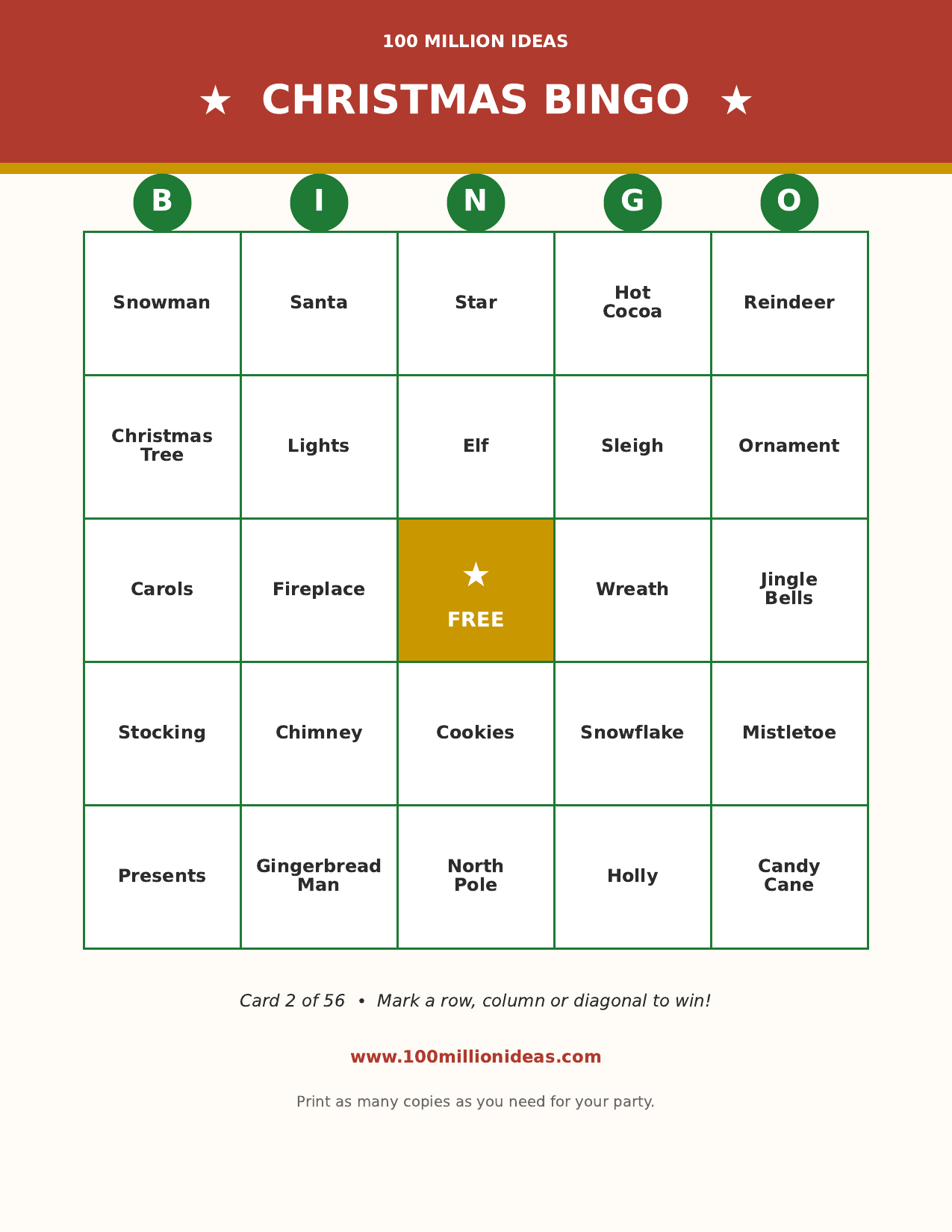
Our printable Christmas Bingo comes with 56 unique cards, so a big group can play round after round without two people holding the same card. Every square is a Christmas picture with its word underneath — a tree, a snowman, a candy cane, a stocking — which means younger children who cannot read yet can still play by matching the pictures. It is the kind of game you print once, keep in a folder, and pull out every December.

At a Glance
- Players: 2 to 56 (one card per player; 56 unique cards included)
- Ages: 4 and up — picture-based, so early readers can play
- Time per game: 10 to 15 minutes
- What you need: printed cards, something to mark squares with, and the calling cards from the pack
- Best for: family Christmas Eve, classroom parties, church socials, office parties, and neighborhood gatherings
What’s Included in the Printable
The download is a 57-page PDF, and every page earns its place. The bulk of it is the 56 bingo cards themselves, each one a different arrangement of the same set of Christmas pictures and words. You will spot familiar favorites on the cards: Christmas tree, gingerbread man, snowman, mistletoe, carols, reindeer, lights, ornament, star, candy cane, chimney, Santa, cookies, snowflake, hot cocoa, North Pole, jingle bells, stocking, presents, wreath, sleigh, and holly.
Because every card is unique, you can hand them out in any order without checking for duplicates first — a small thing that matters a lot when you have twenty excited children waiting. Print as many cards as you need for your group; the file is yours to reprint for your own parties and classroom use, year after year.
The set also includes calling cards, so the person running the game has a proper deck to draw from instead of trying to remember which pictures have already been called. If you are playing with very young children, you can hold up each calling card as you say the word, so they can match the picture even if they miss what you said.
Get the Printable Game in Our Shop
Get Christmas Bingo in our shop — on sale for $3 (regular $5)
The full set includes all 56 unique cards plus the calling cards, ready to print at home. Playing with a big group, or want more games for the same party? The Christmas Games Bundle — $17 includes this bingo set plus 23 more Christmas games, which works out to far less than buying them one at a time.
What You Need to Play
- Printed bingo cards — one per player. Print on regular paper for a casual game, or on cardstock if you want the cards to survive being handled by a room full of children and last for next year. Cardstock is worth it if this is becoming a family tradition.
- Markers — bingo daubers are the classic choice and children love them, but anything works: coins, dried beans, buttons, small wrapped candies, or a pencil to cross squares off. If you laminate the cards, use dry-erase markers or small objects so the cards can be wiped clean and reused.
- Calling cards — included in the printable. Cut them out and put them in a bowl, a Santa hat, or a gift bag to draw from.
- Prizes (optional) — one small prize per round keeps the energy up. Candy canes, mini chocolate bars, stickers, or small ornaments all work. For a classroom, a “pick from the prize box” moment is usually more exciting than the prize itself.
If you want proper bingo daubers, a 12-pack of assorted colors is plenty for a family game night — one dauber per player, with spares for the ones that wander off. Dabbin’ Fever Bingo Daubers, 12-pack is a solid, inexpensive option that shows up ready to use.
How to Play Christmas Bingo
1. Hand out the cards
Give one card to each player and a pile of markers. If you have fewer than 56 players, just use the top of the stack — there is no need to sort or check anything first.
2. Decide the winning pattern before you start
This is the step most people skip, and it is the one that causes arguments. Before the first picture is called, say out loud what wins: a straight line across, down, or diagonally is the standard. For the first game of the night, keep it simple — any straight line. You can use fancier patterns in later rounds (see the variations below).
3. The caller draws and calls
The caller pulls one calling card from the bowl, holds it up, and says the word clearly — “Snowman!” — then sets it aside face up so players can check the discard pile if they missed one. Call at a relaxed pace, roughly one picture every ten seconds, so younger players can find the square without feeling rushed.
4. Players mark their squares
When a player hears a picture that is on their card, they cover that square with a marker. The middle square is the free space on every card, so everyone starts the game one square ahead.
5. Someone shouts “Bingo!”
When a player completes the winning pattern, they call out “Bingo!” — and this is where the caller earns their keep. Before handing over the prize, check the winning card against the called cards in the discard pile. It takes thirty seconds and it prevents the one moment that can sour a party game: a wrongly claimed win. If the card checks out, that player wins the round.
6. Clear the cards and play again
Clear the markers, shuffle the calling cards back into the bowl, and start a new round with a different winning pattern. Because the cards are all different, players can keep the same card all night or swap with a neighbor between rounds.
Tips for a Smooth Game Night
- The caller should not play their own card. Calling and playing at the same time is a recipe for missed squares and suspicious wins. Give the caller a job they enjoy — a Santa hat helps.
- Call the picture and the word. Saying “Reindeer — the reindeer picture” helps the youngest players and anyone playing in a noisy room.
- Keep a visible discard pile. Lay called cards in a row where everyone can see them. When someone says “Did you call the star already?” the answer is right there.
- For mixed-age groups, pair little ones with an adult. A four-year-old with a parent as a teammate gets the fun of playing without the frustration of falling behind.
- Print a few extra cards. Someone always arrives late, and a spare card beats a disappointed guest.
Fun Variations to Keep It Fresh
- Four corners: the first player to cover all four corner squares wins. This is a lovely first round for very young children because the target is easy to explain.
- Blackout: every square on the card must be covered. This takes longer — twenty minutes or so — so save it for the final round of the night, with the best prize attached.
- Picture frame: cover every square around the edge of the card. It sounds easy and it is not, which is exactly why people enjoy it.
- Christmas Eve countdown: play one round after each Christmas activity — after dinner, after the movie, after presents. The winner of each round picks the next Christmas song.
- Team bingo: pair players up and give each team one card. Great for classrooms and for shy children who would rather play with a friend than alone.
Who This Game Is For
This is one of the rare party games that genuinely fits a whole mixed group. For families, it keeps children, parents, and grandparents at the same table instead of splitting the room by age. For teachers, it is a calm, structured activity for a class party that needs almost no supervision once it starts — print the cards, cut the calling cards, and one adult can run a room of thirty. For offices, it is a low-pressure icebreaker that does not ask anyone to perform, sing, or share something personal. And for anyone hosting a neighborhood or church gathering, 56 unique cards means you will not run out.

Frequently Asked Questions
How many players can play at once? Up to 56, one card per player. If your group is bigger than that, split into two games or let late arrivals share a card as a team.
Can preschoolers play? Yes. Every square is a picture with the word underneath, so children who cannot read yet can match pictures. Pairing a very young child with an older sibling or parent works well for the first game.
How long does a game last? A standard straight-line game takes 10 to 15 minutes. A blackout round takes closer to 20 minutes. Plan for three or four rounds in an hour, including time to hand out prizes and reset.
Do I need bingo daubers? No — coins, buttons, beans, or a pencil all work fine. Daubers are simply faster and more fun, especially for children. If you laminate the cards, use dry-erase markers or small objects so the cards can be reused.
Can I reuse the cards next year? Yes. Print on cardstock and store them flat in a folder or large envelope, or laminate them and use dry-erase markers. The PDF stays yours, so you can also just reprint fresh cards each December.
What if two people call bingo at the same time? Check both cards. If both are correct, split the prize or play a one-picture tiebreaker: the first to have the next called picture on their card wins.


